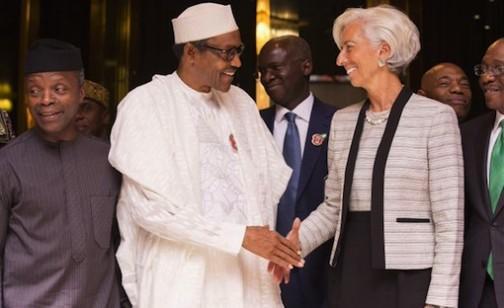
Christine Lagarde, Managing Director of the International Monetary Fund (IMF) concluded her official discussions with Nigerian policy-makers yesterday, with a clear message that Africa’s largest economy does not have the luxury of time to quickly pull itself out of the looming distress, worsened by low global oil prices.
Lagarde says Nigeria is exposed to quite a number of vulnerabilities, including lower oil prices, fiscal savings and reserves, export earnings, capital spending government revenues, private sector investment; weak investor confidence; as well as spillovers resulting from trade, exchange rates and capital flows.
But Lagarde said Nigeria could pull through the economic downturn through policies that ensure increased revenue like broadening the tax base, improving compliance and enhancing collection efficiency and reducing leakages, just as she sees the need to discontinue fuel subsidies and make careful decisions on borrowing.
She specifically advised government to consider raising Value Added Tax (VAT) from the present 5 percent- one of the lowest globally- especially as oil price is projected to fall significantly in 2016.
Speaking at a session with the National Assembly yesterday, Lagarde acknowledged that Nigerians have created a large and diversified economy that has grown by about 7 per cent a year, over the last decade, a remarkable achievement, a testament to Nigeria’s immense potential.
But there are concerns on the outlook, which has weakened. Growth in 2015 is estimated at about 3.2 percent—its slowest pace since 1999—and only a modest recovery is expected in 2016- and for a country with a rapidly increasing population, this means almost no real economic growth in per capita terms.
Lagarde said on top of the slowdown, vulnerabilities have increased as the ability to manage shocks is restricted by low fiscal savings and reserves.
Moreover, a weakening oil sector could stress balance sheets and put pressure on the banking system, as reduced confidence and lower capital spending also impact the non-oil corporate sector, which looks less resilient today than during the downturn of 2008-09.
“Companies that have increased their leverage and US-dollar debt in recent years may now come under pressure, as they face rising interest rates and a stronger dollar,” she warned.
The IMF chief is further worried that Nigeria also has a large regional footprint, and its fortunes affect its neighbours, especially through trade. It is estimated that a one percent reduction in Nigeria’s growth causes a 0.3 percent reduction in Benin’s growth.”
She sees an immediate priority—a fundamental change in the way government operates.
“The new reality of low oil prices and low oil revenues means that the fiscal challenge facing government is no longer about how to divide the proceeds of Nigeria’s oil wealth, but what needs to be done so that Nigeria can deliver to its people the public services they deserve—be it in education, health or infrastructure.
“This means that hard decisions will need to be taken on revenue, expenditure, debt, and investment going forward,” she stated.
Lagarde recommend that the Nigerian government would need to “Act with resolve—by stepping up revenue mobilisation, build resilience—by making careful decisions on borrowing and exercise restraint—by focusing on the quality and efficiency of every naira spent.
“Nigeria’s debt is relatively low at about 12 percent of GDP. But it weighs heavily on the public purse. Already, about 35 kobo of every naira collected by the Federal Government is used to service outstanding public debt.
“This is critically important. As more people pay taxes there will, rightly, be increasing pressure to demonstrate that those tax payments are producing improvements in public service delivery.
A second priority, according to the IMF chief, is for the government strengthen Nigeria’s external position. “The essential fact is that, given the structure of the economy, the massive fall in oil prices—which is expected to continue—has changed the medium term foundations for economic resilience.”
Lagarde bemoaned the country’s vulnerabilities triggered by global economic recession, continuous slide in oil prices and the Boko Haram scourge. She stressed the need for Nigeria to focus on high-impact and high value-added projects such as power, integrated transport (roads, rail, air, and ports) and housing, as well as education and health.
She also emphasised the need for government to cut down on recurrent expenditure by streamlining the cost of governance and improving efficiency of public service delivery across the federal and sub-national governments.
“To be clear, the goal of achieving external competitiveness requires a package of policies, including business-friendly monetary environment, flexible exchange rate and disciplined fiscal policies, as well as implementing structural reforms.
“Additional exchange rate flexibility—both up or down—can help soften the impact of external shocks, make output and employment less volatile, and help build external reserves. It can also help avoid the need for costly foreign exchange restrictions – which should, in any case, remain temporary.
“And going forward, improved competitiveness from improved exchange rate flexibility and other reforms will facilitate the needed diversification of the exports base and, ultimately, growth.”
According to her, Nigerian policy makers need to act with resolve to significantly improve transportation networks and power delivery including generation, transmission and distribution.
She also tasked Nigeria on the need to build resilience by fostering a sound banking (well-capitalised banks) system that would be more resilient than during the downturn of 2008-09.
She however observed that Nigerian banks “are beginning to feel the impact of the growing vulnerabilities in the corporate sector. This means rising non-performing loans.”
While expressing support for the ongoing anti-graft war by the present administration, Lagarde disclosed that “corruption not only corrodes public trust, but it also destroys confidence and diminishes the potential for strong economic growth.
“At the global level, it is estimated that the cost of corruption is equivalent to more than five percent of world GDP, with over $1 trillion paid in bribes each year.
“Here in Nigeria, important initiatives to discourage graft are underway and should be applauded.
“Let me highlight the publication of monthly data on the finances and operations of the Nigerian National Petroleum Corporation. This provides information on a key sector, building confidence in transparency, and improving accountability of oil revenues, for the benefit of all Nigerians,” she observed.
Onyinye Nwachukwu & Kehinde Akintola

Join BusinessDay whatsapp Channel, to stay up to date
Open In Whatsapp