For the last two weeks, I have received calls from players in the financial sector, energy sector, peers from the data center industry and cloud companies asking about my views on the effect of CBN’s directive to regulated financial institutions and payment service providers to ensure that payment-related data generated within Nigeria is stored domestically.
This is expected, especially as GFA Technologies Group subsidiary, GFA Data Centers (GDC) launched ABK-1, a new 0.5MW capacity data center in Abeokuta just a few months ago in March 2026.
What I noticed though, is that the immediate conversation has centered on compliance.
The Banks asked how they would comply. Fintechs reviewed their hosting strategies. Payment processors examined their technology architectures.
Some financial institutions raised concerns, that Nigeria does not have enough data center capacity for the directive to be operable.
The well respected Chief Executive Officer of Open Access Data Centre (OADC), Dr. Ayotunde (Tunde) Coker, dismissed such concerns insisting that the country’s data centre infrastructure is sufficient to support the transition.
These are all valid discussions.
However, I was surprised that many people seemed to overlook a significant question:
How much new digital infrastructure will Nigeria actually need because of this directive?
The answer matters, not only to banks and fintechs, but also to policymakers, investors, development finance institutions, telecommunications companies, cloud providers, and data centre operators.
For the first time, a regulatory directive has the potential to create measurable, long-term demand for sovereign digital infrastructure in Nigeria.
This led me to task GFA Data Centers research team to help quantify demand from CBN’s directive.
The scale of Nigeria’s digital payments economy
The CBN’s own electronic payment statistics illustrate the scale of Nigeria’s digital economy.
According to actual and extrapolated data from the Central Bank of Nigeria, the country processed the following electronic payment transactions from 2021 to 2026 which include mobile money transactions, alongside billions of transactions across NIBSS Instant Payments (NIP), POS terminals, ATMs, internet banking and other electronic payment channels.
2021 (Actual) – 16.3 billion transactions
2022 (Actual) – 22.1 billion transactions 35.6% growth
2023 (Actual) – 38.7 billion transactions 75.3% growth
2024 (Estimated) – 44.8 billion transactions 15.8% growth
2025 (Projected) – 51.9 billion transactions 15.8% growth
2026 (Projected) – 60.1 billion transactions 15.8% growth
Source: Central Bank of Nigeria electronic payment statistics (2021–2024). 2024 full-year figure has been annualised from January–June 2024 data. 2025 and 2026 figures are GFA Data Centers projections assuming continuation of the implied 2024 annual growth rate of approximately 15.8%. These projections are illustrative and intended to support infrastructure demand analysis rather than serve as official forecasts
Behind every one of these transactions sits an increasingly complex digital infrastructure comprising payment switches, databases, cybersecurity platforms, backup systems, disaster recovery environments and analytics platforms.
As transaction volumes continue to grow, so too does the strategic importance of resilient domestic infrastructure. The CBN directive therefore represents far more than a compliance requirement, it represents an infrastructure milestone.
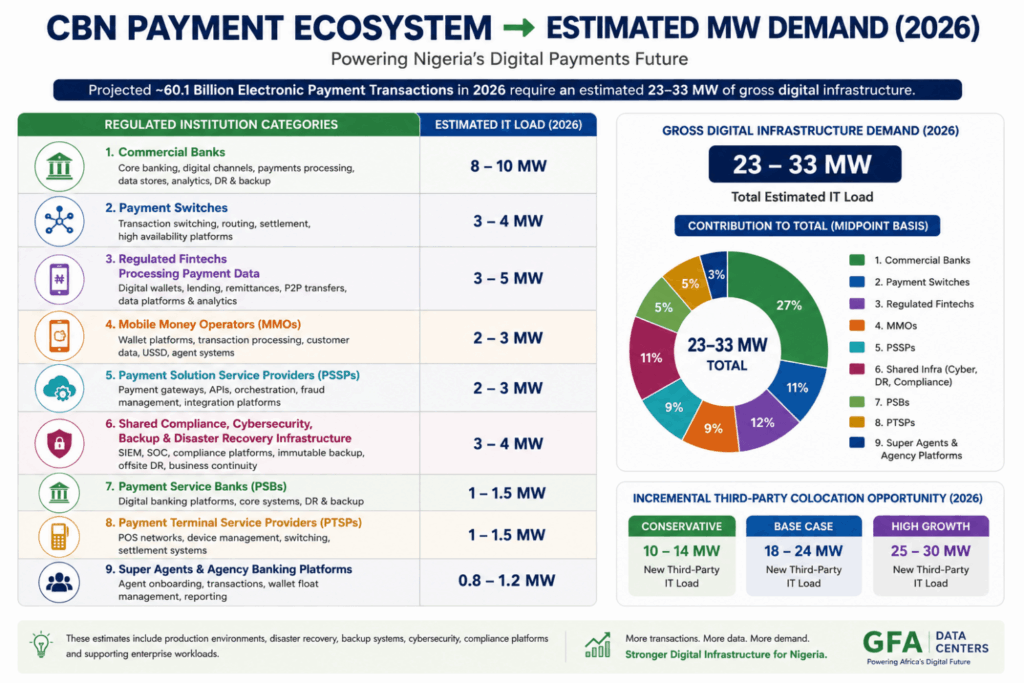
Illustrative Demand Allocation by Regulated Institution Category (2026 Projection)
The question naturally follows:
If Nigeria processes approximately 60 billion electronic payment transactions annually by 2026, how much additional digital infrastructure will the country require?
While the Central Bank of Nigeria has rightly focused on strengthening data sovereignty through its Data Localisation Directive, it has not sought to quantify the digital infrastructure implications of that policy. Yet for investors, policymakers, financial institutions and infrastructure developers, understanding the scale of future demand is essential.
To address this gap, GFA Data Centers (GDC) developed an analytical demand model based on:
CBN electronic payment statistics;
the projected growth of Nigeria’s digital payments ecosystem;
publicly available information on regulated payment participants; and industry-standard enterprise infrastructure architectures for production, disaster recovery, cybersecurity, compliance and business continuity.
This approach reflects GDC’s broader philosophy as Africa’s first Demand-Driven Sovereign Digital Infrastructure Platform.
Traditional infrastructure developers typically build capacity first and then seek customers to occupy it. Our approach is fundamentally different. We begin by identifying where future digital demand will originate, whether in financial services, healthcare, government, education or enterprise, and then design digital infrastructure capable of supporting that demand at national scale.
In other words, rather than asking “How do we fill the data centre?”, we first ask “Where will Africa’s next generation of digital infrastructure demand come from?”
Applying this methodology to Nigeria’s financial services sector produces the following illustrative estimate.
Compliance Is About Much More Than Storage
Before I go into the demand from the CBN directive, it’s important to mention that many people interpret data localisation as simply moving databases from one country to another. That is only part of the picture.
A compliant financial institution must also maintain:
Production computing environments
Disaster Recovery (DR) facilities
Backup and archival storage
Security Operations Centres (SOC)
Compliance monitoring platforms
Audit systems
Database replication
Development and testing environments
Increasingly, AI and advanced analytics infrastructure
In other words, the directive creates demand for an entire digital infrastructure ecosystem—not just server storage.
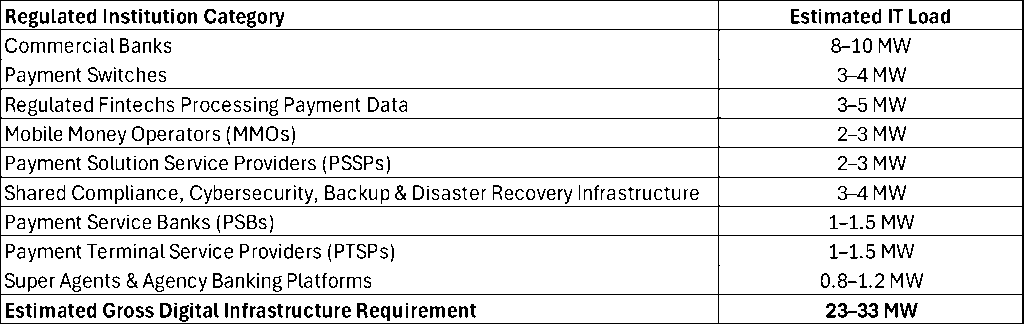
Estimated Gross Digital Infrastructure Demand by 2026
Estimated Gross Digital Infrastructure Requirement
These figures represent the estimated gross IT infrastructure requirement necessary to support Nigeria’s regulated payments ecosystem by the end of 2026. They extend well beyond production environments to include disaster recovery, backup systems, cybersecurity platforms, compliance infrastructure, database replication and other mission-critical workloads required by regulated financial institutions.
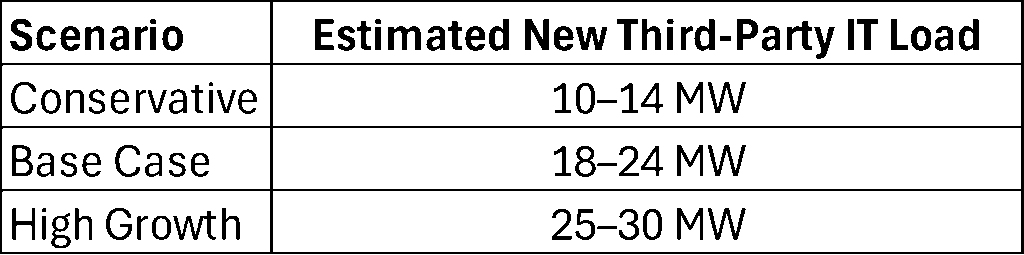
However, not all of this demand will translate into new commercial colocation requirements. Many institutions already operate captive infrastructure or utilise existing Nigerian data centres.
After adjusting for existing domestic deployments, enterprise-owned facilities and expected infrastructure efficiencies, GFA Data Centers estimates that the incremental third-party colocation opportunity created by the CBN Data Localisation Directive could reach:
Incremental third-party colocation opportunity
For perspective, an additional 18–24 MW of third-party IT load represents multiple new enterprise-grade data centre facilities and several billions of dollars in long-term digital infrastructure investment over the coming years.
Introducing the Digital Infrastructure Intensity (DII)
One of the challenges in digital infrastructure planning is the absence of a common metric that links digital economic activity with physical infrastructure requirements.
To address this, GFA Data Centers introduces the Digital Infrastructure Intensity (DII) metric.
Digital Infrastructure Intensity (DII) measures the estimated megawatts (MW) of IT infrastructure required to support one billion annual electronic payment transactions.
Based on our analysis:

Estimated megawatts (MW) of IT infrastructure required to support one billion annual electronic payment transactions.
The remarkable consistency of the DII suggests that as Nigeria’s digital economy expands, demand for resilient sovereign digital infrastructure is likely to grow broadly in proportion to transaction volumes, notwithstanding improvements in hardware efficiency and cloud optimisation.
While this metric has been developed using Nigeria’s financial services ecosystem, we believe it has broader potential as a planning tool for governments, development finance institutions, infrastructure investors and policymakers seeking to estimate digital infrastructure requirements across Africa.
See content credentials
What this means for Nigeria
By the end of 2026, we expect Nigeria would have processed more than 60 billion electronic payment transactions for the year.
Supporting an ecosystem of that scale will require more than software innovation. It will require sustained investment in sovereign digital infrastructure, including carrier-neutral data centres, resilient power systems, fibre connectivity, disaster recovery facilities, cybersecurity platforms and highly skilled digital infrastructure professionals.
The infrastructure deployed to support today’s payment systems will also provide the foundation for tomorrow’s AI workloads, digital healthcare, e-government services, education technology and enterprise cloud adoption.
The CBN data localisation directive should therefore be viewed not simply as a compliance requirement, but as a catalyst for Nigeria’s next phase of digital infrastructure development.
Adebola (Debo) Omololu is a co-founder of GFA Technologies Group. He is also a serial entrepreneur and helps businesses & governments with digital transformation through the development of software, AI and other technology tools.

Join BusinessDay whatsapp Channel, to stay up to date
Open In Whatsapp