The future of any nation is not built overnight; it is cultivated in classrooms, strengthened through innovation and realised in the marketplace.
Omo Aregbeyen, professor of Economics at the University of Ibadan, buttressed this ideology when he emphasised that innovation, research and entrepreneurship are the critical pillars for achieving sustainable development in Nigeria and across Africa.
Aregbeyen highlighted that in a knowledge economy, the most valuable asset is not what people have in their head, hence it is wrong for Nigeria to merely rely on its mineral resources without investing in human capital development.
“Though, Nigeria’s wealth comes from oil, land, labour as resource economy, the most valuable asset is not what you have in the ground, but what you have in your head,” he said.
To maximise the knowledge economy, Nigeria has opportunities in areas such as its young digital-native population, mobile penetration, which is above 90 percent, and a large internal market.
However, according to Aregbeyen, the country must close gaps in low R&D spending, weak industry, academia linkage, brain drain and poor research funding.
“We don’t lack talent. We lack translation. In the knowledge economy, universities are no longer the custodians of knowledge. We must become the engines of its creation and application,” he noted.
Across Nigeria, educators, students and entrepreneurs are proving that education is more than a pathway to employment; it is the foundation for economic growth, technological advancement and national development.
Emmanuel Eze, country director of HP Nigeria, toeing the views of Aregbeyen emphasised that Nigeria is not suffering from a lack of talent but struggles with converting its talent into skills that employers actually need.
Eze maintained that Nigeria’s competitive advantage will no longer depend on the number of graduates it produces but on how effectively it equips them with practical, industry-relevant capabilities.
According to Eze, the problem lies less in academic qualifications and more in the lack of practical experience, digital literacy and collaborative skills demanded by today’s workplace.
Study shows that poor learning outcomes significantly hinder human capital development by limiting an individual’s ability to acquire the necessary knowledge, skills, and competencies for personal and professional growth.
According to the World Bank report, Nigeria’s Human Capital Index (HCI) in 2020 was 0.36. This score indicates that a child born in Nigeria in 2020 will likely grow up to achieve only 36 percent of the productivity they could have achieved with quality education and full health.
Stakeholders express worries that these half-baked youngsters would one day become doctors, lawyers, engineers, and professionals of tomorrow.
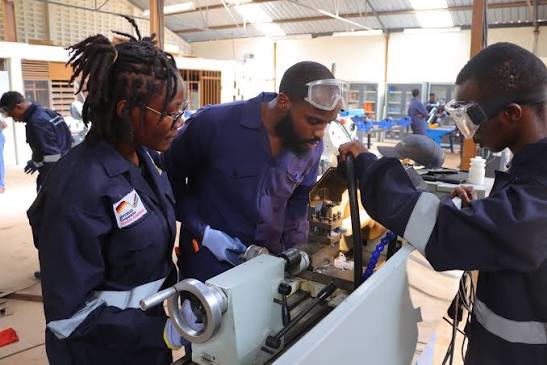
Kingsley Moghalu, the president of Institute for Governance & Economic Transformation speaking on the need for the country to embrace vocational education to develop its economy said; “Vocational skills are crucial for meeting the demands of a rapidly evolving labour market and supporting industries such as construction, manufacturing, and services.
Without a skilled workforce in areas such as plumbing, welding, electrical work, and automotive repair, Nigeria may struggle to meet infrastructure needs, maintain industrial machinery, and provide essential services. This can impede economic development and hinder efforts to build resilient and sustainable communities.”
Education beyond classrooms puts skill development right at its centre. Nigeria’s education must go beyond rote memorisation of facts to helping learners acquire various forms of skills that make them form a formidable human capital for the nation.
Educated citizens must be skilled to be able to create individual livelihoods, community wealth, and national value chains and thus effectively contribute to the economic transformation and global competitiveness of the nation, especially in light of the Fourth Industrial Revolution.
Christopher Itua, head of industrial services and development at the Institute for Industrial Technology (IIT), said vocational skills will not only transform Nigeria’s economy, but will also elevate families from poverty.
According to a World Bank report, “Nigeria’s poverty rate in 2023 was estimated to have reached 38.9 percent, with an estimated 87 million Nigerians living below the poverty line, the world’s second largest poor country after India.”
According to Kelvin Bob-manuel, senior communications coordinator at West Africa Vocational Education, to tackle youth unemployment, Nigeria must teach the self-motivated unemployed youth liabilities skills, and connect them to work opportunities.
Youth unemployment, underemployment and unemployability seems to be shooting up the sky as many youngsters lack appropriate skills that will empower them.
One of factors escalating unemployment in Nigeria is the mismatch between skills acquired in schools and the skills needed by the labour market.
The quest for certificates at the expense of practical skills, and entrepreneurship is seen fueling unemployment and underemployment rates in the country.
As Nigeria seeks to build a more competitive and resilient future, stakeholders agree that learning must extend beyond the classroom, equipping young people with skills, values and opportunities needed to thrive in an evolving global economy.

Join BusinessDay whatsapp Channel, to stay up to date
Open In Whatsapp