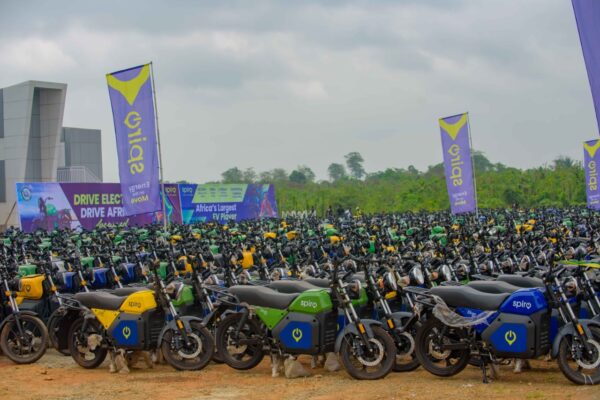
Spiro, Africa’s largest electric mobility company, on Tuesday unveiled its first Sustainability Report, committing to achieve net-zero Scope 1 and Scope 2 greenhouse gas emissions by 2040 and positioning itself among the first electric vehicle companies on the continent to publish a comprehensive environmental, social and governance (ESG) baseline.
Africa’s electric mobility industry is entering a new phase where investors and policymakers are demanding more than rapid expansion. Companies are now being judged on their ability to measure and reduce their environmental impact, and Spiro is attempting to set the pace.
Read also: Spiro bets on football to speed up Kenya’s electric vehicle adoption
The report marks a shift in Africa’s electric vehicle industry from reporting fleet growth to measuring climate, economic and social impact, as global investors increasingly tie financing to sustainability performance and transparent emissions reporting.
“This report reflects how far SPIRO has come—not only in terms of growth, but in our ability to measure and improve our impact. As we expand across Africa, sustainability will remain a core business driver, shaping how we invest, manufacture, innovate and partner for the long term,” said Anant Badjatya, group chief executive officer of Spiro.
The company said it completed its first end-to-end greenhouse gas inventory covering Scope 1, Scope 2 and Scope 3 emissions across its operations and value chain, creating what it describes as a benchmark for measuring future progress. It also registered with the Science Based Targets initiative (SBTi) and aligned its reporting with the Global Reporting Initiative (GRI) standards, signalling its intention to meet internationally recognised ESG disclosure practices.
Beyond its long-term net-zero ambition, Spiro projects that its expanding electric mobility ecosystem could help avoid as much as 700,000 tonnes of carbon dioxide emissions annually by 2030 as more commercial riders switch from petrol-powered motorcycles to electric alternatives.
The report also provides one of the clearest pictures yet of the environmental footprint of an African electric mobility company. Spiro reported approximately 243 tonnes of Scope 1 emissions and about 16,652 tonnes of Scope 2 emissions in 2025, figures that will serve as its baseline for future emissions reductions.
Industry experts say such disclosures are becoming increasingly important as development finance institutions, climate funds and commercial investors require measurable ESG performance before committing capital.
“Having grown up in India, I have witnessed firsthand the impact of vehicle emissions on public health and urban environments. At SPIRO, our responsibility as founders is not only to scale innovation, but to ensure that the systems we build endure economically, socially and environmentally for generations to come,” said Gagan Gupta, founder of Spiro and chairman of Equitane.
The report shows the company is looking beyond vehicle deployment to decarbonise its operations. Spiro is evaluating the installation of 80-125 KVA solar systems at selected battery-swapping stations to reduce dependence on electricity grids, while smart energy management initiatives at its assembly facilities have already lowered energy consumption by between 15 and 25 percent.
The company said it also plans to expand battery reuse, second-life energy storage and recycling programmes as part of a broader circular economy strategy.
While environmental commitments dominate the report, Spiro argues that electric mobility is becoming an economic necessity as much as a climate solution.
According to the company, commercial riders using its electric motorcycles reduce operating costs by between 70 percent and 80 percent compared with petrol-powered motorcycles through lower energy and maintenance expenses while avoiding the impact of volatile fuel prices.
The report also highlights the company’s growing investment in local industrial development. Through the Spiro Academy, more than 4,000 people were trained across Africa in 2025 in electric vehicle maintenance, battery management and technical operations. Spiro also launched what it describes as Africa’s first women-led electric motorcycle assembly line, part of a broader effort to increase female participation in advanced manufacturing.
Read also: Spiro secures additional $55m to scale electric mobility in Africa
The company now operates more than 100,000 electric motorcycles supported by over 2,500 battery-swapping stations across six African countries. It says more than 30 million battery swaps have been completed since its launch, replacing petrol-powered transport with electric alternatives.
The report reflects the maturation of Africa’s electric mobility industry. While early competition focused on expanding fleets and attracting venture capital, the next stage is likely to be defined by companies’ ability to demonstrate measurable climate impact, stronger governance and sustainable business models.
By publishing its first comprehensive ESG baseline, Spiro is positioning itself ahead of that shift, raising the reporting standard for an industry expected to play a growing role in Africa’s energy transition, urban transport and climate agenda.


Join BusinessDay whatsapp Channel, to stay up to date
Open In Whatsapp