
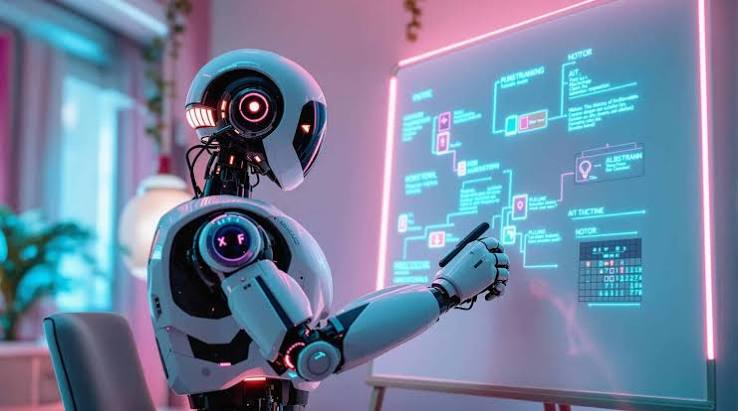
Businesses are deploying Artificial Intelligence to automate workflows, analyse data, write code, manage schedules and even complete tasks independently.
The result is a shift from AI as a simple assistant to AI as a digital coworker, as Artificial Intelligence in 2026 is no longer just about generating text or answering questions.
Artificial Intelligence has become an active participant in work planning tasks, as organisations that combine these capabilities with strong governance and workforce training are likely to see the greatest productivity gains, while those that fail to adapt risk falling behind as AI becomes embedded in everyday business operations.
Here are the 10 biggest AI productivity trends transforming work this year.
Digital employees
The biggest trend in 2026 is the rise of AI agent systems that can plan, reason, and complete tasks with little human intervention.
Unlike traditional chatbots, these AI agents can schedule meetings, respond to emails, conduct research, manage projects, and complete multi-step workflows.
Microsoft describes this as the emergence of ‘Frontier Firms,’ where employees supervise teams of AI agents instead of performing repetitive administrative work themselves.
AI’s understanding
Modern AI has become fully multimodal, meaning it can process images, documents, videos, voice, PDFs, presentations and spreadsheets.
Instead of switching between several applications, workers now upload almost any file into AI to receive summaries, insights or recommendations. ChatGPT, Gemini and Microsoft Copilot can analyse entire projects rather than individual documents.
AI embedded in workplace software
AI is disappearing into the background of everyday applications because rather than opening separate AI tools, employees now access AI directly in Microsoft 365, Google Workspace, Slack, Notion, Salesforce, HubSpot and Adobe products.
Users can draft reports, summarise meetings, generate presentations and analyse spreadsheets without leaving their existing software.
Coding with AI
Artificial Intelligence now helps developers to generate code, debug applications, explain unfamiliar programming languages, write documentation, test software and refactor existing code.
Software developers are making use of Artificial Intelligence throughout the development process. Rather than replacing engineers, AI is reducing the time spent on repetitive programming tasks.
AI replaces traditional search
Instead of typing keywords into search engines or corporate databases, workers ask AI questions in natural language.
This includes AI searches across emails, documents, meeting notes, internal knowledge bases, and cloud storage. It then produces a synthesised answer rather than a list of links.
Personal AI assistants
AI assistants are becoming proactive rather than reactive as they can now prioritise daily tasks, organise calendars, prepare meetings, suggest replies to emails, track deadlines and recommend follow-up actions.
Some systems can even remind users about unfinished work before they ask. AI is evolving from answering questions to helping people organise their professional lives.
AI transforms meetings
Meetings are now becoming automated as Artificial Intelligence now records conversations, produces transcripts, creates summaries, identifies action items, assigns responsibilities, and sends follow-up notes automatically.
Many professionals no longer take meeting notes manually, which implies teams can focus on discussions instead of documentation.
AI creates hyper-personalised workflows
Modern AI remembers context across multiple conversations and connected workplace applications as it learns writing style, preferred workflows, common tasks, frequently used documents, and business terminology.
This allows AI to produce personalised responses and automate recurring work because AI adapts to individual work habits instead of treating every request as new.
Businesses are building private AI systems
As companies adopt Artificial Intelligence at scale, many are choosing enterprise-grade AI platforms instead of relying solely on public chatbots.
Private AI models can securely access internal documents, financial records, customer databases, product information, and corporate knowledge, which enables organisations to automate work while keeping sensitive information protected.
AI skills as a workplace requirement
Knowing how to use AI effectively is becoming a core professional skill across industries as productivity gains depend on employees’ ability to collaborate with AI rather than compete against it.
Employers value workers who can write effective prompts, verify AI-generated outputs, automate repetitive tasks, integrate AI into daily workflows, and work alongside AI agents.


Join BusinessDay whatsapp Channel, to stay up to date
Open In Whatsapp