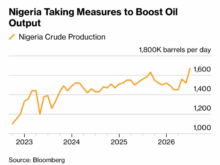
…700,000 bpd oil output expected
…Execution risk is the biggest threat -Wood Mackenzie
For more than ten years, Nigeria’s deepwater oil fields sat largely untouched by the world’s biggest energy companies, starved of the investment that once made the country a magnet for offshore drilling.
That drought is now easing, as a wave of project approvals and asset deals signals renewed appetite from Shell Plc, Exxon Mobil Corp., Eni SpA and TotalEnergies SE for some of Africa’s most prized offshore acreage.
The shift follows a sweeping set of fiscal reforms by President Bola Tinubu’s government, which is racing to hit targets of three million barrels a day of oil output and 12 billion cubic feet a day of gas production by the end of the decade.
BusinessDay’s findings showed that six legacy offshore contracts between state producer NNPC Ltd. and international partners were renegotiated in 2022, and further tax incentives introduced in 2024 sweetened terms for any project that reaches a final investment decision before 2029.
“Operators are responding, advancing deepwater development planning across numerous opportunities,” according to Wood Mackenzie’s energy team, which tracked the shift at the last Nigeria Oil and Gas conference in Abuja
Simon Flowers, the consultancy’s chairman and chief analyst, along with Ian Thom, upstream research director and Gavin Thompson, vice chairman for energy across Europe, the Middle East and Africa, have been closely watching the pipeline of projects moving toward sanction.
Wood Mackenzie’s energy team noted that acquisitions have also ticked up as oil majors seek greater control and alignment over their Nigerian development strategies and timelines.
Shell’s approval of the Bonga North project in late 2024, two decades after the field was first discovered, marked what analysts at Wood Mackenzie describe as the turning point for the industry.
Exxon followed last week with a $1 billion sanction of its Usan Infill Project, part of a broader $10 billion commitment the U.S. major has made to its Nigerian deepwater holdings.
“Nigeria’s deepwater sector could be on the cusp of a new era,” according to Wood Mackenzie.
The clearest sign yet of how far Nigeria is willing to go came last week, when the federal government signed off on an unprecedented production-linked fiscal incentive package for Shell’s long-delayed Bonga Southwest Aparo project.
The framework, approved by President Tinubu, grants Shell and its co-venturers a tax credit of $11.50 for every barrel of crude produced from the field, more than double the baseline incentive typically available under the Petroleum Industry Act.
BusinessDay’s findings showed officials have moved to frame the arrangement as the start of a broader policy shift rather than a one-off concession to a single operator.
Olu Verheijen, the presidential adviser on energy, alongside the Nigeria Revenue Service, have confirmed that the same $11.50 pricing buffer will be made available to other international oil companies, including Exxon, Chevron and TotalEnergies, for infrastructure deployed across new deepwater acreage through at least 2029.
Deal-making has picked up alongside the new project approvals, as majors consolidate stakes to gain tighter control over development timelines. TotalEnergies has agreed to buy Conoil’s 50 percent interest in the Egina South discovery, while Shell has taken a 10 percent stake from TotalEnergies in OML 118, a move designed to speed up the Bonga Southwest-Aparo development.
Wood Mackenzie estimated that four major greenfield projects alone could unlock more than 2 billion barrels of oil equivalent in resources.
Beyond Bonga North and Usan, a cluster of fields- Bonga Southwest-Aparo, operated by Shell; Owowo, operated by Exxon; and Zabazaba and Etan, both operated by Eni- are seen as critical to sustaining momentum.
Exxon has signalled that sanctioning its Bosi field hinges on progress at Owowo, while the gas-heavy Nnwa-Doro project, a joint venture between Shell and Chappal Energies, still faces high costs and a fragmented ownership structure that could complicate its path to approval.
Taken together, Wood Mackenzie calculates that a full slate of projects, Bonga Southwest-Aparo, Owowo, Zabazaba, Etan, Preowei, Nnwa-Doro and Bosi, alongside Bonga North and Usan, could add roughly 700,000 barrels a day of liquids and 950 million cubic feet a day of gas at peak output.
That would go a long way toward reversing a decline that saw Nigeria’s deepwater liquids production fall from a peak of about 800,000 barrels a day in 2016 to under 500,000 barrels a day within a decade.
“A transformed operating environment gives Nigeria a real shot at reversing the decline in deepwater production seen over the past decade,” Wood Mackenzie said.
Wood Mackenzie’s analysts point to execution risk as the single biggest threat to the recovery.
“In addition, partner alignment, capital competition, unitisation, regulatory approvals, gas sales agreements and offshore supply-chain constraints could also slow progress,” Wood Mackenzie’s analysts said.
They noted that spare capacity on existing FPSOs offers a lower-cost, lower-risk tieback opportunity, but creaky infrastructure will test this.
“Projects that require new-build FPSOs will face higher costs, longer timelines and greater execution risk,” Wood Mackenzie said.
According to Wood Mackenzie, the next 18 months are likely to prove decisive.
“Whether Bonga Southwest-Aparo, Zabazaba and Preowei advance to final investment decisions in that window will determine whether Nigeria’s deepwater comeback is durable or merely a brief rebound,” WoodMackenzie said.

Join BusinessDay whatsapp Channel, to stay up to date
Open In Whatsapp