Africa’s banking sector is delivering one of the strongest growth stories in global finance, even as it remains one of the world’s smallest.
The continent’s lenders posted faster growth in profits and capital than the global banking industry in 2025, highlighting their resilience despite representing less than one percent of global banking capital.
According to The Banker’s latest Top 1000 World Banks ranking, Africa’s banking industry “has grown rapidly over the years but remains small compared with those of other regions.” Despite accounting for around one-fifth of the world’s population, the continent’s banks account for “less than one percent of the total Tier 1 capital base” of this year’s rankings.
Yet the report says Africa’s biggest lenders continue to “punch above their weight,” with aggregate profit and Tier 1 capital growth “far above that of the aggregate for the Top 1000 as a whole.”
The figures highlight a striking paradox. Africa is home to one of the world’s fastest-growing populations and economies, but its financial sector remains significantly undercapitalised compared with those of Asia, Europe and North America. Limited banking depth continues to constrain credit creation, infrastructure financing and private-sector investment across much of the continent.
Still, it’s leading lenders have shown resilience in the face of high inflation, volatile exchange rates, geopolitical tensions and tighter global financial conditions.
The UK-based banking and financial intelligence publication reported that all 33 African banks included in this year’s Top 1000 ranking increased their Tier 1 capital in US dollar terms, with only Mauritius-based State Bank of Mauritius recording a marginal decline in assets. The report also noted that only five African lenders posted lower pre-tax profits, while all but three banks improved their positions in the global rankings.
Part of this performance reflects the weaker US dollar during 2025, which boosted the dollar value of banks’ local currency capital. However, exchange-rate gains tell only part of the story.
African banks have benefited from high interest rates, stronger net interest margins, improving asset quality and expanding regional operations. Many of the continent’s largest banking groups have spent the past decade building pan-African franchises that now provide diversified earnings across multiple markets.
South Africa continues to dominate the continental rankings, with six of Africa’s top 10 banks coming from the country. Standard Bank retained its position as Africa’s largest lender after recording a 30.1 percent increase in pre-tax profit, supported by strong growth in corporate and investment banking, insurance and asset management.
According to The Banker, higher net interest income, stronger non-interest revenue and lower credit impairments drove the lender’s performance.
Moroccan lenders also continued their steady ascent. All seven Moroccan banks in the Top 1000 improved their global rankings, reflecting the country’s relatively strong economic growth and improving banking fundamentals. Market leader Attijariwafa Bank climbed 20 places after increasing its Tier 1 capital by 19.4 percent, while recent credit-rating upgrades by S&P Global Ratings and Fitch Ratings reinforced confidence in the sector’s improving asset quality.
Nigeria produced some of the continent’s strongest movers.
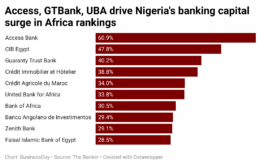
The Banker noted that Nigerian lenders “marched up this year’s rankings,” benefiting from a stabilising economy and the weaker dollar. Access Holdings recorded Africa’s largest annual increase in Tier 1 capital following its acquisition-led expansion across the continent, including purchases of National Bank of Kenya and several Standard Chartered subsidiaries.
Zenith Bank climbed 55 places globally after growing its Tier 1 capital by 29.1 percent, while Guaranty Trust Bank ranked highest among Nigerian lenders on operational efficiency, asset quality and financial soundness.
Egypt’s Commercial International Bank (CIB) emerged as Africa’s biggest climber, rising 89 places after increasing Tier 1 capital by nearly 48 percent, driven largely by higher retained earnings.
The latest rankings reinforce an important reality: Africa’s banking champions are becoming stronger, larger and more profitable. But they also expose the continent’s biggest financial challenge. Even with improving profitability and capitalisation, the continent still accounts for less than one percent of global banking capital.
Closing that gap will require deeper financial markets, stronger domestic savings mobilisation, sustained economic reforms and continued bank recapitalisation. If those conditions are met, Africa’s banks will be better positioned not only to climb global rankings but also to finance the continent’s industrialisation and long-term economic transformation.

Join BusinessDay whatsapp Channel, to stay up to date
Open In Whatsapp