…targets $130bn chocolate market as four-nation cocoa alliance takes shape
The Federal Government has unveiled an ambitious plan to transform Nigeria from a major exporter of raw cocoa beans into a leading processor and manufacturer of cocoa products, as it seeks to capture a larger share of the global chocolate market valued at more than $130 billion.
The strategy, announced at the Cocoa Value Addition Summit 2026 themed “From Bean to Brand” in Abuja on Tuesday, also saw Nigeria join Ghana, Côte d’Ivoire and Cameroon in a new regional alliance aimed at strengthening Africa’s bargaining power in the global cocoa industry, promoting domestic processing and ensuring fairer returns for millions of cocoa farmers.
Delivering President Bola Tinubu’s keynote address, Abubakar Kyari, Minister of Agriculture and Food Security, said Africa currently produces about 70 percent of the world’s cocoa, yet retains only a fraction of the value generated by the global chocolate industry.
“It is a rare day when a single seat summons ministers, governors, ambassadors, bankers and farmers into one hall. Yet that is precisely what has happened here in Abuja,” Kyari said.
He noted that although the global chocolate economy is worth between $130 billion and $165 billion, Africa retains barely six cents of every dollar, while the remaining value accrues to countries that process, brand and market finished chocolate products despite producing little or no cocoa.
Read also: Appraisal of FG’s cocoa value chain support
“We did not gather in Abuja today to lament that arithmetic. We gather to end it,” he said.
According to the President’s address, Nigeria will no longer rely on exporting raw cocoa beans while importing finished chocolate products.
“Nigeria will no longer export raw beans while importing finished value. We will grind our beans at home, press our butter at home, make our chocolate at home, brand it at home and sell it to the world on our own terms,” Kyari said.
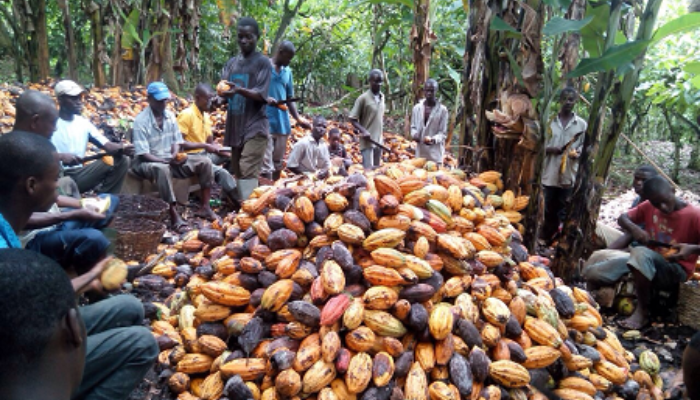
He said cocoa has become increasingly important to Nigeria’s economy, with more than 300,000 farming families cultivating the crop across about 1.4 million hectares. The country accounts for between six and seven percent of global cocoa production.
Kyari added that when international cocoa prices surged above $10,000 per tonne, the commodity generated more than N3 trillion for Nigeria and accounted for nearly a quarter of the country’s non-oil exports.
“But those record earnings still came overwhelmingly from raw beans. The windfall was priced in a market we do not control, for a harvest we do not process. That is not a strategy,” he said.
To accelerate industrialisation of the sector, the government announced plans to expand domestic processing capacity, support private investment and rejuvenate cocoa plantations.
Kyari disclosed that a 70,000-tonne cocoa processing facility is currently under construction in Sagamu, describing it as the largest in Nigeria, while national cocoa grinding capacity has surpassed 120,000 tonnes annually.
He also highlighted the rollout of one million improved cocoa seedlings by the Federal Ministry of Agriculture and Food Security through the Cocoa Research Institute of Nigeria (CRIN), saying the initiative is designed to replace ageing plantations with higher-yielding and climate-resilient varieties.
“Before we ask the world to invest in our factories, we put the trees in the ground. The bar begins with the bean, and the bean begins with the tree,” he said.
Also speaking, John Owan Enoh, Minister of State for Industry, said the volatility in global cocoa prices underscored the need for producing countries to move beyond exporting raw commodities.
He noted that cocoa prices rose above $11,000 per tonne in late 2024 before falling to about $3,100 in March this year and recovering to around $5,000 per tonne, exposing farmers to severe market risks while processors and global brands retained most of the industry’s value.
“When the price rose, farmers received only a fraction of the gains. When prices fell, they bore the losses first. Meanwhile, the price of chocolate remained high. That is not market failure; it is market design,” Enoh said.
He announced the adoption of the Cocoa Value Addition Accord, a framework bringing together the Federal Government, cocoa-producing states, industry associations, research institutions and the Bank of Industry to drive implementation of Nigeria’s cocoa industrialisation agenda.
The accord establishes a Delivery Council, to be chaired by the minister, with annual public performance reviews.
Enoh also announced dedicated financing windows by the Bank of Industry for cocoa processing projects, particularly those involving smallholder farmers, alongside the development of a national cocoa traceability system to help exporters comply with emerging international regulations such as the European Union Deforestation Regulation.
A major outcome of the summit was the signing of the Abuja Declaration, establishing the Cocoa Value Addition Alliance involving Nigeria, Ghana, Côte d’Ivoire and Cameroon.
The four countries together account for roughly three-quarters of global cocoa production and intend to coordinate on value addition, sustainability standards, traceability systems and market engagement.
The alliance builds on the existing Ghana-Côte d’Ivoire cocoa cooperation and seeks to strengthen Africa’s negotiating position on issues including producer prices, environmental standards and access to global markets.
Enoh said the alliance would enable African producers to speak with one voice on international cocoa policies and ensure that the costs of sustainability compliance are shared across the value chain rather than borne solely by farmers.
“The countries that grow the bean will no longer be strangers to the wealth of the chocolate bar,” he said.

Join BusinessDay whatsapp Channel, to stay up to date
Open In Whatsapp