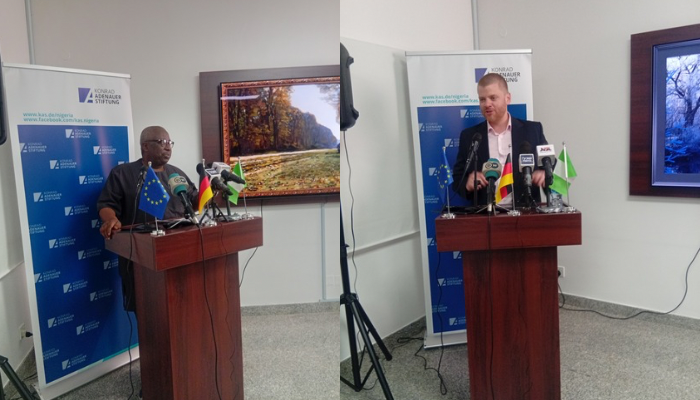
Dapo Olorunyomi, a media chief executive has says that Nigeria’s democracy needs a new professional ethic for reporting religion, refering to it as Faith Journalism.
He stated this while delivering a keynotes address during a breakfast dialogue with media: religion and freedom media reports in Nigeria held at Konrad Adenauer Stiftung KAS office in Abuja.
He said Faith Journalism is not journalism that advocates for a religion, defends religious institutions from scrutiny, or turns reporters into evangelists. It is the disciplined, independent, constitutionally grounded practice of reporting religion with the rigour, literacy, and moral seriousness the subject demands, distinguishing faith from those who speak falsely in its name, holding religious power accountable exactly as we hold political and economic power accountable, and treating every citizen, of every conviction or none, as constitutionally equal.
“Nigeria is perhaps one of the few countries in the world where religion is not merely practised, it is performed, narrated, debated, contested, celebrated, commercialised, and increasingly mediated. Faith no longer resides only in churches, mosques, temples, or sacred groves. It circulates through dawn radio broadcasts, livestreamed sermons, WhatsApp devotionals, YouTube channels, and TikTok clips. It shapes our mornings and evenings, informs political calculation, inspires philanthropy, comforts the bereaved, and — regrettably — has often been manipulated to divide neighbours who lived peacefully together for generations. Every religious gathering, every doctrinal controversy, every allegation of blasphemy, every outbreak of communal violence, is potentially transformed into public narrative through the work of journalists. If journalism is the first draft of history, then media reporting is also, in large part, the first draft of the nation’s understanding of itself.
My claim this morning is simple: Nigeria’s democracy needs a new professional ethic for reporting religion, and I call it Faith Journalism. Faith Journalism is not journalism that advocates for a religion, defends religious institutions from scrutiny, or turns reporters into evangelists. It is the disciplined, independent, constitutionally grounded practice of reporting religion with the rigour, literacy, and moral seriousness the subject demands — distinguishing faith from those who speak falsely in its name, holding religious power accountable exactly as we hold political and economic power accountable, and treating every citizen, of every conviction or none, as constitutionally equal.
“Behind that claim sit questions that many of us have asked in private but rarely answered in public: How should journalists report religion in a society where faith commands such deep emotional allegiance? How should religious leaders engage the media without expecting exemption from scrutiny? How can the constitutional guarantee of religious liberty coexist with the equally indispensable freedoms of expression and of the press? Posed this way transforms what is ordinarily a series of media questions into cogent democratic questions, which is exactly why I believe the answer must be an ethic, not a set of good intentions.
“I make this claim on four grounds, which I will take in turn: what our Constitution requires; what we know about how media framing shapes reality; what our deepest moral traditions, Nigerian and global, converge upon; and what artificial intelligence has now made urgent. I will close with what this ethic looks like in practice, in the form of a short charter for our newsrooms.
“The Constitutional Ground
Section 38 of our Constitution guarantees freedom of thought, conscience, and religion as an inherent right, not a privilege extended by the majority. It protects the freedom to believe, to change belief, to worship, to propagate faith peacefully, or to reject religion altogether equally for the Christian, the Muslim, the adherent of African Traditional Religion, the member of a minority faith, the sceptic, and the non-believer. Constitutional rights do not fluctuate with numbers or popularity. A democracy is not measured by how securely the majority worships; majorities rarely fear for their freedoms. It is measured by how confidently minorities and dissenters live without intimidation.
According to Dapo, Section 38 does not stand alone. It sits within an ecosystem alongside freedom of expression, the protection of human dignity, and the guarantee of equality before the law, rights that are not rivals but mutually reinforcing pillars. A free press lets society debate faith openly; equality before the law ensures no faith is privileged over another. Our courts have consistently held that the Constitution does not rank fundamental rights but harmonises them. Religious liberty cannot justify suppressing inquiry, just as free expression cannot licence incitement. This principle is not ours alone: Article 8 of the African Charter on Human and Peoples’ Rights guarantees freedom of conscience alongside Article 9’s protection of expression, and Article 18 of the Universal Declaration of Human Rights affirms the same freedom to adopt, change, or decline belief. Democratic societies everywhere have concluded that these two freedoms rise or fall together.
“Our quest for a true democratic polity faces the tension of contrasting pulls from advocates of a secular versus a confessional state building model in our country. However, while Nigeria’s secularity reflected in Section 10 of our Constitution, forbids the state from adopting any religion as a state religion, is hardly a full-throated refutation of a confessional state. To be sure, its definition of neutrality is not the absence of expression of religiousity. This point is often misunderstood, because our history is genuinely complex: the Constitution recognises Sharia Courts of Appeal in defined areas of personal law, and governments have long supported both Christian and Muslim pilgrimages. Thus neutrality is not the absence of religion from public life; it is the state’s refusal to become the property of any one faith. Nigeria is a religiously plural constitutional republic: it protects the mosque without becoming an Islamic republic, protects the church without becoming a Christian state, and above all protects the individual conscience, the most sacred constitutional territory we have.
This is the first ground for Faith Journalism. If the Constitution’s whole architecture exists to secure equal citizenship regardless of belief, then journalism, the institution that mediates how citizens see one another’s convictions, carries a constitutional duty, not merely a professional one, to report religion in a way that upholds that stated equality rather than eroding it. A journalist who just compulsively frames a dispute as “Christian versus Muslim” subverts a fundamental democratic position when in fact the Constitution asks only whether public institutions acted with equality and impartiality. Such uncritical act of simply choosing a headline is, in the final analysis, misreporting the spirit of the Republic itself.
He said religion has never been merely private in Nigeria. Long before colonial rule, faith shaped political authority, justice, and communal organisation. Yoruba kingdoms developed intricate relationships between political authority and indigenous religious institutions. Further north, after the jihad of 1804, the Sokoto Caliphate represented a sophisticated fusion of scholarship, governance, and Islamic jurisprudence. This history matters for journalism, because it means religious identity in Nigeria was never a simple, single story waiting to be reported, it was, and remains, a set of overlapping histories that deserve to be reported with the same care historians bring to them.
He said some of Nigeria’s earliest newspapers emerged from missionary initiatives; print culture and religious communication were intertwined from the start. Radio and television later expanded religious broadcasting, and Pentecostal and Islamic organisations alike developed sophisticated media ministries that reached far beyond the local congregation. Today the smartphone has become perhaps the most influential religious platform in the country, every citizen now carries a printing press, a broadcasting station, and a publishing house in the palm of the hand. This has democratised religious education and civic engagement on an unprecedented scale. It has also created fertile ground for fabricated miracles, manipulated videos, and sectarian rumour. Religion no longer travels only through trusted institutions. It travels at the speed of vitality.
“If our journalism is truthful, our democracy will be wiser. If our religion is compassionate, our citizenship will be stronger. And if we hold to Faith Journalism as our shared discipline, Nigeria’s diversity will become not a burden to be managed, but a gift its Republic is continually renewed by. That is the promise of religious freedom.
In his welcome speech, Moritz Sprenker said Breakfast dialogue with Media: Religion and Freedom of Religion Media Reports in Nigeria creates space for input, reflection, discussion, and networking.
He said this is important because the issues are complex. They require professional experience, ethical judgment, and above all, a willingness to listen.
“Religion in Nigeria is not an abstract concept. It shapes identity, community, public debate, and politics. At the same time, freedom of religion is protected by our Constitution. This is not just a legal principle—it is a lived reality, shaped every day by how we
“I am especially pleased that we meet in this format: a breakfast dialogue—not a lecture, but an open and constructive exchange.
“This is not just a legal principle—it is a lived reality, shaped every day by how we speak about one another, and crucially, by how the media reports. In a diverse society like ours, journalism can either build understanding or deepen mistrust.
“A headline can clarify or inflame. A report can shed light on complexity—or reduce it to a harmful binary. That is why your role as journalists is so central. Nigeria’s conflicts are rarely one-dimensional. Religion often intersects with ethnicity, politics, and economic realities. When we reduce complex situations to “religious conflict” alone, we risk overlooking deeper causes and possible solutions. At the same time, we should not avoid religion just because it is sensitive. The task is not silence, but responsible reporting.
“Professional journalism means accuracy before speed, context before sensationalism, and careful language that does not turn communities into adversaries. It also means asking ourselves a simple question: Does this report help the public understand, or does it reinforce existing fears? This responsibility is even greater in an age of rapid misinformation. Simplified and polarizing narratives can quickly erode trust and social cohesion.
“In this environment, journalists are not only providers of information—they are also guardians of context. Today’s dialogue is not about criticizing the media. On the contrary, it is about recognizing the vital role of free, professional, and responsible journalism. Freedom of religion and freedom of expression are both essential, yet in practice, tensions can arise.
“Navigating these tensions responsibly is one of the key challenges we will address today. I am grateful that we have excellent speakers to guide us today.
“I hope today’s discussion will be open, thoughtful, and constructive. Let us speak not only about risks, but also about opportunities: to build trust, to counter misinformation, to protect fundamental freedoms, and to strengthen social cohesion.
“If we leave this dialogue with a deeper shared understanding of how to report on religion accurately, responsibly, and sensitively, then we will have achieved something truly meaningful.

Join BusinessDay whatsapp Channel, to stay up to date
Open In Whatsapp