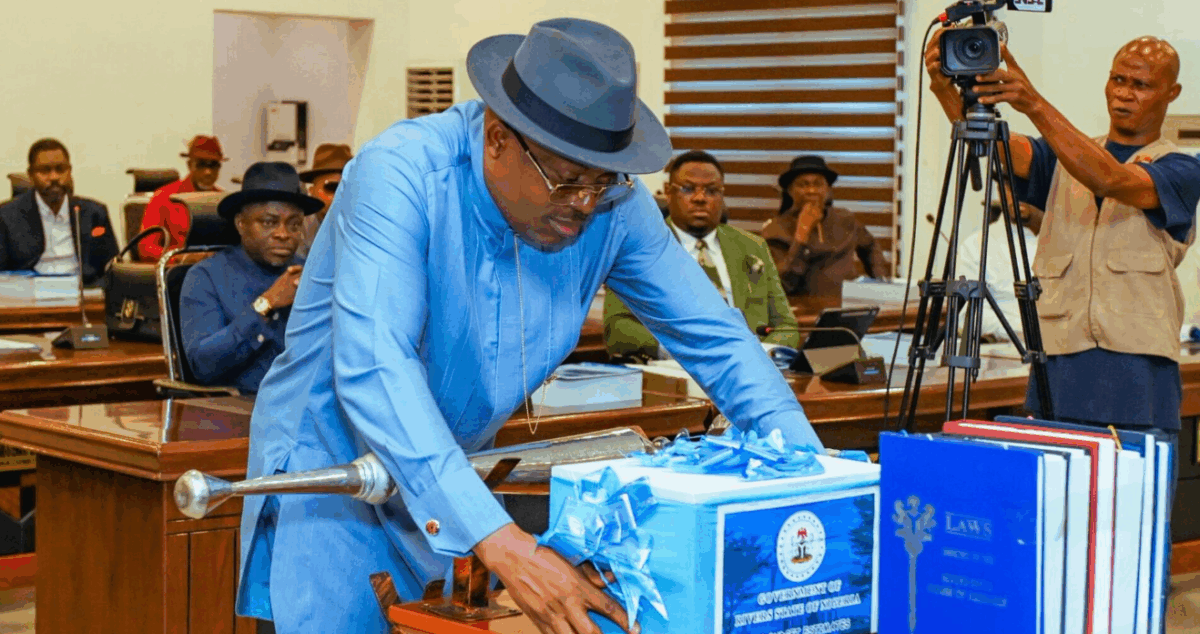
Gov Siminalayi Fubara of Rivers State has at last presented a budget of N1.85 trillion to the Rivers State House of Assembly (RSHA) for consideration.
The presentation came less than three weeks after he submitted his 2026–2028 Medium Term Expenditure Framework (MTEF) to the Assembly, and more than eight months after he and the legislators returned from a State of Emergency–induced suspension.
Since the lifting of the State of Emergency by President Bola Tinubu, the Martin Amaewhule–led House of Assembly has repeatedly called on the governor to present the 2026 Appropriation Bill.
Analysts suggest Fubara’s eventual presentation of the budget signals a reconciliation of the rift between him and Nyesom Wike, Minister of the Federal Capital Territory (FCT), which had plunged the state into a political crisis.
While presenting the budget on Friday, July 10, 2026, Fubara placed the total estimated revenue for the year at N1.8 trillion but gave total expenditure as N1.85 trillion.
He said the 2026 budget, titled “Budget of Resilience for Growth and Development,” is the result of considerable public participation in a shared vision for building an economically resilient, thriving and prosperous Rivers State.
Fubara said that despite the challenges confronting the state, “The machinery of governance has continued to function, and we have made significant progress in our priority areas of road infrastructure, human capital development, as well as in the security of lives and property.”
The governor said the total projected revenue for the 2026 fiscal year is N1.85trn only. “This means our proposed total operating revenue for 2026 is projected to increase by 24.49 per cent over the 2025 adjusted budget projections, due to possible increases in returns from FAAC, derivation funds and internally generated revenue, as the national economic outlook continues to show positive growth,” he said.
Fubara noted that the details of the 2026 budget assumptions and fiscal objectives were outlined in the Medium-Term Expenditure Framework 2026–2028, which he said the House had already considered.
He listed projected revenue and sources as follows: Internally Generated Revenue (IGR) N487.6bn; total FAAC allocation, including derivation funds, value-added tax and exchange gain N936.0bn; opening and closing balances N48.1bn; and total capital receipts, including domestic loans, grants and asset sales N382.5bn; with total projected revenue placed at N1.85trn.
Fubara further said a total of N413.1bn is allocated to recurrent expenditure.
A breakdown of recurrent expenditure included: total personnel costs, including salaries for ministries, departments and parastatals N154.7bn; new recruitments N15.2bn; consolidated revenue fund charges N772.9m; overheads for MDAs N36.7m; grants, contributions and subsidies N9.7bn; gratuities N20bn; death benefits N7.bn; and monthly pensions N55bn.
Others include Employee Compensation Act N4bn; legacy pension gratuities N20bn; group life insurance N5bn; interest on domestic loans N28bn; interest on foreign loans N6.5bn; short-term domestic loan principal repayment N3.9bn; long-term domestic loan principal repayment N30.4bn; and foreign loans principal repayment N15.7bn, totalling N413.1bn.
Fubara added: “Mr Speaker may wish to note that we have proposed at least a 50% increase in overhead expenditure, to be enacted immediately once the budget becomes law.”
He said the sum of N1.4trn is allocated to capital expenditure. The sectoral breakdown is as follows: Administration N278.7bn, Economic N625.9bn, Law and Justice N65.3bn, and Social N435.4bn, totalling N1,4trn.
Fubara noted that “the capital budget has increased from N713.7bn in 2025 to N1.4trn in 2026, saying it is a 22.49% rise in infrastructure services expenditure.
“Major capital expenditure is planned in the following areas: Works and Infrastructure N533.3bn, Educational Development N315bn, Healthcare Delivery N105.4bn, Rivers State House of Assembly N41.5bn, Rivers State Judiciary N30bn, Agriculture N19.3bn, Power N15bn, Chieftaincy and Community Development N8.5bn, Sports N8bn, Youths N7bn, Women Affairs N6.5bn, and Environment and Sustainable Development N6.6bn.”
“Hon. Speaker, in addition to aligning with our fiscal realities, the 2026 budget prioritises the core objectives of building a secure, prosperous and resilient State characterised by inclusive economic growth, sustainable development, and improved standards of living for all.
“At the core of this budget is our commitment to infrastructure development – including new investments, the completion of ongoing road projects, and the maintenance of existing roads and bridges.
“We have also allocated an exceptionally large budget to education, aiming to reshape the future of our state’s education systems to achieve better outcomes.
“The 2026 budget is not just about allocating funds to specific socio-economic sectors. Instead, it is a people-centred budget that acts as a blueprint for progress and service delivery, outlining a vision for a better future. It will bring tangible benefits to every ward, local government area, and resident.
“I urge all honourable members, regardless of political affiliations, to support and approve this budget,” he said.

Join BusinessDay whatsapp Channel, to stay up to date
Open In Whatsapp