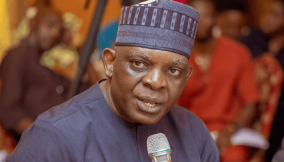
As construction progresses on the Lagos section of the Sokoto-Badagry super highway, David Umahi, the Minister of Works, has assured of the federal government’s commitment to delivering quality and durable road infrastructure catalyse economic growth.
The minister gave the assurance while inspecting ongoing construction on the Lagos-Ogun section of the Sokoto-Badagry super highway,
He assessed the progress of work and quality and quantity of construction materials being, directing the Ogun State Federal Controller of Works to provide updates on completed sections and outstanding engineering works.
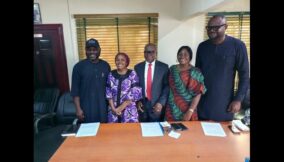
The minister, who was accompanied by federal lawmakers and officials of the ministry, commended Hitech Construction Company for the quality of work on the project, describing the super highway as one of the federal government’s flagship infrastructure investments expected to improve interstate connectivity, lower logistics costs and stimulate economic growth.
Umahi said the government is prioritising durable infrastructure capable of supporting long-term economic development, arguing that Nigeria’s road infrastructure deficit is largely the result of decades of underinvestment and poor construction standards.
“If we were building this kind of quality of roads in previous administrations, we wouldn’t be crying for road infrastructure today,” he said, adding that contractors handling federal projects would continue to be held accountable for meeting approved engineering specifications.
Providing an update on construction progress, the engineer overseeing Section Three of the Sokoto-Badagry Super Highway, Oyewande Aliu, said the 162.352-kilometre section stretching from Lagos through Ogun State to the Oyo State boundary has recorded significant progress.
Aliu disclosed that 25 kilometres of continuously reinforced concrete pavement (CRCP) have been completed on the left carriageway, while 9.4 kilometres have been constructed on the right carriageway. Earthworks have reached approximately 81 kilometres, while site clearance has extended to about 145 kilometres of the corridor.
He noted that work on some sections has slowed temporarily to accommodate the construction of a major interchange bridge and the installation of cross culverts, both of which are essential for effective drainage and the long-term durability of the highway.
The super highway forms a critical component of the federal government’s infrastructure renewal programme and is expected to strengthen trade links between Nigeria’s northwestern and southwestern economic corridors while improving the movement of people and goods across the country.
The minister also addressed concerns raised over the flooding incident around the Lagos-Calabar coastal highway, insisting that there is no technical evidence linking the project to the recent flooding experienced in some parts of Lagos.
He disclosed that President Bola Tinubu had directed his ministry to carry out a comprehensive technical evaluation of the highway corridor and adjoining communities to determine the actual causes of the flooding.
“The team will evaluate the coastal highway and its surroundings, not because we are causing the flooding, but because the president has directed that we undertake a technical assessment,” Umahi said.
According to him, the flooding is largely a consequence of the non-implementation of the Lagos State flood management master plan, inadequate drainage infrastructure and indiscriminate dumping of refuse into drainage channels and manholes.
“You can see the amount of refuse blocking drainage channels. This indiscipline obstructs the free flow of water and contributes significantly to flooding,” he said, maintaining that the coastal highway was designed with adequate drainage systems that comply with modern engineering standards.

Join BusinessDay whatsapp Channel, to stay up to date
Open In Whatsapp