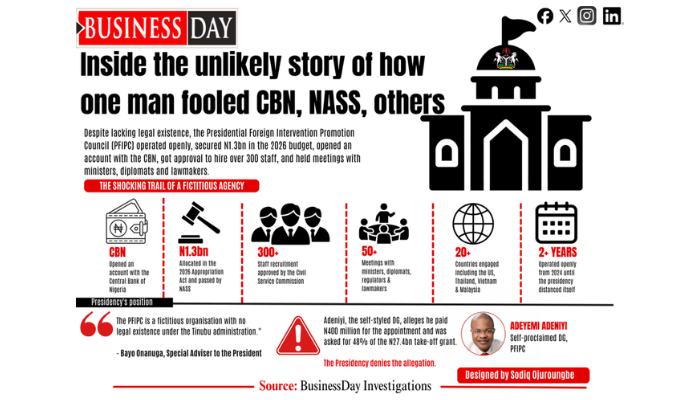
The Presidency says the Presidential Foreign Intervention Promotion Council never legally existed. Yet the council secured a N1.3 billion budget allocation, operated accounts with the Central Bank of Nigeria, received approval to recruit more than 300 staff and held meetings with ministers, diplomats and lawmakers. Using official documents, interviews and open-source analysis, BusinessDay Investigations traces how a supposedly fictitious agency became embedded in the machinery of government.
Escaping the checks and balances of the National Assembly, the verification processes of the Central Bank of Nigeria (CBN), and oversight mechanisms within the federal bureaucracy, one man has been accused of operating a presidential council that the Presidency now says never legally existed.
For nearly two years, Adeyemi Adeniyi operated openly in Abuja as Director-General of the Presidential Economic Advisory Council (PEAC) and the Presidential Foreign Intervention Promotion Council (PFIPC). He met ambassadors, organised conferences, attended official functions and interacted with senior government officials much like the heads of other federal agencies. Then, on June 11, the Presidency publicly disowned the council.
In separate statements, the Office of the Chief of Staff and the Presidency described PFIPC as a fictitious organisation with no legal existence under the administration of President Bola Tinubu.
The declaration immediately raised a troubling question: if PFIPC never existed, how did it secure a budget allocation, obtain a CBN account, receive approval to recruit more than 300 employees and gain recognition from multiple government institutions?
BusinessDay Investigations examined official records, budget documents, government correspondence, social media archives and public statements to investigate the unlikely rise of the PFIPC, a body the presidency now describes as fictitious.
How a ‘fictitious’ agency got N1.3bn
Nigeria’s 2026 budget was passed by the National Assembly after four months of submission by the Executive Arm.
Sitting on page 4 of the 2790 pages of the 2026 Appropriation Act is the Presidential Economic Advisory Council (PEAC) and the Presidential Foreign Intervention Promotion Council (PFIPC), immediately below the National Council on Climate Change (NCCC), a council established under Nigeria’s Climate Change Act, 2021.
A total of N1.3 billion was budgeted for the agency under Budget Code 0111062001.
Placed under the umbrella of the Presidency, the budget entailed allocations for personnel costs (N802.9m), overhead (N200m), and capital projects (N300m).
The Council, now labelled as fictitious by the same Presidency, went through verification before being included in the budget.
The Federal Executive Council reviews estimates, the Budget Office consolidates proposals, before the National Assembly conducts public hearings and committee-level defence sessions.
The Defence sessions are chaired by the Committee on Appropriations, which invites the Head of MDAs or their representatives to justify their proposed spending.
Between February 2 and 13, 2026, the Senate Committee on Appropriations, chaired by Solomon Adeola (popularly known as Yayi), conducted budget defence sessions with all Ministries, Departments and Agencies (MDAs).
Adeola publicly warned, “Let me emphasise that all MDAs must appear before their respective committees to defend their budget proposals. Where MDAs fail to justify their estimates, the Committee on Appropriations will recommend reallocation.”
Despite these assurances, lawmakers approved N1.3 billion for an agency the Presidency now says never existed.
Presidency’s misleading claim on CBN account, appointment letter
Beyond the budget allocation, PFIPC also gained access to another powerful symbol of government legitimacy: a Treasury Single Account with the Central Bank of Nigeria.
As contained in Onanuga’s statement, the DG of the Council used a forged appointment letter from the Chief of Staff to create an account with the CBN. In Nigeria, appointment letters for senior public officers are issued by the Secretary to the Government of the Federation.
The CBN is the apex bank in the country that serves as both the regulator of the industry and the national purse. BusinessDay Investigations found the inaccuracy of the presidency’s claim on the creation of a bank account for a government agency with the CBN.
The process of opening an account by a government department or agency starts with the Office of the Accountant-General of the Federation (OAGF).
As part of the process, the OAGF verifies that the agency is a legally recognised government entity. This includes confirming that it has a valid establishing instrument, such as an Act of the National Assembly, an Executive Order, or a gazetted government notice.
According to a top official who works with the CBN and spoke to BusinessDay Investigations on anonymity due to fear of sanction, the process of using the establishment act of the council could not have been skipped except with appropriate clearance.
“For the account to be opened, there is a need to have the instrument of creation of such a council or agency that will determine the type of account to be opened,” he said.
This verification ensures that the applicant is a duly constituted public institution.
He added that government agencies do not apply directly to the CBN. Instead, the request is routed through the OAGF. The Accountant-General is designated as the “primary contact point” with the CBN.
Once the agency’s legal status has been confirmed, the account is opened within the Treasury Single Account (TSA) framework.
He further explained, “the agency or department is then required to nominate its authorised signatories, usually the head of the agency and a designated finance officer. Supporting documents, including appointment letters, means of identification, and specimen signatures, are submitted to validate the signatories’ authority to operate the account.”
This paper found that an agency’s legal existence is expected to be established before it is treated as a legitimate spending unit within GIFMIS, the platform through which budget codes and MDA accounts are processed.
Civil Service Commission approves 300 staff for Adeniyi’s council
The DG of the Agency did not operate alone; he managed to secure the employment of 300 staff members.
In an Instagram post, Adeniyi expressed appreciation to President Bola Tinubu for approving a waiver for his council to recruit over 300 staff; establish PFIPC offices in all 36 states and 127 offices across the world. This is a public post made almost a year ago without a reaction or disclaimer from the presidency or any arm of the government.
A report also confirmed that the waiver to boycott a federal government’s embargo on general civil service recruitment was indeed granted to Adeniyi’s PFIPC in a letter signed by Mimi Abu, director of Organisation Design and Development in the Office of the Head of the Civil Service Commission of the Federation, and copied to the Office of the Secretary to the Government of the Federation.
The recruitment approval covered positions across senior management, professional, administrative and support cadres.
These included 10 directors, alongside administrative officers, planning officers, statisticians, commercial officers, investment promotion officers, accountants, legal and procurement officers, programme analysts, information officers, executive officers, data processing personnel, confidential secretaries, technical officers, and motor drivers/mechanics.
The presidency’s argument that the council is fictitious suggests that the OAGF, the SGF, and the Civil Service Commission did not conduct any verification on Adeniyi’s claim or the submitted documents.
Meanwhile, BusinessDay contacted the Federal Civil Service Commission to inquire about the conditions under which the waiver was granted to the Council during a federal hiring freeze.
Its spokesperson, Ibraheem Zakariyya, told our correspondent that the approval of the waiver followed the commission’s internal procedures and was based on the documents presented at the time.
“The commission’s decisions on recruitment waivers are guided by established civil service procedures and are subject to approvals based on the merits of each request at the time,” he said.
“However, given the ongoing reviews and the issues that have since emerged, it would be premature to make definitive comments until all relevant facts have been fully established. What is important is that the Commission remains committed to due process, accountability and transparency in all its operations,” he added.
The Presidency’s position that PFIPC was fictitious suggests that several government institutions accepted documents and representations from the council without identifying any irregularities.
Dining with high and mighty
Adeniyi neither operated a shadow agency, nor did he move stealthily in Abuja or anywhere else.
BusinessDay Investigations traced his digital trail in contrast with the presidency’s account, and examined the unanswered questions surrounding the network he built.
On August 19, 2025, Adeniyi shared photographs of separate visits to the Minister of State for Humanitarian Affairs and Poverty Reduction, describing discussions on aligning humanitarian programmes with Nigeria’s economic objectives, and the Minister of State for Education, Professor Suwaiba Said Ahmad, where he said discussions centered on education reforms.
Days later, he posted photographs from meetings with the National Salaries, Incomes and Wages Commission, before announcing engagements with foreign diplomats, including the Thai Ambassador, the Vietnamese Ambassador and the Malaysian High Commissioner, whom he said were discussing strategic investment partnerships with Nigeria.
On September 5, Adeyemi published photographs from a visit to the Economic and Financial Crimes Commission (EFCC) headquarters, declaring that he had “landed at EFCC Headquarters for collaboration and not for interrogation”.
His social media timeline also included meetings with officials of the Nigerian Electricity Regulatory Commission (NERC), a delegation he described as representing the World Bank, and several foreign investors.
By October 2025, Adeniyi’s activities had attracted mainstream media attention.
On October 17, he announced that Nigeria had secured hosting rights for the World Investment Summit from 2026 to 2030, projecting that the event would attract $5 trillion in foreign direct investment. The announcement was subsequently reported by Vanguard, Channels Television and Pan Nigerian News.
According to the State House statement, concerns within the government crystallised after Adeniyi reportedly held a meeting with ambassadors on October 10, 2025.
The Ministry of Foreign Affairs sought clarification on October 15, the Chief of Staff petitioned security agencies on October 17, and police eventually arrested him on October 27.
But findings by our correspondents showed that Adeniyi’s public posts show that meetings with ministers, diplomats, regulators and senior public officials had been taking place for weeks before those dates.
Legislative collaboration
Beyond budget allocation, Adeniyi’s agency has enjoyed collaboration and support from both chambers of the National Assembly.
The House of Representatives did not only approve the budget of the said “fake” presidential council, but the leadership of the Green Chamber also granted tacit approval and recognition to the FCPIC and its DG through meetings and exchange of correspondence.
In July, 2025, Adeniyi met with the Deputy Speaker of the House of Representatives, Benjamin Kalu, at the lawmaker’s office in Abuja.
As reported by PUNCH, the meeting was held as “part of efforts to align policy ambition and legislative resolve.”
Also, a letter seen by Business Day Investigation shows that the House Committee on Treaties, Protocols and Agreements, headed by Rabiu Yusuf, representing the Sumaila/Takai Federal Constituency of Kano State addressed a letter to the DG of the agency to participate in the “Executive Study Exchange on Institutional Excellence in Treaty Governance, scheduled to take place in Casablanca, Morocco, between November and December 2025.”
The programme was organised by the Committee in collaboration with the Africa Development Studies Centre (ADSC). In the invitation letter, it is described as a “strategic intervention aimed at strengthening Nigeria’s federal and state capacities in treaty negotiation, domestication, and compliance.”
Also, on September 2, 2025, the Senate Committee on Anti-Corruption and Financial Crimes, chaired by Senator Emmanuel Udende, nominated PFIPC’s DG for a “High-Level Study Exchange on Anti-Corruption Policy and Institutional Reform” in London, UK.
The nomination letter obtained by BusinessDay Investigations was signed by Uboh Emelike, the committee clerk.
When BusinessDay Investigations contacted the Senate Committee and asked whether it was aware of the legal status of the council before nominating its Director-General for the Anti-Corruption Policy and Institutional Reform event, the committee’s clerk, Uboh Emelike, said the chairman was unavailable to comment.
Emelike added that he was not at liberty to discuss the affairs of the committee, particularly in light of the recent developments surrounding the council.
The Man behind the council
Born on October 26 and identified as an indigene of Ogbomoso, Oyo State, Adeniyi publicly describes himself as a graduate of Ladoke Akintola University of Technology (LAUTECH).
However, BusinessDay’s search of publicly available graduation records and convocation databases could not independently verify the claim. He married Oluwatoyin Alagbe Adeniyi on December 23, 2017.
In January 2017, Nigerian newspapers reported that Adeniyi had been elected President-General of the World Youth Organisation (WYO) at a conference in New Delhi, India, on November 12, 2016.
The media reports published by PUNCH, Tribune and Vanguard claimed he was elected with 1,679 votes after defeating 9 other candidates and would assume duty at the UN headquarters in Geneva, Switzerland.
He was profiled as a former aide to UN Secretary-General Ban Ki-moon with degrees in Agronomy from LAUTECH and Accounting from Western University of Ontario, and was a chartered accountant and former accounting officer to the late Ooni of Ife.
Subsequent investigations by this paper found no evidence on publicly available UN organisations confirming WYO as a UN-recognised organisation or Adeyemi’s claimed office in any UN database.
Analysing his Facebook page followed by nearly 7,000 users, alongside his Instagram account and the account created for the Presidential Foreign Intervention Promotion Council, BusinessDay discovered that these became a carefully curated archive of meetings with ministers, diplomats, regulators, lawmakers and traditional rulers.
The images followed a consistent pattern of conference rooms adorned with the Nigerian flag, portraits of President Bola Tinubu, the council emblem, professionally branded backdrops and group photographs with senior public officials.
How many documents does it take to build a ‘fake’ government agency?
If the Presidency’s account is correct, then the story extends far beyond a forged appointment letter.
According to the Presidency’s claim that the agency never existed, the accused must have forged more than one appointment letter.
Based on BusinessDay’s review of Nigeria’s administrative processes and the document trail left behind, Adeniyi would have had to create or rely on at least 20 separate official documents to sustain what appeared to be a functioning federal government council for more than two years.
The most important document is the appointment purportedly issued by the Office of the Chief of Staff to the President. According to the presidency, the document carried a forged signature, reference number, and official seal.
To obtain a Treasury Single Account (TSA) with CBN, the OAGF is expected to first verify that an agency was lawfully created through an Act of the National Assembly, an Executive Order, or another recognised legal instrument before forwarding any request to the CBN. However, the presidency claimed that Adeniyi misled the OAGF using fabricated records.
From this point, the CBN’s own account-opening requirements, which include signatory nomination, identification documents, and specimen signatures for both Adeniyi and a designated finance officer. Three or four further documents would be needed to scale through this stage.
Also, operating from the Federal Secretariat Complex would ordinarily require an office allocation request and correspondence establishing entitlement to government accommodation.
Engagement with ministries, including the Ministries of Education, Humanitarian Affairs, NERC, EFCC, and others, would also require introduction letters, collaboration requests, briefing notes, or official correspondence identifying the council and its DG.
The presidency also alleged that the council requested a verbal note from the Ministry of Foreign Affairs to facilitate U.S. visas for its officials. Such a request would ordinarily be accompanied by supporting correspondence, staff details, and documentation explaining the purpose of the diplomatic request.
Also appearing in the budget would have involved personnel schedules, organisation structures, mandate documents, and budget justifications submitted via the Ministry of Budget and Economic Planning’s Call Circular and defended at bilateral sessions.
Similarly, the Federal Civil Service Commission’s approval of a waiver to recruit more than 300 staff would ordinarily require recruitment requests, an organisational structure, manpower plans, approved salary grades, and establishment schedules.
While the presidency’s claim suggests that Adeniyi forged a single appointment letter, BusinessDay discovered that if the claim is anything true, then the embattled DG would have fabricated more than 20 separate records spanning at least nine agencies of government.
If the Presidency’s account is correct, then PFIPC was not sustained by a single forged appointment letter. It would have required a chain of documents, approvals and interactions stretching across multiple institutions of government. The question is no longer whether Adeniyi deceived the system, but how many parts of the system accepted the alleged deception.
BusinessDay observed that the chronology of Adeniyi’s social media differs in important respects from the presidency’s account.
According to the State House statement, concerns within the government crystallised after Adeniyi reportedly held a meeting with ambassadors on October 10, 2025. The Ministry of Foreign Affairs sought clarification on October 15, the Chief of Staff petitioned security agencies on October 17, and police eventually arrested him on October 27.
But findings by our correspondents showed that Adeniyi’s public posts show that meetings with ministers, diplomats, regulators and senior public officials had been taking place for weeks before those dates.
His final Facebook post before an extended silence came on October 26, when he shared a post to celebrate his birthday and a birthday party post; this is a day before October 27, the day the presidency claimed he was arrested.
His social accounts then remained inactive until January 2026.
BusinessDay contacted Senator Solomon Olamilekan Adeola, Chairman of the Senate Committee on Appropriations, for comments on the existence of the Council in the 2026 appropriation act.
An aide to the senator, who answered the Senator’s phone and identified himself as Razaq, acknowledged the inquiry and said Senator Adeola would respond within the hour.
However, repeated calls to the senator’s mobile line did not connect, and text messages sent to him had not been answered as of the time of filing this report.
Efforts to get the reaction of the Senate on the same were also not successful, as Yemi Adaramodu, Senate Spokesperson, did not respond to his calls.

Join BusinessDay whatsapp Channel, to stay up to date
Open In Whatsapp