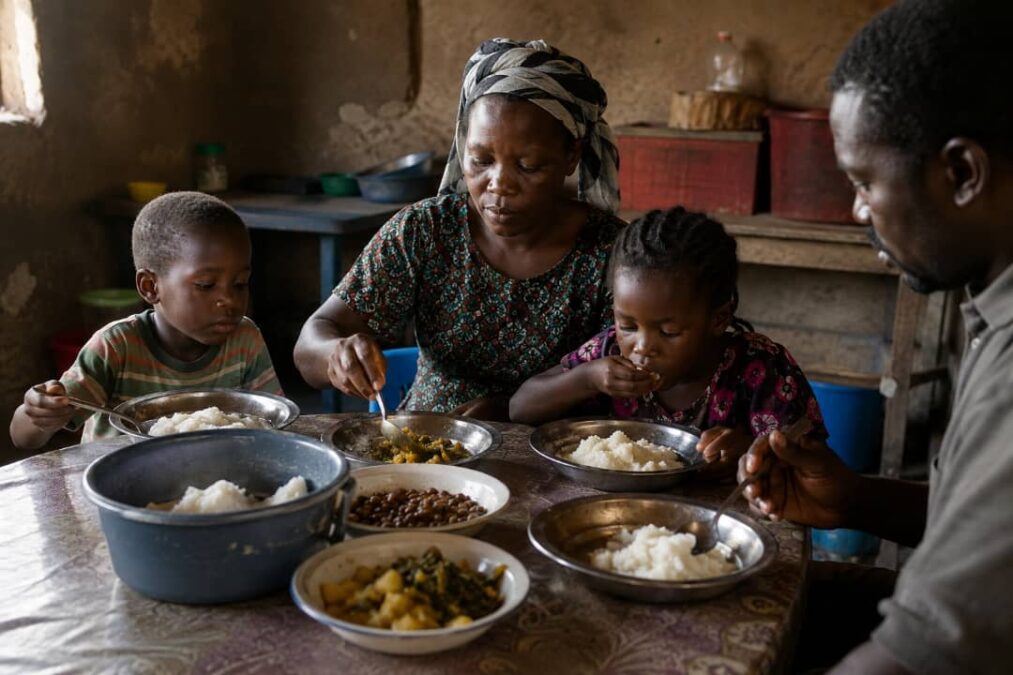
Across Africa, millions of children go to bed with full stomachs but undernourished bodies.
They eat enough cassava, rice, maize, yam or other staple foods to satisfy hunger, yet many remain dangerously short of the vitamins and minerals needed for healthy growth, learning and productivity.
Unlike famine, this crisis is largely invisible. There are no haunting images of empty plates or severely wasted bodies. Instead, there are children who struggle to concentrate in school because they lack iron, pregnant women battling anaemia, and workers whose productivity is reduced because their diets fail to provide the nutrients their bodies require.
Nutrition experts call it hidden hunger, and increasingly, economists say it is becoming one of Africa’s least discussed barriers to economic growth.
According to estimates from the World Health Organization (WHO), the United Nations Children’s Fund (UNICEF), the World Food Programme (WFP) and the Global Nutrition Report, about 1.9 billion people worldwide suffer from micronutrient deficiencies. Sub-Saharan Africa bears the heaviest burden, with West and Central Africa accounting for more than 45 percent of the region’s micronutrient deficiency burden.
The challenge extends beyond health. Poor nutrition affects educational outcomes, weakens labour productivity, increases healthcare costs and slows economic development. A child who is unable to develop cognitively because of chronic iron deficiency today may become a less productive worker tomorrow.
The numbers tell a troubling story.
Regional nutrition data show that anaemia affects 69 percent of children under five in Nigeria, 60 percent in Ghana, 72 percent in Côte d’Ivoire, 77 percent in Burkina Faso, 79 percent in Mali, 72 percent in Niger, 71 percent in Benin, 68 percent in Senegal, 70 percent in Togo, and 59 percent in Cameroon. Across many of these countries, deficiencies in iron, zinc, iodine, vitamin A and folate remain widespread, limiting healthy development during the most critical years of life.
For Margaret Mary Tohouenou, nutritionist at Nestlé’s Research and Development Centre in Abidjan, Côte d’Ivoire, the problem begins with a misunderstanding of what nutrition really means.
“Nutrition is not just about eating until you are full. It is about nourishing the body,” she said during a media engagement at the company’s regional research facility.
She explained that many households across Africa are forced by economic realities to prioritise foods that provide calories at the lowest cost. Rice, maize, cassava and yam become the centre of most meals, while fruits, vegetables, fish, eggs and dairy products, which supply many essential vitamins and minerals, are often consumed less frequently because they are more expensive.
“You may have enough food in your stomach, but still lack the nutrients your body needs to function properly,” she said.
According to Tohouenou, micronutrients such as iron, zinc, iodine, vitamin A, vitamin C, vitamin D and the B vitamins are required only in small quantities, but they perform some of the body’s most critical functions.
Iron helps produce haemoglobin and prevents anaemia. Zinc strengthens immunity, supports growth and aids wound healing. Vitamin A protects eyesight and immune function. Iodine is essential for thyroid function and brain development, while B vitamins help convert food into energy and support the nervous system.
“When these nutrients are missing, the consequences are enormous, particularly for pregnant women and young children,” she said.
She noted that iron deficiency remains one of the region’s biggest concerns because anaemia during pregnancy can affect both mothers and unborn children, increasing health risks and impairing early childhood development.
Recognising the scale of the problem, governments across Africa have increasingly turned to food fortification as a public health intervention. Salt is fortified with iodine, vegetable oils with vitamin A, while wheat flour in many countries is enriched with iron and other micronutrients.
The private sector has also begun investing heavily in nutrition science. Rather than encouraging consumers to completely change their eating habits, food manufacturers are seeking ways to improve the nutritional value of foods people already consume every day.
Nestlé says this strategy has become central to its nutrition programme across Africa.
According to the company, more than 95 percent of its product portfolio in Nigeria is fortified to provide at least 15 percent of the Nutrient Reference Value (NRV) for key vitamins and minerals per serving, while remaining within internationally recognised safety limits.
One of its biggest interventions involves Maggi bouillon cubes, one of the most widely used cooking ingredients in Nigerian kitchens and across West Africa.
Each standard 4-gram Maggi cube contains about 2.1 milligrams of iron and 0.10 milligrams of iodine, nutrients intended to help reduce iron-deficiency anaemia and iodine deficiency disorders among populations that consume the seasoning regularly.
The company has also fortified Golden Morn, its maize and soya breakfast cereal, with iron, vitamin A and calcium. According to Nestlé, every 100 grams contains about 5.9 milligrams of iron, 300 milligrams of calcium and 920 International Units (276 micrograms) of vitamin A, nutrients that support healthy blood formation, stronger bones, improved vision and immune function.
Other products have been designed for specific population groups.
Cerelac infant cereal is fortified with iron, zinc, vitamins A and C, while Milo contains iron, B vitamins and vitamin C to support energy metabolism. More recently, Maggi Soy Chunks, a plant-based protein alternative introduced in Egypt, has been fortified with iron and zinc.
Tohouenou stressed that fortification is not intended to replace healthy diets but to complement them.
“The objective is not simply to provide food that satisfies hunger. We want to provide products that nourish the body and help prevent nutrient deficiencies,” she said.
Behind those fortified foods is a significant scientific infrastructure.
According to Jeroen Muller, head of research and development for Nestlé Sub-Saharan Africa, the company’s research centre in Abidjan is the only regional Nestlé R&D hub dedicated to serving the African continent.
“Our centre here in Abidjan is one of our regional innovation hubs and the only one serving Africa,” Muller said.
He explained that Nestlé operates around 22 research and development centres globally, each serving different functions within the company’s innovation network.
While the central research centre in Switzerland conducts clinical studies, develops food safety technologies and investigates emerging issues such as contaminants and microplastics, the Abidjan facility focuses on adapting scientific discoveries to African realities.
Researchers study local crops, consumer behaviour, nutritional deficiencies and food preferences before developing products for African markets.
The centre also works with cocoa and coffee farmers to improve crop yields and climate resilience while operating pilot production facilities where new food concepts can be tested before commercial launch.
“We work closely with consumers, universities and research institutions to understand local nutritional needs and translate science into products that respond to those realities,” Muller said.
Beyond product development, the centre collaborates with universities across Africa through postgraduate research partnerships, internships and food science programmes aimed at building local scientific capacity.
For Florence Kacou, regulatory and scientific affairs cluster manager for Sub-Saharan Africa, ensuring that nutrition claims are backed by science is equally important.
“Consumers choose products because they trust them. What they often don’t see is the extensive scientific work happening behind the scenes before those products reach supermarket shelves,” she said.
Kacou said every product undergoes rigorous assessments covering food safety, ingredient approvals, nutritional claims, labelling accuracy and compliance with regulations across multiple countries.
Nestlé’s global Regulatory and Scientific Affairs network comprises about 400 scientists and regulatory specialists who work across different markets to ensure innovations remain both scientifically sound and legally compliant.
“Safety and innovation must move forward together,” she said.
She cited the development of standards for recycled plastics used in food packaging as an example of years of scientific collaboration involving regulators, researchers and industry experts before consumers ever saw the final product.
According to Kacou, maintaining public confidence depends on ensuring that every claim appearing on a product label can withstand scientific scrutiny.
“If claims are misleading, consumer trust is lost,” she said.
Nutrition specialists, however, insist that food fortification alone cannot solve Africa’s hidden hunger crisis.
The WHO continues to recommend balanced diets rich in fruits, vegetables, legumes, dairy products and animal proteins alongside food fortification, improved sanitation, disease prevention and regular healthcare.
Experts also argue that reducing poverty remains fundamental because healthier diets often become possible only when household incomes improve.
Food systems must also become more resilient, agriculture more productive and nutrition education more widespread.
For Africa, where nearly one in four people will live by 2050, investments in nutrition are increasingly being viewed as investments in economic competitiveness.
Healthy children are more likely to perform well in school. Healthy adults are more productive in the workplace. Stronger nutrition reduces healthcare costs, strengthens human capital and improves national productivity.
Economists say the continent’s demographic dividend, will depend not only on creating jobs but also on ensuring that the people who fill those jobs are healthy enough to realise their full potential.
That makes hidden hunger more than a health challenge.
It is an economic challenge hiding in plain sight, one that governments, businesses, researchers and development partners must confront together if Africa is to fully unlock the promise of its young and growing population.

Join BusinessDay whatsapp Channel, to stay up to date
Open In Whatsapp