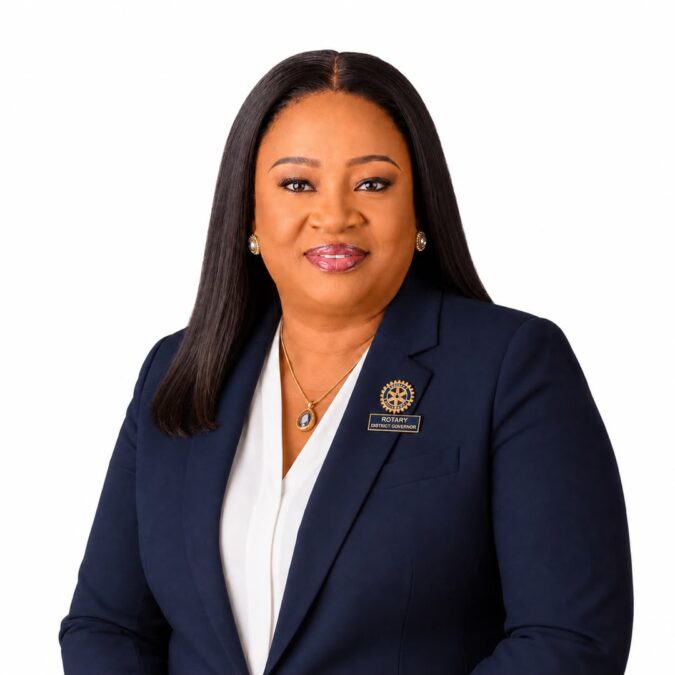
From managing the high-stakes security realities of premium corporate assets to overseeing a vast network of humanitarian clubs across Lagos and Ogun states, Bukola Olabisi Bakare represents the modern face of strategic leadership. Bakare officially assumed office as the District Governor for Rotary District 9111, capping off a remarkable journey of selfless service and strategic leadership. But Bakare is no ordinary diplomat; she is a battle-tested entrepreneur who built a premier domestic security empire from the ground up upon her return from the United States in 2004. Speaking with IFEOMA OKEKE-KORIEOCHA, Bakare opens up about the weight of fulfilled expectations, her global grant strategy for mental health advocacy, and the profound lessons gathered from traveling through 108 countries across six continents.
You returned to Nigeria in 2004 from Miami, Florida, to establish Around ‘D’ Clock Security (ADCS) and pushed it into the Top 10 domestic security service firms within four years. What specific operational frameworks or service-delivery standardizations did you bring from your experience at Gabriel Securities USA that allowed you to break through this executive glass ceiling so rapidly?
When I returned to Nigeria in 2004, I brought with me a strong appreciation for systems, processes, accountability and professionalism. My experience at Gabriel Security and Vanguard Security inc. in Miami exposed me to a very structured way of doing business. There were clear operating procedures, measurable performance standards, continuous training programmes and strong client-service culture.
However, one of the biggest lessons I learned very quickly was that I could not simply copy and paste an American model into Nigeria. The realities were completely different.
In America, many workplace behaviours are reinforced by culture and institutions. In Nigeria, business leaders often have to spend considerable time building workplace discipline, professionalism and accountability. Building systems was important, but building culture was even more important.
One of the challenges many employers face is strengthening workplace culture and long-term professional commitment. People are dealing with significant economic and social pressures, and sometimes that affects workplace behaviour. Staff turnover can be high. Employees may leave unexpectedly. Continuous retraining becomes necessary.
As a result, our focus was not just on security operations but on creating a culture of professionalism. We invested heavily in training, supervision, client reporting, quality assurance and performance monitoring.
I also insisted that ADCS should not be seen as a guard company but as a professional security solutions provider. We focused on client relationships, responsiveness and service excellence.
Looking back, I believe our success came from combining international best practices with a deep understanding of local realities. We built systems, but we also built people.
Over the past two decades, ADCS has scaled across physical, digital and facility security. Given the current economic landscape—with shifting corporate security needs and cost-cutting pressures—how are you adapting your workforce development and technology integration strategies?
The security industry today is very different from what it was twenty years ago. Clients are under increasing pressure to optimise costs while still maintaining high security standards. At the same time, security threats are becoming more sophisticated and technology-driven. Our response has been to focus on both people and technology.
Technology can be purchased. Culture and competence must be developed.
One of the realities of operating in Nigeria is that organisations often need to invest continuously in training and retraining. Technical skills can be taught relatively quickly, but accountability, attention to detail, ownership and professionalism require constant reinforcement.
We have strengthened our workforce development programmes because technology is only as effective as the people managing it.
On the technology side, we are increasingly integrating surveillance systems, access control, remote monitoring, digital reporting platforms and data-driven security solutions.
The future of security is not human versus technology. It is human expertise supported by technology. The organisations that will succeed are those that can combine both effectively.
How does a premium security company maintain bulletproof operational precision when institutional clients are scaling back budgets?
It certainly is not easy.
Many people assume the biggest challenge is maintaining profitability during difficult economic times. In reality, the bigger challenge is maintaining service quality while balancing client expectations, employee welfare and operational realities.
Clients want more value for less money. Employees are dealing with rising living costs. Regulatory requirements continue to evolve. Yet service standards cannot drop. The solution is efficiency rather than compromise.
We continuously review our processes, optimise deployment strategies and invest in technologies that improve productivity without reducing effectiveness.
We also spend a lot of time educating clients. Security is one area where cutting corners can become extremely expensive. A security breach can cost significantly more than the savings achieved from reducing security investments.
Another important factor is trust. Many of our clients have remained with us for years because they understand that we are not simply vendors; we are partners committed to protecting their people, assets and reputation.
Your investiture as District Governor for Rotary District 9111 fulfills a remarkable 2015 prophetic declaration by the late Rotary International President, Jonathan Babatunde Majiyagbe—the first African to hold that office. Looking back at that exact moment, did you see it as a distant honorary nod, or did you immediately begin mapping out a long-term strategic timeline toward the district governorship?
To be honest, I did not immediately begin planning a path to the district governorship. When the late Jonathan Babatunde Majiyagbe made that statement, I received it with gratitude and respect, but I saw it more as encouragement than a prediction.
At that stage of my life, I was focused on serving Rotary, building my business and supporting my family. What happened over the years was not the pursuit of a title. It was the pursuit of service.
I accepted assignments, took on responsibilities and continued learning from exceptional Rotary leaders. Looking back now, I can see that every experience was preparing me for greater responsibility.
Jonathan Majiyagbe was a remarkable leader with an extraordinary ability to identify potential in people. Perhaps he saw something in me that I had not yet fully recognised in myself. Today, I feel humbled that his words became reality, but more importantly, I feel grateful for the opportunity to serve.
What are your specific plans to leverage this global spotlight to attract significant international grants and cross-border project collaborations directly to District 9111?
One of the greatest strengths of Rotary is its global network. As District Governor, I intend to leverage relationships across Rotary districts worldwide to attract not only funding but also expertise, partnerships and long-term collaboration.
Our flagship project, the 60-bed Rotary Wellness Centre for Mental Health at the Federal Neuropsychiatric Hospital, Yaba, is already attracting international attention and support. We have engaged Rotary partners from different parts of the world because mental health is a global issue that requires collaborative solutions.
We are also exploring opportunities for additional Global Grants in healthcare, education, economic empowerment and disability inclusion.
The reality is that international partnerships are built on credibility and relationships. Fortunately, Rotary provides both.
My goal is to position District 9111 as a district known for innovation, accountability and impactful projects. When partners see results, they are more willing to invest and collaborate.
I want District 9111 to become a destination for meaningful Rotary partnerships globally.
You have built relationships with financial institutions, corporate organisations and development partners that have translated into significant support for community-impact initiatives. What is your strategy for securing and sustaining these partnerships, and what lessons can other NGOs learn about corporate relationship management?
One of the first things I learned many years ago is that people do not invest in projects; they invest in confidence, credibility and relationships.
Many organisations approach corporate institutions with a funding request. I approach them with a partnership opportunity.
There is a significant difference between the two.
When I sit across the table from the leadership of a financial institution, corporate organisation or development partner, I am not simply asking for support. I am presenting a shared opportunity to solve a problem, create impact and leave a lasting legacy.
Corporate organisations are under increasing pressure to demonstrate measurable social impact. They want to know that their resources are being deployed responsibly, efficiently and transparently. They want evidence that the project will create meaningful outcomes and not simply become another cheque-writing exercise.
Over the years, I have found that credibility is one of the most valuable currencies in partnership building. Organisations are more willing to support initiatives when they trust the people leading them. Trust is built through consistency, transparency, accountability and delivering on promises.
Another important lesson is that partnerships should never be transactional. Too often, organisations approach corporate institutions only when they need funding. Sustainable relationships require continuous engagement. You must keep partners informed, share successes, acknowledge their contributions and demonstrate the impact of their investment.
I also believe strongly in aligning interests. Before approaching any organisation, I take time to understand its priorities, values and areas of focus. The most successful partnerships occur when there is a natural alignment between what the organisation cares about and the impact you are trying to create.
Perhaps the most important lesson for NGOs is this: stop viewing corporate organisations as donors and start viewing them as strategic partners.
When people feel they are part of a meaningful mission rather than simply writing a cheque, they become more invested in the success of the project.
Long-term partnerships are built on trust, mutual respect, transparency and measurable impact. Those principles have served me well throughout my business career and my Rotary journey.
As you transition from managing a club to overseeing the vast network of clubs across District 9111, how do you plan to scale up fundraising strategies to meet your target goals for The Rotary Foundation?
Fundraising at the district level requires both strategy and education. One of the challenges we face is that many people see fundraising as asking for money. I see it differently. Fundraising is about inspiring people to invest in impact.
The Rotary Foundation has transformed lives across the world. It has funded hospitals, educational initiatives, water projects, disease prevention programmes and countless humanitarian efforts.
When people understand that every dollar donated can eventually return to communities in the form of life-changing projects, giving becomes much easier.
We are also broadening participation. While major donors are important, I want every Rotarian in District 9111 to feel that they have a role to play regardless of the size of their contribution. We are approaching fundraising the same way we approach service—through inclusion, engagement and ownership.
We are also engaging corporate partners, friends of Rotary and philanthropic individuals who share our commitment to service. Most importantly, we are leading by example. People are more likely to support a cause when they see leaders investing their own time, resources and energy into it.
Your travels have taken you across six continents and 108 countries, exposing you to diverse global leadership, security and humanitarian models. When you return to the realities of local governance, emergency response and community development within Lagos and Ogun states, what is the most critical lesson from your international travels that directly shapes your agenda for District 9111 over the next twelve months?
Without question, the most important lesson is that sustainable development happens when communities take ownership of solutions. Across the world, I have visited countries with different cultures, economic realities and political systems. Yet the most successful projects always have one thing in common: the people affected by the problem are actively involved in the solution.
I have learned that meaningful change is rarely about money alone. It is about leadership, collaboration, accountability and community ownership. Another lesson is that no organisation succeeds in isolation. Governments, businesses, NGOs and communities must work together.
That philosophy is shaping my agenda for District 9111. Whether it is our Mental Health Wellness Centre, Mega Medical Mission, Mission for Vision, Ability Without Limits Initiative, Teacher Training Programme or Economic Empowerment Programme, collaboration will be central to our approach. My travels have also reinforced something very important: many of the solutions we seek already exist somewhere in the world. We do not always have to reinvent the wheel. Sometimes we simply need to adapt proven ideas to local realities.
Over the next twelve months, my focus will be on bringing together Rotary, government, businesses, development partners and communities to create sustainable solutions that continue delivering value long after the projects have been completed.
That, to me, is what creating lasting impact truly means.

Join BusinessDay whatsapp Channel, to stay up to date
Open In Whatsapp