No fewer than 1,500 students in Rivers State public schools have received Science, Technology, Engineering, Arts and Mathematics (STEAM) training under a partnership between the state and Oando Foundation to expand access to quality science and technology education.
Rivers State government pledged to sustain and expand collaboration with relevant stakeholders to achieve universal access to basic education and improve the quality of learning for school-age children in the state, following a 30-school pilot programme, tagged the ‘School STEAM Project,’ funded by Oando Foundation.
Samuel Ogeh, executive chairman of the Rivers State Universal Basic Education Board (RSUBEB), speaking at the close-out ceremony held recently in Port Harcourt, assured that the board will integrate the project’s initiatives into the state’s teaching and learning processes.
Ogeh commended Oando Foundation for funding and organising the School STEAM Project.
“RSUBEB will consider the quality of learning and teaching established by the project as a standard for basic education in the state,” he said.
However, he emphasised the importance of sustaining the initiative and urged Oando Foundation to keep the School STEAM Project running beyond the ‘close-out’ ceremony.
“When I saw the word ‘close-out’, it sounded like an ending. We must not allow this project to end with a ceremony.
“We will integrate your team into our teaching and learning process and take extra steps to protect the infrastructure you have put in place,” he assured.
The board chairman applauded Oando Foundation’s focus on early childhood and practical learning methods. He urged parents, volunteer teachers, and other stakeholders to join efforts to sustain and expand the initiative.
Tonia Uduimoh, head of Oando Foundation, explained that the project was created to improve access to basic education and strengthen learning quality for pupils already in school, especially in public schools where gaps still exist.
“We have desired to see children of the so-called less privileged, the underserved, children who may not have access to interventions such as this, be able to compete favourably with their peers,” she said,
Uduimoh further said, “Nigeria has the highest number of out-of-school children globally.
“The core of our work is simple: provide access for children who do not have access to basic education, and more importantly, improve the quality of learning for those who are in school.”
Besides, she said that the foundation’s mission is to complement government efforts, not replace them, by helping to bridge the learning gap, and emphasised that the initiative started as a primary-school pilot but has already shown strong results.
Moreover, Uduimoh applauded the staff and volunteers, who, she said, served as mentors across the schools as they played major roles in translating the project’s ideas into practical classroom learning.
Solomon Ikanada-Agba, Oando Plc’s general manager, base & district, represented by Boniface Nwachukwu, the operations divisional manager, disclosed that the programme was designed to encourage children to develop an interest in learning and to prepare them for future leadership roles in Nigeria.
He commended Oando Foundation and its parent company, Oando Plc, for supporting the pilot project aimed at deepening children’s learning, emphasising that the foundation’s efforts were especially meaningful given the current state of public education in the country.
“We at Oando Plc will continue to do our best to support the foundation. What the foundation has done is very good. This is just a pilot project, so it means that in the future the foundation is going to do more,” he said.
Nimi Davies, a director at RSUBEB, said, “Our teachers and learners were guided through practical experiences in problem identification and solving, design thinking, creativity and innovation.
“This journey commenced with an intensive capacity-building training held between November 4 and 11, 2025. 300 teachers from 30 pilot schools were equipped with modern pedagogical skills in science, technology, engineering, arts and mathematics.”
In addition, she said, “The training laid a solid foundation for what has become a highly impactful initiative. The next phase began on 16 February 2026 with a mentorship programme themed ‘Oando Design Thinking’.
Jadesola Adedeji, co-founder of STEM METS, the implementing partner of the School STEAM Project, said the initiative involved training 300 teachers and 1,500 students across 30 schools, with 50 students selected from each school.
She said that after the training, the pupils had only five weeks to identify a problem in their environment and return with a solution.
Adedeji said the children performed well and demonstrated significant talent, noting that 30 projects were submitted and selection was difficult because of the quality of work presented.
Adedeji revealed that the organisation has spent the last 12 years running STEM-focused programmes that have reached over 50,000 children and over 2,000 teachers.
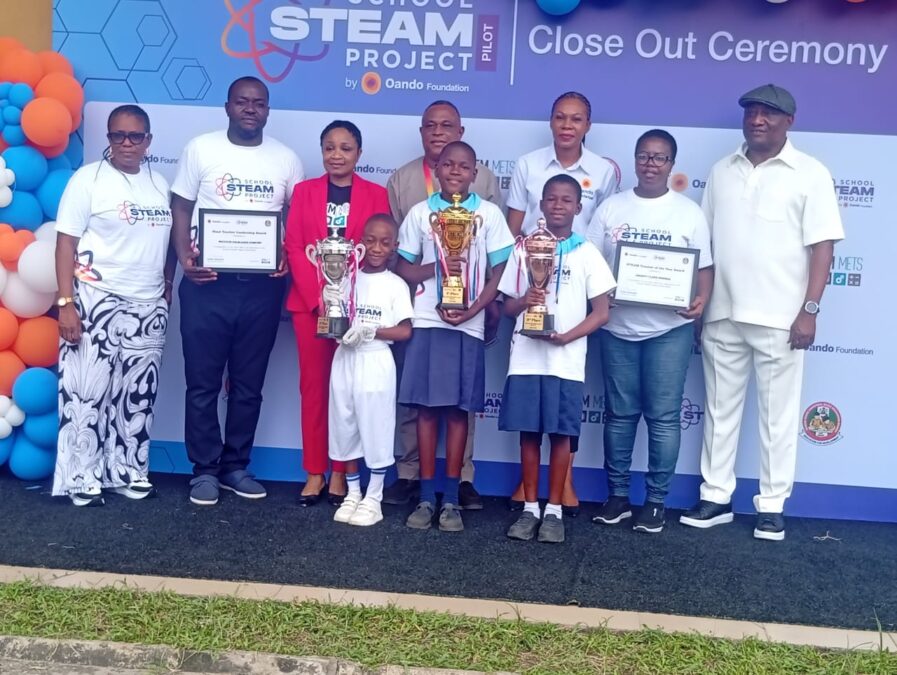
Clara Obianyi, winner of the STEAM Teacher of the Year Award, from State Primary School 1, Olanada, and Maxson Edmond, winner of the Head Teacher Leaders Award from State Primary School (UBE) Elekahia, thanked Oando Foundation for the opportunity.
“For us, it has been a journey of inspiration, commitment and dedication. The project has transformed their approach to learning and teaching.
“It has already started impacting our approach to teaching. The training changed our mindset and the way we lead the learners,” they said.
The five schools that made the finals were State Primary School (UBE) Elekahia, project on biogas and digester; State Primary School, Rumuokwurusi, sustainable playground; State Primary School, Rumueme, table fan and lemon-powered bulb; State School (UBE) Choba, water dispenser and hydro-generator; and All Saints’ Model Primary School, Rumuokwurusi, Smart Bin (the odour eliminator).
State Primary School, Rumueme, got N2.5 million for emerging top with 178 points; State Primary School (UBE) Elekahia got N2 million as second place with 173 points; and State Primary School, Rumuokwurusi, received N1.5 million for third position with 157 points.

Join BusinessDay whatsapp Channel, to stay up to date
Open In Whatsapp