
When Sundry Markets Limited opened its first Marketsquare store in Yenagoa in 2015, the ambition did not immediately announce itself in grand terms. At the time, Nigeria’s organised retail sector was still consolidating, and expansion beyond major commercial hubs was widely considered a high-risk undertaking.
Ten years later, that single store has evolved into a 41-store national network spanning 19 cities across 15 states, serving more than two million customers monthly and partnering with over 900 suppliers across Nigeria. The company now stands as the country’s largest indigenous grocery retail chain.
But behind the scale lies a more instructive story: one of deliberate strategy, operational discipline and adaptation to one of the most complex business environments in Africa.
At the company’s 10th anniversary celebrations themed “10 Years Strong – Powered by People, Driven by Purpose,” founder and Chief Executive Officer, Ebele Enunwa framed the journey as one defined less by speed and more by resilience.
“Ten years ago, Sundry Markets was only a dream. Today, Marketsquare has become a household name across Nigeria,” he said.
A strategy built outside convention
From the outset, Marketsquare’s growth strategy diverged from traditional retail expansion models in Nigeria.
Instead of concentrating early operations in Lagos or Abuja, the company chose Yenagoa as its starting point, a decision that initially drew industry scepticism.
For Enunwa, however, the decision reflected a deeper strategic logic. “Many asked, ‘Why Yenagoa?’ My answer was simple: why not? Every community deserves access to quality living,” he said.
That philosophy would later define the company’s expansion approach: identifying underserved markets and building structured retail presence where organised retail infrastructure was limited.
Industry analysts often describe this as “demand-first expansion”, entering markets based on consumption need rather than prestige location.
Scaling in phases, not leaps
Marketsquare’s expansion has followed a phased growth pattern that prioritised operational stability – 2015: 1 store; 2020: 15 stores; 2026: 41 stores
Rather than pursuing aggressive rapid scaling, the company focused on strengthening systems before expanding footprint. This approach, according to executives, allowed the business to maintain consistency in store operations, product availability, and customer experience across locations.
Today, Marketsquare operates across more than 50,000 square metres of retail space and serves over two million customers monthly.
Operating in a volatile macroeconomic environment
Nigeria’s retail sector has faced sustained pressure over the past decade, including inflationary cycles, foreign exchange instability, infrastructure gaps and shifting consumer behaviour.
Marketsquare’s leadership describes this environment not as a constraint, but as a constant variable requiring continuous adaptation. “In the early days, power supply could not sustain our systems. But we learned, we adapted, and we grew,” Enunwa recalled.
Read Also: Marketsquare at 10: How a homegrown retail giant built a nationwide footprint from adversity
This operational reality shaped the company’s internal structure, forcing investments in backup systems, logistics optimisation and supply chain flexibility.
In retail, where margins are often thin and efficiency is critical, such adaptability has become a competitive advantage.
Supply chain as a growth engine
One of the less visible but most important elements of Marketsquare’s strategy is its supplier ecosystem.
The company currently works with over 900 suppliers across Nigeria, ranging from FMCG manufacturers to agro-processors and distribution partners. This network has expanded in parallel with store growth, creating a multiplier effect across the value chain.
For many suppliers, Marketsquare has provided consistent market access at scale, an important factor in a country where distribution remains fragmented. In effect, the company has become not just a retailer but a distribution platform connecting producers to consumers across multiple regions.
Jobs, scale and economic footprint
Marketsquare’s expansion has also translated into significant employment creation.
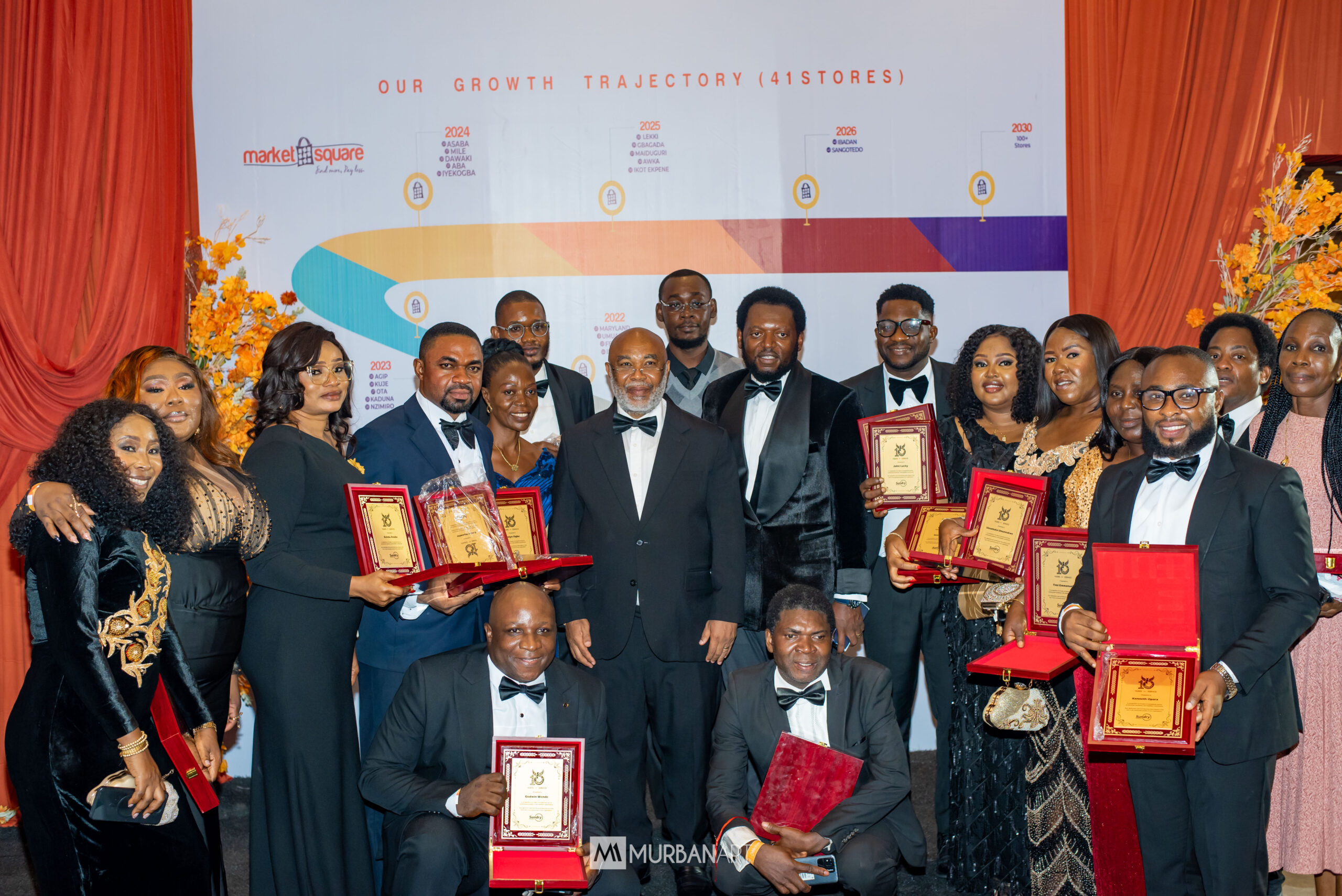
The company currently employs more than 4,000 people directly across its retail network, with thousands more indirectly engaged through supply chain and logistics operations. “From a handful of employees to thousands, Marketsquare has served millions, created jobs, and raised the bar for grocery retail in Nigeria,” Enunwa said.
Charles Odita, chairman of the Board, reinforced this point, noting that the company’s contribution extends beyond commercial performance. “Our contribution goes beyond retail. We have strengthened local economies, empowered businesses, and created opportunities that improve lives across the communities we serve,” he said.
Standardisation as competitive advantage
As Marketsquare expanded, one of its core strategic challenges was maintaining consistency across locations.
Retail businesses often struggle with variability in customer experience as they scale. Marketsquare addressed this through standardised store formats, operational processes, and customer service frameworks.
The result is a recognisable brand experience regardless of geography. This consistency has been central to building customer trust and brand loyalty, particularly in emerging retail markets.
Recognition and institutional credibility
Marketsquare’s growth has also attracted external validation, including recognition by the Financial Times as one of Africa’s fastest-growing companies. “This recognition affirms the strength of our vision and the discipline of our execution,” Odita said.
For stakeholders, such recognition reinforces the company’s position as a credible indigenous retail institution operating at scale.
Vision 2030: The next phase of growth
Looking ahead, Marketsquare has outlined an ambitious Vision 2030 strategy anchored on five pillars: expansion into underserved communities, digital transformation and AI-driven retail systems, customer experience enhancement, leadership and talent development, sustainability and renewable energy adoption.
The strategy reflects broader global shifts in retail, where technology, data and sustainability are becoming central to competitiveness. “We are building technology-driven solutions that will redefine convenience and create experiences beyond imagination,” Enunwa said.

From expansion to institution-building
Marketsquare’s first decade has been about proving that large-scale indigenous retail is possible in Nigeria.
The next phase, according to its leadership, is about consolidation, transitioning from rapid expansion to long-term institution-building.
In a sector often characterised by volatility and short-lived growth cycles, Marketsquare’s sustained trajectory positions it as a case study in disciplined scaling.
As the company moves into its second decade, the central question is no longer whether it can grow. It is how far that growth can go and how deeply it can reshape Nigeria’s retail economy.

Join BusinessDay whatsapp Channel, to stay up to date
Open In Whatsapp