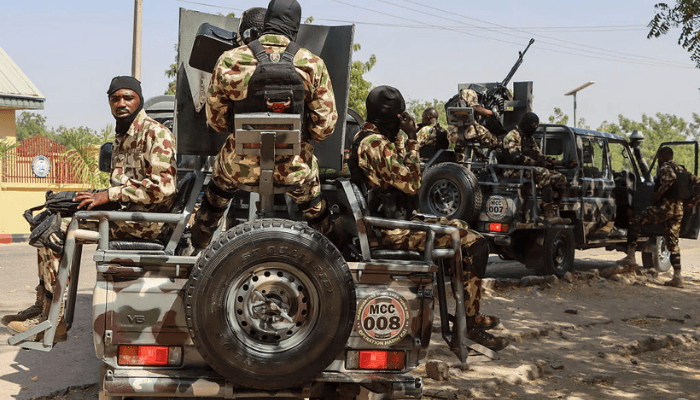
The United States has withdrawn most of the military personnel it deployed to Nigeria for a joint counterterrorism operation in the Lake Chad Basin.
However, Washington says it will continue supporting Nigeria through intelligence sharing and other security cooperation to sustain the fight against terrorism.
Dagvin Anderson, Commander of U.S. Air Forces in Europe-Air Forces Africa, disclosed this during a virtual press briefing on the outcome of the African Chiefs of Defence Conference 2026.
Anderson said although the specific military operation had concluded and the bulk of the U.S. troops assigned to it had departed Nigeria, the United States remained committed to assisting the country with intelligence collaboration at the request of the Nigerian government.
He noted that the Lake Chad Basin operation not only strengthened security within the immediate region but also disrupted the global network of the Islamic State (ISIS/Daesh).
According to him, the U.S. has transitioned from direct military involvement to a partnership model focused on intelligence support, enabling Nigerian security forces to continue prosecuting complex counterterrorism operations.
Read also: Africa’s defence outlook through 2027: Preparing for a new security era
“And so that operation in the Lake Chad Basin of Nigeria not only helped the countries in that immediate region; it also helps countries globally as that disrupts the ISIS network.
“And then we have withdrawn much of our forces that were just there for that operation, but are continuing the partnership that Nigeria has asked for to help continue with the intelligence sharing and the understanding that’s necessary to be able to prosecute these difficult tasks,” Anderson said.
The U.S. Air Force commander described Nigeria as a strategic and capable security partner with a strong military, vibrant economy and well-educated population, adding that the collaboration between both countries had produced significant gains in the fight against terrorism.
He revealed that intelligence cooperation between the United States and Nigeria played a decisive role in a joint operation that eliminated Abu-Bilal Al-Minuki, the second-in-command of the global ISIS network.
According to Anderson, the operation combined U.S. intelligence capabilities with Nigerian military expertise to target one of the terrorist group’s most influential leaders, who was responsible for its global operations, media activities and recruitment network.
“I think the partnership that we have shown recently with Nigeria, where Nigeria’s a very capable and large country, it’s got a strong economy; it’s got a large, educated population; it’s got a very capable military.
“But there are things that we have learned in the counterterrorist fight over several years that we were able to assist and integrate with them to help them with their intelligence and help with the intelligence sharing that eventually led to a cooperative effort to where we were able to bring some unique capabilities that the U.S. brings and be able to prosecute together the number two leader within the ISIS or Daesh organization who is responsible for much of their global operations, their global media, and their recruiting,” he stated.
Anderson said the operation demonstrated the effectiveness of intelligence-driven partnerships over prolonged foreign troop deployments, stressing that future U.S. engagement in Africa would focus on providing specialised capabilities that enhance the operational effectiveness of partner nations.
Read also: Insecurity: Northern Nigeria faces worst hunger crisis in nearly a decade – UN
He also called for stronger intelligence sharing among African countries to combat terrorism, drug trafficking and other transnational crimes.
Anderson disclosed that coordinated intelligence among the United States, African partners and European allies led to the interception of a record 31-ton shipment of cocaine originating from South America and transiting through the West African coast.
According to him, information shared through the U.S. interagency system and the U.S. Africa Command (AFRICOM) enabled partner nations to act swiftly, with a Spanish naval vessel eventually intercepting the shipment in what he described as the largest maritime drug seizure on record.
“I was able to coordinate through our interagency in the United States, through AFRICOM, and then notify some of the partners.
“And eventually it was a Spanish ship that interdicted the ship that had 31 tons of cocaine on it, and it turns out is the largest interdiction of drugs at sea that we’ve ever seen,” he said.
He maintained that sustained collaboration among African governments, international allies and the private sector remains essential for tackling security threats while creating an environment that supports economic growth and investment across the continent.
The withdrawal follows the deployment of about 200 U.S. military personnel to Nigeria in February 2026 to support intelligence, surveillance and counterterrorism operations in the Lake Chad Basin amid deepening security cooperation between Abuja and Washington against ISIS and other terrorist groups.
The deployment came after Donald Trump, U.S. President redesignated Nigeria as a Country of Particular Concern and pledged stronger American support for counterterrorism efforts in the country.
The security partnership had earlier seen the U.S. conduct airstrikes on two terrorist enclaves in the Bauni Forest of Tangaza Local Government Area, Sokoto State, on December 25, 2025.

Join BusinessDay whatsapp Channel, to stay up to date
Open In Whatsapp