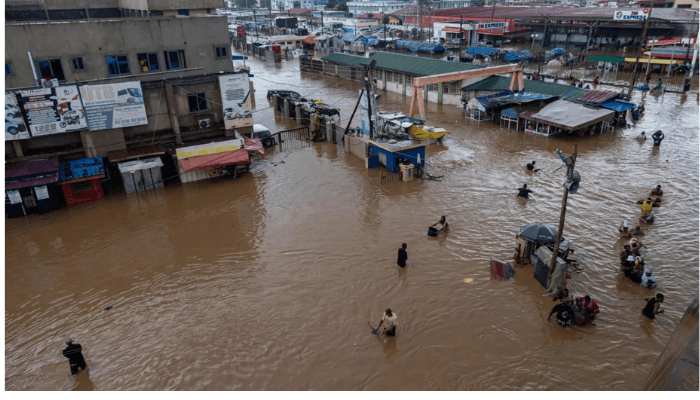
At least 13 people have died after torrential rain triggered severe flooding across Ghana’s capital, Accra, leaving homes submerged, roads cut off and hundreds of residents rescued as authorities warned that more heavy rain could worsen the crisis.
Emergency teams from the fire service, police, military and the National Disaster Management Organisation have been deployed across the city to rescue stranded residents and assess the damage. Officials say the death toll could still rise as recovery operations continue.
The Ghana National Fire Service said it had rescued more than 470 people after large parts of the city were inundated following Sunday’s intense downpour. Low lying communities were among the worst affected, with floodwaters swallowing homes, vehicles and businesses.
The government urged residents to remain indoors if they were in safe locations or move immediately to higher ground if floodwaters threatened their homes.
“Stay indoors if you are in a safe location,” the president’s office said in a statement.
“Do not attempt to cross flooded roads, whether on foot or in a vehicle. If your home is being inundated, move immediately to higher ground and call 112 for emergency assistance.”
Read also: Ghana guaranteed $13.5m windfall after world cup round of 32 qualification
The Ghana Meteorological Agency warned that another storm approaching from the east could bring fresh rainfall across southern Ghana, including Accra, on Tuesday, increasing the risk of further flooding.
The agency advised residents to avoid sheltering under trees, stay away from exposed electrical wires and never attempt to walk or drive through floodwaters.
President John Mahama said preliminary figures showed about 140 millimetres of rain fell over Accra during the storm, more than double the highest single day rainfall recorded in the city last year.
Read also: Ghana posts Africa’s weakest business activity despite record low inflation
“By comparison, the highest single day rainfall recorded last year was about 56 millimetres,” Mahama wrote on X, adding that the unusually intense rainfall reflected the growing impact of climate change.
The flooding also sparked a major fire at a rubber factory, while electricity was cut to several affected communities as a safety precaution.
The Ghana Grid Company Limited and the Electricity Company of Ghana said power was temporarily switched off in flood hit areas because water had affected several substations, creating serious risks to equipment and emergency workers.
Many residents described losing valuable belongings as floodwaters swept through their homes.
“My 1970s collection of vinyl records is now underwater,” resident Philip Mensah told AFP.
Schoolteacher Patience Naa Adjeley Adjei said she spent hours trying to stop water from entering her room.
“I have mopped my room more than eight times,” she said. “I can’t even step out because my room is flooded, and outside is flooded.”
Markets and businesses across parts of the capital remained closed on Monday as authorities prepared for another round of heavy rain.
Flooding has long been a recurring problem in Accra, where blocked drainage systems, rapid urban growth and illegal construction on waterways have increased the city’s vulnerability during the rainy season.
After inspecting affected areas from the air, Mahama ordered the demolition of illegal structures built on waterways.
“The irresponsible actions of a few individuals end up putting entire communities at risk,” the president said.
The disaster has revived painful memories of the devastating floods in 2015, when floodwaters triggered an explosion at a fuel station that killed about 150 people.
Environmental groups say the latest disaster highlights the need for stronger planning as climate change increases the frequency of extreme weather events.
“What we are witnessing in Accra is not an isolated weather event, but part of a pattern intensified by climate change and rapid, unplanned urbanisation,” said Ewurabena Yanyi Akofur, Ghana director of WaterAid.
She called for stronger urban planning and improved disaster preparedness to better protect communities before, during and after extreme weather events.

Join BusinessDay whatsapp Channel, to stay up to date
Open In Whatsapp