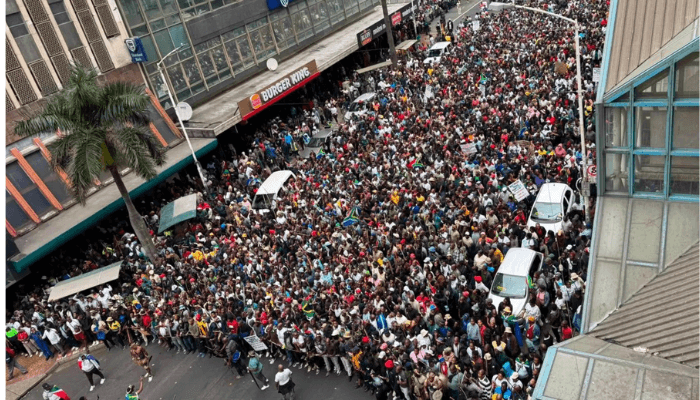
Thousands of people marched across South Africa on Tuesday, demanding that undocumented migrants leave the country, as police and private security officers maintained a heavy presence in major cities to prevent violence.
The coordinated demonstrations, organised by anti migrant groups, followed a self-imposed deadline for undocumented migrants to leave South Africa. While most protests remained peaceful, authorities reported isolated incidents of looting, intimidation, and assaults in some areas.
Read also: African Union pressures South Africa to arrest and prosecute anti immigrant trouble makers
According to the BBC, many foreign nationals have already fled the country in recent weeks to escape intimidation and possible attacks. South African police said about 25,000 undocumented migrants have been repatriated so far, most of them from other African countries.
In Johannesburg, one of the main centres of the demonstrations, the usually busy city centre was noticeably quiet as many businesses remained closed and police patrolled key streets. Some protesters threw bricks, smashing windows in Yeoville, a suburb with a large migrant population.
Police said five people were arrested for allegedly looting a foreign-owned shop in Soweto. In KwaZulu-Natal province, about 10 more people were arrested for looting, while another woman was detained for allegedly assaulting a police officer and a man was arrested on intimidation charges after reports that a foreign national had been assaulted.
Read also: South African President Ramaphosa meets leaders of anti immigrant protest to warn against violence
Cyril Ramaphosa, president of South Africa, met protest leaders on the eve of the demonstrations in an effort to reduce tensions. While acknowledging growing public concern over immigration, he urged demonstrators to respect the law.
“Some foreign nationals who live in South Africa are here lawfully,” Ramaphosa said in his weekly newsletter, according to the BBC.
“They work, study, raise families, invest in our economy and contribute positively to our society. They too are entitled to the protection of our laws and our Constitution.”
He added: “The right to protest and freedom of expression does not allow people to threaten or intimidate others, or to engage in acts of vandalism or violence.”
Official figures show South Africa is home to more than three million documented foreign nationals, although the number of undocumented migrants is unknown and remains a major source of political tension. Police said around 50,000 undocumented migrants have been arrested since January.
Many protesters insisted their campaign was aimed at enforcing immigration laws rather than targeting foreigners.
Read also: 269 more Nigerians evacuated from South Africa as FG steps up repatriation efforts
A Soweto resident told the BBC the protesters simply wanted migrants “to comply” with South Africa’s laws, adding that the large police deployment would likely prevent violence.
Another protester from the anti migrant group Operation Dudula warned that demonstrators would “push the police to do their job” if undocumented migrants did not leave the country.
The demonstrations have deepened fears among migrant communities, many of whom came to South Africa after the end of apartheid in 1994 in search of better economic opportunities. With unemployment remaining above 30 percent, anti migrant sentiment has grown steadily in recent years.
Nigeria evacuated 269 of its citizens on the eve of the protests, bringing the total number flown home to around 600, with more evacuations expected. Ghana, Malawi, Mozambique and Zimbabwe have also been repatriating their nationals by air and road.
According to the BBC, thousands of migrants have spent weeks in temporary transit camps while waiting to be processed because they feared for their safety.
In Durban, one of the cities that witnessed the largest demonstrations, temporary camps housing mainly Malawian migrants were being dismantled as authorities accelerated repatriation efforts. Malawian media reported that about 7,000 of the country’s citizens had already returned home.
Nelson Mbewe, a Malawian migrant preparing to leave, said he had travelled to South Africa to find work and support his family.
“But we’ve faced challenges. They’re saying we should go back home because we do not have the right documents,” he told the BBC.
“They say we are ‘makwerekwere’,” he added, referring to a derogatory term used against African migrants.
“It’s their country, so what can we do? That’s why we have accepted that we just have to go back home.”
Another Malawian, Hassan Phiri, appealed for unity despite the tensions.
“All I want to say to South Africans is that we are all one. No matter what is happening, no matter what will happen, Africa must remain Africa,” he told the BBC.
“Africa can’t be Africa without South Africa, without Malawi, without anywhere. So whatever will happen, we must love each other and stick together as Africa.”
Police had warned organisers that traditional weapons such as shields, sticks and whips would not be permitted during the marches, although officers reportedly allowed many protesters to carry them while confiscating at least one machete in Durban.
Xenophobia has remained a persistent challenge in South Africa for years. According to the African Centre for Migration and Society’s Xenowatch tracker, two people have been killed in xenophobic violence this year. In 2008, more than 60 people died during one of the country’s deadliest waves of attacks against foreign nationals.

Join BusinessDay whatsapp Channel, to stay up to date
Open In Whatsapp