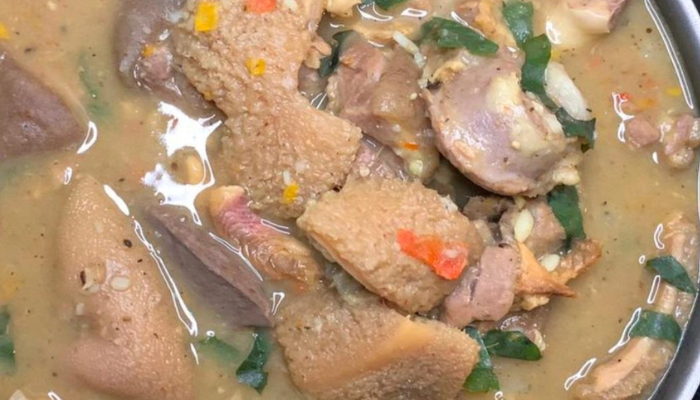
Afia Efere is similar to the Igbo soup ‘Ofe Nsala’ except that fewer ingredients are used, and this one does not contain uyayak (a local seasoning).
This Southern Nigerian culinary tradition is a rich, aromatic, and spicy traditional delicacy native to the Efik and Ibibio people of Cross River and Akwa Ibom states.
The unmistakable aroma of the soup usually, would announce itself long before the meal gets to the table.
When preparing the soup across the villages, the aroma would always slip quietly through kitchen windows, drifts across family compounds and settles into ‘foodicious’ conversations.
Joy Ikpe, a 100 level Mass Communication student of the University of Lagos who suggested this African cuisuine was super delighted talking this famous White Soup.
The Ibibio and Annang people of Akwa Ibom State say the soup represents a living expression of history, identity, hospitality and indigenous knowledge that has endured for centuries.
This is a time when the world is increasingly recognising the importance of safeguarding cultural traditions through UNESCO’s representative List of the Intangible Cultural Heritage of Humanity and Afia Efere deserves to be part of this global conversation.
Read also: Editan soup: Bitter treasure for UNESCO’S ICH list
Across Akwa Ibom State, from Uyo to Ikot Ekpene, Abak, Etinan, Oron and countless rural communities, Afia Efere remains one of the most treasured culinary symbols of the people.
The soup has however travelled from Nigeria to Africa and other continents as the lovers of this delight and foodies settle down through migration.
Little wonder why all the ingredients that make for the preparation of the soup are readily available across the African stores and food equally available across some African restaurants in other climes.
For many Akwa Ibom indigenes living outside their homeland, the first spoonful of Afia Efere evokes memories that no photograph or souvenir can capture. It recalls childhood afternoons spent watching mothers and grandmothers stir large cooking pots over firewood, family celebrations where laughter echoed through crowded compounds, and festive occasions when guests were welcomed with generous servings of the cherished soup.
For many in diaspora, preparing or eating Afia Efere is an emotional journey back home, reconnecting them with their roots regardless of where life has taken them.
The name which literally means “White Soup” in the Ibibio language, is a reflection of its creamy appearance, which is achieved without the use of palm oil.
Instead, the soup derives its distinctive colour and flavour from carefully selected local ingredients, including fresh goat meat, fish, stockfish, smoked fish, crayfish, and other optional seafood as well as onions
It is pertinent to note that indigenous spices and cocoyam or pounded yam are commonly used as a natural thickener.
Unlike many modern recipes that exist in cookbooks or online tutorials, the finest versions of Afia Efere live almost entirely in memory.
Despite the civilisation and modern ways of cooking, the unique ‘Africanness’ as well as the knowledge of preparing the soup has been handed down orally from one generation to the next as most mothers teach daughters, while grandmothers patiently guide granddaughters through careful precision and supervision.
Measurements are rarely written down. Rather, they are learned through observation, practice and intuition.
Young cooks discover when the meat has reached the perfect tenderness, how much cocoyam produces the ideal consistency, and the precise moment when the spices release their rich aroma.
This unique method of transmitting knowledge is one of the defining characteristics of intangible cultural heritage.
Preparing Afia Efere is itself a cultural performance because, in many Akwa Ibom homes, cooking the soup becomes a communal activity that brings generations together.
One person cleans the fish while another prepares the goat meat, someone else pounds the yam, another grinds crayfish, while children run errands and elders supervise every stage of the process.
Somehow, away from these ordinary kitchen activities lies something much deeper, which is the interaction, conversation, relationship, exchange of stories, family ties, family histories and unforgettable moments of unity, community and togetherness.
Through these village culinary activities, impact and influence become the order of the day as children learn the importance of patience, cooperation, respect for elders and the cultural expectation that every visitor deserves warmth and generous hospitality.
The kitchen becomes more than a place for preparing food; it becomes a classroom where identity is quietly passed from one generation to another.
This explains why Afia Efere occupies a prominent place in the family, the communities and especially during weddings, traditional marriage ceremonies, naming ceremonies, festivals, thanksgiving services, family reunions and other significant occasions.
Serving the soup to guests is regarded as a mark of true hospitality, honour and respect.
Within Ibibio and Annang culture, hospitality is not merely a social courtesy but a deeply cherished value.
A steaming bowl of Afia Efere communicates acceptance, appreciation and belonging in ways words often cannot. It assures every guest that they are welcomed into the family and community.
Beyond its cultural significance, Afia Efere is also a remarkable example of indigenous nutritional wisdom. Long before conversations about balanced diets, organic foods and sustainable eating became global priorities, communities in Akwa Ibom had already developed culinary traditions that relied on fresh, locally sourced ingredients rich in essential nutrients.
Fresh fish provides high quality protein and omega-3 fatty acids that support brain and heart health. The goat meat offers lean protein, iron, zinc and vitamin B12, which are essential for healthy muscles, blood formation and immunity.
The crayfish contributes calcium and phosphorus that strengthen bones and teeth, while cocoyam supplies dietary fibre, potassium, vitamin C and easily digestible carbohydrates that provide energy and promote digestive health.
Together, these ingredients create a wholesome meal that nourishes the body while preserving centuries of traditional culinary knowledge.
The health benefits of Afia Efere extend beyond its nutritional composition. Its fresh ingredients contain natural antioxidants that help protect the body against harmful free radicals, while its rich protein content supports growth and tissue repair.
The mineral-rich broth promotes hydration and recovery, making the soup both comforting and nourishing.
Because it relies largely on natural ingredients rather than heavily processed additives, Afia Efere reflects dietary practices that modern nutritionists increasingly recommend for healthier living.
Perhaps one of the most fascinating aspects of Afia Efere is its simplicity. Although it appears modest in colour, achieving its delicate balance of flavour requires considerable culinary skill.
Traditional cooks know exactly how to combine indigenous spices so that no single ingredient overwhelms another.
They understand how slow cooking allows flavours to develop naturally and how each ingredient contributes not only taste but also texture, aroma and nutritional value.
This mastery of local ingredients represents an invaluable body of indigenous knowledge accumulated over generations.
Food scholars often observe that traditional dishes are among the most enduring expressions of cultural identity because they preserve more than recipes. They preserve language, memory, values and ways of life. Afia Efere exemplifies this truth.
Every ingredient reflects the environment of Akwa Ibom. Every cooking technique embodies generations of practical experience. Every family gathering around a pot of Ibibio White Soup reinforces bonds that extend far beyond the dining table.
These are precisely the qualities UNESCO seeks to protect through its Intangible Cultural Heritage programme, which includes the practices, expressions, knowledge and skills that communities recognise as part of their cultural identity and actively transmit to future generations.
Afia Efere satisfies these principles in remarkable ways. It remains widely practised across communities. It strengthens social cohesion. It embodies indigenous knowledge, culinary craftsmanship and cultural values.
Of great essence is the fact that the culinary tradition continues to be cherished by the people who inherited it.
Around the world, several culinary traditions have already received UNESCO recognition because they represent living cultural practices rather than mere recipes.
Examples abound. These include the Japanese Washoku, the Mediterranean Diet and Mexico’s traditional cuisine among others. They all relish international recognition for preserving unique knowledge systems and community values.
Nigeria possesses culinary traditions of comparable significance, and Afia Efere undoubtedly stands among them.
The argument for recognising Afia Efere is therefore not simply about celebrating a delicious soup but preserving a living archive of indigenous knowledge, protecting a culinary tradition that has shaped generations, and ensuring that future generations inherit not only the recipe but also the values of hospitality, family unity, cultural pride and communal identity that accompany it.
Every day, in homes across Akwa Ibom, this heritage continues quietly. It survives in the careful stirring of a cooking pot, in the laughter of families gathered around the kitchen, in the patient guidance of grandmothers teaching younger hands, and in the joy of guests welcomed with a steaming bowl of White Soup.
Perhaps humanity’s greatest heritage has never resided solely in monuments, museums or historic buildings but in the lives and traditions people preserve in their homes, carry in their memories and share around their tables.
Afia Efere is therefore a tradition, a delicacy, and the taste of history, couple with the aroma of identity and the enduring soul of Akwa Ibom.
It deserves to be celebrated, safeguarded and recognised as part of humanity’s shared cultural heritage.

Join BusinessDay whatsapp Channel, to stay up to date
Open In Whatsapp