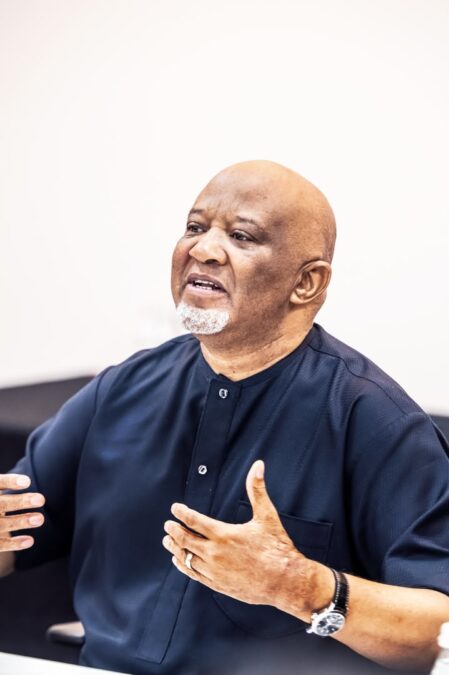
MTN Group chairman Mcebisi Jonas has delivered one of the strongest public criticisms yet by a leading African business executive of South Africa’s growing anti-foreigner sentiment, arguing that immigrants are being unfairly blamed for problems caused by years of state failure, corruption and poor governance.
Speaking at the funeral of Zimbabwean-born activist and public servant Thokozani Damasane, Jonas said South Africa’s economic and social challenges would not disappear even if every foreign national left the country.
“Foreigners can leave tomorrow, inequality will still be with us. Foreigners can leave tomorrow, unemployment will still be with us. Foreigners can leave tomorrow, our police will remain corrupt,” he told mourners.
The remarks have attracted wide attention because they move beyond a traditional funeral tribute to directly address one of South Africa’s most sensitive political issues. They also represent a rare intervention from the chairman of one of Africa’s largest multinational companies, whose operations span 19 countries across the continent.
Read also: MTNN CFO makes bullish bet with N1.03bn new shares acquisition
Jonas, a former South African deputy minister of Finance, argued that immigration has become a convenient political target while deeper structural problems remain unresolved.
According to him, weak border management, poor public services, ineffective law enforcement and rising inequality have created frustration that some politicians exploit by blaming foreigners instead of fixing the country’s institutions.
“The problem is the failure of the state. The state doesn’t manage immigration. It doesn’t manage its borders. It doesn’t enforce law enforcement. It doesn’t manage education,” Jonas said.
He warned that leaders seeking political support often use immigrants as scapegoats instead of offering practical solutions to unemployment, crime and poverty.
Jonas said he reflected on the meaning of “home” while travelling to Damasane’s funeral after hearing renewed calls for foreigners to leave South Africa.
For him, Damasane’s life challenged those views.
Born and educated in Zimbabwe, Damasane later settled in South Africa, where he dedicated his career to public service and civic engagement.
“He became one of us,” Jonas said, describing him as someone who devoted himself to the struggles and aspirations of South Africans despite arriving as an outsider.
The MTN chairman also challenged long-held ideas about tribal identity, describing tribalism as a colonial tool that divided African societies.
He argued that ethnic politics has evolved into a dangerous force that now fuels discrimination against both foreigners and fellow South Africans.
“Identity politics—we must banish them,” Jonas said, adding that South Africa must reject ethnic nationalism if it hopes to build a more united society.
Jonas recalled a conversation in which Damasane once warned a young South African that changing political and economic conditions could one day force him to seek opportunities outside his own country.
Those words, Jonas said, now seem increasingly relevant as corruption, inequality and economic hardship continue to undermine the promise of post-apartheid South Africa.
He ended his address by urging South Africans to embrace what he called a renewed national consciousness built on African solidarity rather than exclusion.
“South Africa is nothing without Africa. Our fortunes are intertwined with the growth of the continent,” he said.
The comments carry significance beyond domestic politics.
South Africa has experienced repeated outbreaks of xenophobic violence over the past two decades, with migrants from Zimbabwe, Nigeria, Mozambique, Malawi and other African countries frequently targeted. Those attacks have strained diplomatic relations, triggered protests across the continent and occasionally affected South African businesses operating in other African markets.
For MTN, Africa’s largest mobile network operator by geographic footprint, the issue has commercial as well as moral implications. The company serves millions of customers across West, East and Southern Africa, making regional stability and stronger continental relations critical to its long-term growth strategy.
Read also: MTN CEO says company outgrew S/A amid migration tensions
Industry analysts say Jonas’ intervention reflects a growing recognition among African business leaders that economic integration cannot succeed where social divisions continue to deepen. As governments pursue initiatives such as the African Continental Free Trade Area, rising nationalism and anti-immigrant sentiment remain major risks to cross-border trade, investment and labour mobility.
Rather than delivering the message at a business conference or shareholder meeting, Jonas chose the funeral of a respected public servant to make his appeal, using Damasane’s life as an example of how commitment and service, not nationality, should define belonging.
Quoting anti-colonial thinker Frantz Fanon, Jonas said every generation must discover its mission and either fulfil or betray it.
He said Damasane fulfilled his mission by dedicating his life to the people of a country that eventually became his home, leaving behind a legacy built on integrity, principle and humanity rather than place of birth.
His speech is likely to add fresh momentum to South Africa’s ongoing debate over immigration, governance and the country’s place within an increasingly interconnected African continent.

Join BusinessDay whatsapp Channel, to stay up to date
Open In Whatsapp