Streaming platforms have fundamentally rewired the economics of the Nigerian music industry, shifting power from traditional record labels directly into the artiste hands. By leveraging streaming metrics to reach global audiences, musicians are increasingly abandoning established labels to launch their own imprints or negotiate hybrid distribution deals.
The goal is simple: retain a higher share of royalties and secure ownership of master recordings. The outcomes, however, remain heavily divided between massive commercial windfalls and cautionary tales of stalled momentum.
For Afrobeats’ biggest names, striking out on their own has yielded unprecedented scale. Wizkid, Burna Boy, and Davido built global empires by operating through their personal imprints while utilising major-label distribution pipelines. Wizkid departed EME around 2014 to found Starboy Entertainment. Operating under an RCA and Sony partnership, he became the first African artist to surpass 11 billion Spotify streams across all credits by early 2026.
Burna Boy similarly exited Aristokrat Records to launch Spaceship Entertainment. Through his Atlantic and Warner deal, his catalogue generated billions of streams across platforms, making him the first African artist with two albums exceeding one billion Spotify streams each.
Davido followed suit by founding DMW in 2016, amassing over 3.8 billion Spotify streams and maintaining a consistent presence on the Billboard charts. These three drafted the blueprint for modern Afrobeats success by blending independent creative control with major-label marketing muscle. They own significant masters or negotiate favourable terms, tour globally, and influence Afrobeats’ international rise while nurturing talent under their labels.
Other powerhouses equally function as incubators. Olamide built YBNL Nation into a talent pipeline, offering resources to raw artists who often seek independence once their initial contracts end. Many stayed and chose the exit door, rather peaceably.
Adekunle Gold is a prime example of a successful, amicable exit. He joined YBNL early and released his 2015 debut Gold (which charted on Billboard World Albums). After leaving the label in 2017, he signed with Def Jam, built an independent-leaning career, and pushed his catalogue past two billion streams. Hits like “Party No Dey Stop” (with Zinoleesky) and others from albums such as ‘About 30’ and ‘Tequila Ever After’ performed well. He maintains around 3 million monthly Spotify listeners and releases consistently, proving a successful transition focused on quality and global features.
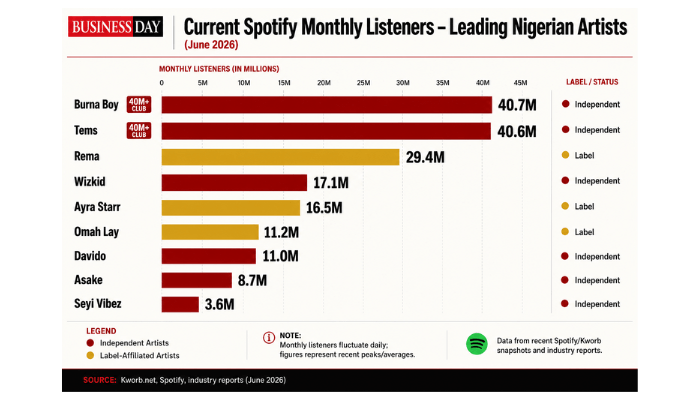
Asake followed a similar, albeit more explosive, trajectory. After his YBNL contract wth Empire distribution ended around 2025, he launched GIRAN Republic. Operating as an independent entity, he approached 3 billion Spotify streams and became the most-streamed artist on Spotify Nigeria, proving that top-tier artists can maintain higher chart peaks without their original label infrastructure.
Full independence has also proven highly lucrative for those who favour corporate structuring over mere music releases. Tems stands out as a global business case. Advised by her manager and business partner Muyiwa Awoniyi, her team prioritised master ownership from the start. They structured an RCA licensing deal with a 12-year reversion clause, ensuring long-term control rather than a permanent handover of rights.
This strategy paid off immensely. Tems became the first African female artist to surpass one billion Spotify streams on a single track, “Wait for U” with Drake and Future. She routinely pulls in over 30 million monthly listeners and captures high royalty yields from Western markets. Omah Lay similarly capitalised on creative independence through KeyQaad, maintaining Warner ties while pushing his catalogue past three billion streams. Projects like ‘Clarity of Mind’ (2026) crossed 300 million Spotify streams quickly. “soso” surpassed 400 million. He maintains 10+ million monthly listeners and a strong African/ global R&B-Afrobeats fusion appeal with consistent milestones.
On a regional level, artists like Seyi Vibez and Kizz Daniel have shown that independence does not require global crossover to be profitable. Seyi Vibez cut ties with Dapper Music Group for full control and partnered with EMPIRE for distribution. By 2025, he became Nigeria’s most-streamed artist, generating 724 million on-demand streams in a single year, largely driven by local street anthems. Kizz Daniel, who left G-Worldwide in 2017 amid public disputes, founded Flyboy Inc and consistently delivered high-yielding singles like the global dance hit “Buga,” proving that core releases can thrive without major-label backing. Albums like ‘No Bad Songz’ and ‘Maverick’, plus tracks like “Cough” and “Twe Twe,” delivered chart-topping runs on Turntable. He continues to maintain impressive, strong local and regional numbers.
However, the transition to independence is not a guaranteed success. The administrative and financial burden of self-management has stalled several promising careers. Runtown spent years battling Eric Many Entertainment in a lengthy legal dispute that severely limited his output and visibility, serving as a stark reminder of the risks of prolonged contract conflicts. Brymo exited Chocolate City and pivoted toward critically acclaimed but commercially quiet independent releases, prioritising artistry over mainstream streaming metrics.
Even contemporary stars face friction. Ruger left Jonzing World around 2024 and, despite a catalogue boasting 1.1 billion Spotify streams, has seen his output slow down due to personal and administrative hurdles. Zinoleesky, who recently departed Marlian Music in 2026 to launch Zinodict Music, is currently testing his ability to sustain the momentum of his past 100-million-stream hits without his former label’s machinery. He enjoyed prior success with tracks like “Party No Dey Stop”, Many Things, and ‘Last Time’. Post-exit, he maintains around 2.5 million monthly listeners.
The streaming era rewards corporate adaptability just as much as musical talent. For Nigerian artists, the data is clear. Those who balance creative independence with sharp business structures and strategic distribution are capturing billions of streams and unprecedented equity. Those who fail to replicate the operational weight of a record label risk losing their market share entirely.

Join BusinessDay whatsapp Channel, to stay up to date
Open In Whatsapp