

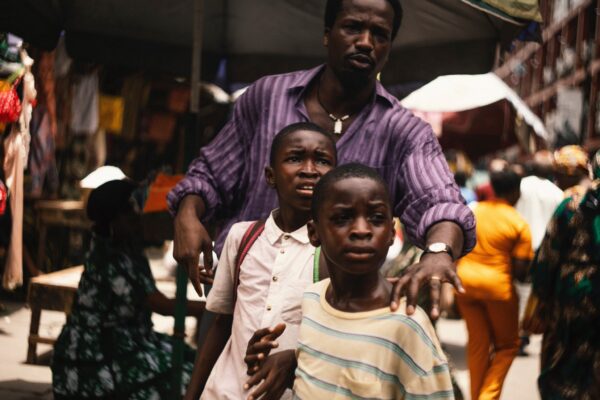
‘My Father’s Shadow’, shot in Lagos on 16mm by Nigerian brothers Akinola Davies Jr. (director) and Wale Davies (writer), has become one of the most celebrated Nigerian films in recent memory. Though it’s made by Nigerians, its core financing is of the British through BBC Film and the BFI, with producers including Rachel Dargavel alongside Nigerian Funmbi Ogunbanwo.
This structure placed primary ownership and capital outside Nigeria, even as the story, cast, crew, and locations were rooted in Lagos.
It premiered in the Un Certain Regard section at the 2025 Cannes Film Festival as the first Nigerian feature in the festival’s official selection and earned a Caméra d’Or Special Mention.
The film was selected as the United Kingdom’s official entry for Best International Feature at the 2026 Oscars. It won a BAFTA for Outstanding Debut by a British Writer, Director or Producer, two Gotham Independent Film Awards (Breakthrough Director for Akinola Davies Jr. and Outstanding Lead Performance for Ṣọpẹ́ Dìrísù), and additional recognition at the British Independent Film Awards.
At the 2026 Africa Magic Viewers’ Choice Awards (AMVCA), ‘My Father’s Shadow’ dominated with five awards: Best Movie, Best Director, Best Writing in a Movie, Best Score/Music, and Best Sound/Sound Design.
Industry observers note that international acclaim from Cannes and other festivals boosted its profile and contributed to its strong showing at the AMVCA. Voters and commentators inside the awards process have pointed to the film’s technical quality, storytelling, and craftsmanship as the core reasons for its wins. One perspective from coverage of the event emphasised that the movie was well made with strong performances and direction, rather than solely relying on foreign validation.
Jason Corder, in a widely shared post, highlighted the broader issue: the film was made on Nigerian soil by Nigerian hands but entered global competitions under the British flag due to financing. “No one stole anything. The money was simply British, BBC Film, the BFI, and the flag follows the money every time,” he wrote. He added, “That is the whole gap. Not imagination, but ownership. Not stories, but infrastructure.” Corder pointed to the need for African capital and infrastructure so that the next major success can “fly its own flag.”
In contrast, C.J. Obasi’s Mami Wata (2023) earned similar international critical acclaim while maintaining Nigerian ownership. Directed and written by Obasi, produced primarily through his Fiery Film Company and other Nigerian partners such as Guguru Studios and Palmwine Media (with some international co-production elements), the black-and-white fantasy thriller premiered at the Sundance Film Festival, where it won the Special Jury Prize for Cinematography.
It was selected as Nigeria’s official entry for the 96th Academy Awards, picked up awards at FESPACO (including African Critics Award, Cinematography, and Set Design), and received nominations at the Independent Spirit Awards and NAACP Image Awards. This demonstrates that Nigerian-owned productions can achieve global success when funding and partnerships support local control.
The pattern of external control over major Nigerian stories extends beyond film to literary adaptations. In September 2024, A24 acquired the rights to Chinua Achebe’s classic novel Things Fall Apart for a television series adaptation. British actor Idris Elba is set to star as Okonkwo and executive produce through his 22Summers banner, with Nigerian-British actor David Oyelowo and his Yoruba Saxon company also executive producing. The project has sparked widespread online discussions in Nigeria, with many expressing concern over foreign studios holding the rights to one of Africa’s most important literary works.
Clapbacks and criticisms on social media highlighted the lack of local ownership, questioning why Nigerian entities could not lead such a high-profile project, and drawing parallels to broader issues of cultural assets being monetised abroad. Others supported the involvement of prominent talents like Elba and Oyelowo for wider global reach, but the debate underscored persistent frustrations around control and infrastructure.
Government and institutional funding initiatives have aimed to close this gap
In recent years, the Nigerian government and partners have announced several support measures for the creative sector. These include the Creative Industry Financing Initiative (CIFI) launched around 2018-2019 with seed capital of N22.9 billion (later referenced in larger figures up to N75 billion), the Nigerian Creative and Entertainment Industry Loan Scheme (NCEILS) through NEXIM Bank, and the more recent Creative Economy Development Fund (CEDF) launched in 2025 as a $100 million initiative offering loans, equity, and grants.
Afreximbank has been a major player, starting with a $500 million Creative Industry Support Fund in 2020, scaling commitments to $1 billion for the Africa Film Fund (focused on production, post-production, distribution, and infrastructure), and doubling overall support to $2 billion through the Creative Africa Nexus (CANEX) programme. In October 2024, Nigeria’s Ministry secured a $200 million facility from Afreximbank specifically for the creative economy.
Outcomes and beneficiaries of these funds remain mixed
Reports indicate challenges in full disbursement and access, with many creatives describing funding as difficult to reach despite announcements. Some beneficiaries include projects supported through CANEX Creations Inc., such as the Nigerian film Clarissa (directed by the Esiri twins), which received investment and secured worldwide distribution by NEON.
Broader Bank of Industry (BoI) disbursements to creative enterprises have been noted, but independent audits and comprehensive impact assessments on high-profile international successes like ‘My Father’s Shadow’ are limited. Critics point to persistent barriers, including bureaucracy, eligibility criteria favoring formal companies, and insufficient scale relative to industry needs.
Nigeria has also pursued international film treaties
In June 2025, the government signed its first audiovisual co-production agreement with Brazil, designed to enable joint development, funding, and distribution of films and TV projects while providing access to incentives in both countries. Earlier efforts include a 2021 co-production treaty framework with South Africa and cooperation agreements, such as with France on film preservation.
These aim to facilitate knowledge transfer, technology access, and shared ownership, though ratification and active utilisation for major productions are still developing.
BusinessDay and other reports have repeatedly covered structural challenges in Nollywood. The industry produces thousands of films annually but faces persistent issues with funding access, distribution, piracy, studios that don’t match up to Hollywood standards due to equipment shortages, and unreliable power supply. These limit the ability of local producers to retain ownership and scale high-quality productions independently.
‘My Father’s Shadow’ demonstrates the talent and creative potential in Lagos. Its success also shows the gap: without a stronger domestic infrastructure and capital retention, even landmark Nigerian stories often end up owned and represented abroad. Initiatives like Afreximbank-backed efforts are working to address this by building local production and ownership capacity. The combination of announced funds, new treaties, and growing African financing offers a pathway forward, but translating pledges into widespread ownership and infrastructure remains the key test.

Join BusinessDay whatsapp Channel, to stay up to date
Open In Whatsapp


