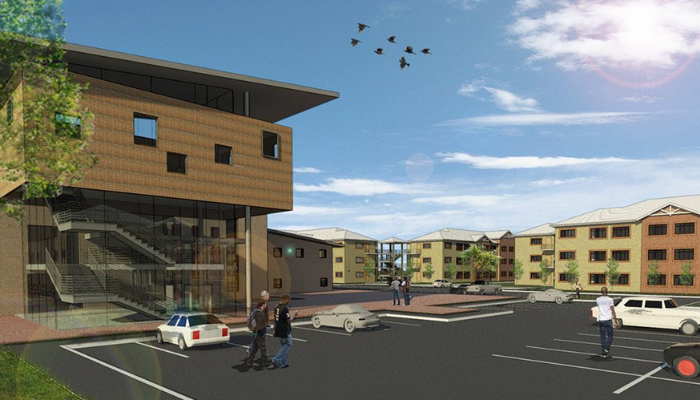
Nigeria, the self-acclaimed giant of Africa, is ahead of its peers on the continent in student housing deficit with about one million bed-spaces, a new report has shown.
The report titled ‘Africa Student Housing Report’ also looked into Africa’s student housing with special focus on purpose-built student accommodation (PBSA) sector across four key markets, including Nigeria, South Africa, Kenya, and Ghana.
It provides a comparative overview of these markets, showing persistent shortages across these countries despite growing investment activity. It highlights Nigeria as both the most constrained market and the one with the most active development pipeline.
The report compiled by Fortren and Company shows that Africa’s PBSA sector remains structurally undersupplied with only 250,000 formal beds available across the continent despite a student population of about 25 million, highlighting a persistent gap between demand and supply.
Though this is generally viewed as a huge challenge in the sector, especially with a staggering continent-wide deficit estimated at 1.5 million beds, it also presents opportunities for savvy investors. Out of the 1.5 million beds deficit, Nigeria alone corners 1 million beds.
Read also: Lighthouse University welcomes pioneer students to campus
As an investment asset class, student housing offers good returns on investment which, according to Abayomi Onasanya, CEO, Student Accommod8, is as high as 22 percent, as against 10-12 percent offered by commercial real estate and 4-5 percent that investors get from residential real estate.
The report notes that Africa’s PBSA market is one of the most structurally compelling and most systematically underfunded real estate investment opportunities on the continent.
“Across Nigeria, Ghana, Kenya, and South Africa, tertiary enrolment is expanding at pace, while institutional student housing supply remains critically insufficient, such that the gap between student population growth and bed supply reflects structural failures in capital formation, policy design, and product innovation,” Martin Uche, Fortren and Company CEO and Research Director, said.
The report notes that even though Nigeria represents one of the most undersupplied student housing markets in Sub-Saharan Africa, with an estimated deficit exceeding 1 million beds, the country leads Africa in development pipeline activity, reflecting strong investor interest in the midst of structural constraints.
According to the report, across Nigeria, Ghana, Kenya, and South Africa, tertiary enrolment is expanding at pace, while institutional student housing supply remains critically insufficient, such that the gap between student population growth and bed supply reflects structural failures in capital formation, policy design, and product innovation.
Nigeria’s public tertiary institutions accommodate fewer than 9 percent of its tertiary student population in on-campus housing. The remainder rely on fragmented, informal off-campus provision characterised by security risks and price distortion.
The report says that students who are forced to rely on private off-campus housing don’t find it easy as the on-campus facilities are severely limited, with prices ranging from ₦330,000 to over ₦1 million per academic session. This leads to high occupancy in low-range, sub-par living conditions.
Despite Nigeria’s large population, South Africa controls approximately 91.8 percent of Africa’s formal PBSA supply, driven by its deep capital markets, National Student Financial Aid Scheme (NSFAS) government-backed rental demand, and a legislated minimum norms and standards framework.
Kenya’s Acorn Holdings has demonstrated that a REIT structure, anchored by DFI equity and a green bond listed on the Nairobi Securities Exchange and London Stock Exchange, can mobilise institutional capital into student housing at scale. Acorn’s portfolio has grown to excess of 27 billion Kenyan Shillings with approximately 20,000 beds under management.
The primary barrier to institutional deployment is development risk. Investors require structures that de-risk the construction and lease-up phases, with DFIs and blended finance vehicles functioning as critical first-movers.
Closing the continental supply gap requires coordinated action across government, DFIs, local pension funds, universities, and private operators.

Join BusinessDay whatsapp Channel, to stay up to date
Open In Whatsapp