Obiora Okonkwo, the executive chairman of United Nigeria Airlines, has revealed that the carrier lost about N10 billion in a three-month stretch, induced by the maritime blockade and subsequent closure of the Strait of Hormuz.
The Strait of Hormuz is a strategic, narrow sea channel separating Iran and Oman and serves as the world’s most critical oil transit chokepoint, facilitating the daily passage of roughly 20 percent of global petroleum supplies.
The geopolitical shutdown of the channel has severely impacted local aviation sector.
Within the last two months alone, the Airline Operators of Nigeria (AON) recorded 266.7 percent surge in Jet A1 (aviation fuel) prices, which spiked from N900 to N3,300 per liter.
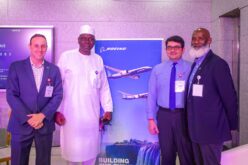
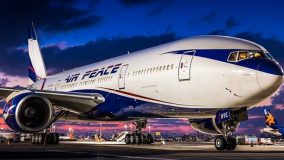
Okonkwo made these disclosures during the unveiling ceremony of two newly acquired Boeing 737-800 Next Generation (NG) aircraft by United Nigeria Airlines (registered as 5N-CFC and 5N-CFB). The aircraft were named in honor of two icons: the Obi of Onitsha,
Igwe Nnaemeka Achebe, and the late globally acclaimed literary giant, Chinua Achebe.
Reflecting on the airline’s survival strategy, Okonkwo stressed that while forward-looking regulatory adjustments under Festus Keyamo, Aviation Minister kept domestic carriers flying, external headwinds continue to bite.
“There are seasons when there are low passengers, but in the last three months, what we have seen is simply too much. We have lost about N10 billion, N5 billion, N6 billion in a space of three months as a result of the closure of the Strait of Hormuz. We have to make up for the losses we have incurred in the last three months,” he explained.
“We have gathered here to celebrate,” Okonkwo stated. “Two, three, four years ago, it was not clear what the future of aviation would be. There were issues, and in Nigeria, aviation was in total turmoil. But until our minister, Festus Keyamo, stepped in, we had a meeting in his office where he promised he would address the policy issues. Today, the right policies have helped us come this far.
“Today we have one Achebe that introduced Africa to the whole world. He is from my home town. Wherever I go around the world, I tell them that Okonkwo in Things Fall Apart is my great-great-grandfather. We have another Achebe who is a living legend and icon.
We have here the Obi of Onitsha, Nnaemeka Achebe.”
Detailing the hidden operational deficits forced upon domestic carriers by international supply chain disruptions, Okonkwo noted:
“The journey of this aircraft purchase was a long one. It started with the Boeing visit, the Minister of Aviation, and Moore Ibekwe.
“It is going to be six aircraft in total, and we just have two here. I thank God Almighty for making this possible.”
Okonkwo expressed immense gratitude to the leadership of the apex regulatory body for removing bureaucratic bottlenecks during the induction of the new fleet.
“We are thankful to the DG of the NCAA who has made our services possible,” he said. “I had told him I had three aircraft that were arriving. Three of his directors came to our office on a Saturday, prepared all the documents, inspected the aircraft, and issued all the certificates. The process of operating aircraft won’t be easy without ease in certifications.”
“United Nigeria started with just four old aircraft. I sent 23 pilots for heavy maintenance C-checks in South Africa, and two days after they left, the airspace closed down. Those 23 pilots were stuck there. We were paying for hotels and medicals.
Okonkwo explained challenges with passengers ger flights.
He said: “I know we have passengers in Nigeria that want to get to their destinations. The important thing is to get passengers to their destinations safely and in time. The truth of the matter is that the operator wants to take you there on time. That you buy a ticket doesn’t put money in our pockets, because you can demand a refund. Sometimes we meet situations beyond our control.
“When one aircraft goes bad, we start to work on the schedule so we don’t leave anyone behind. Sometimes it is a bird strike, sometimes it could be because of airport availability.
Okonkwo spoke against policies squeezing regulatory agencies like the Nigerian Civil Aviation Authority (NCAA) and the Federal Airports Authority of Nigeria (FAAN), pointing out that infrastructural deterioration stems directly from the deductions.
“Minister, we are not happy with the recent report from IATA that Nigeria is the most expensive place to operate,” Okonkwo lamented.
“It means it costs operators more to operate. We want a reduction in the charges. Unless the government leaves the money of aviation in the NCAA and FAAN accounts, the services they offer will not improve.”
“Government yanks out 70 percent from the aviation accounts to do other things that are not aviation-related, and this strains the NCAA and FAAN. If we leave these monies in their accounts, they will be encouraged to provide the needed services.
“The core aspect of the Nigeria economy is driven by aviation. In conclusion, when this is done, the government can also provide a single-digit loan.”
Speaking on behalf of the aircraft manufacturer, Moore Ibekwe, the Executive Sales Director for the Africa Region at Boeing Commercial Airplanes, highlighted that long-term financing and structural capacity are rapidly returning to Nigeria’s airspace following these legal reforms.
“Access to credit and development, safety enhancement, and regulatory requirements; as at today, there has been tremendous improvements in these,” Ibekwe stated.
“Nigeria has been able to access new-generational aircraft. Two days ago, we launched a training. Our engineers come into Nigeria to train engineers. When it comes to operations, the 737s acquired
would create a lot of opportunities for Nigeria.
“The country needs 1,200 aircraft. If we get a good percentage of these aircraft, the sky will not be our limit. We have the manpower, capability, and finances.
Aviation is global, it creates good-paying jobs, opens up the economy, and we have to be on the global stage across the world, whether in science, technology, finance, fashion, or entertainment,” Ibekwe explained.
Receiving the honor, Igwe Nnaemeka Achebe, the Obi of Onitsha expressed intense pride in seeing his name and legacy flying alongside Chinua Achebe.
“I am overwhelmed. I’m lost for words. It is a day of gratitude,” he said.
“I am here to celebrate the arrival of two airplanes. I am overwhelmed that my name is inscribed on one of these aircraft, and it is also inscribed alongside Chinua Achebe. I have gained benefits sharing the same surname with Chinua Achebe,” Achebe said.

Join BusinessDay whatsapp Channel, to stay up to date
Open In Whatsapp