

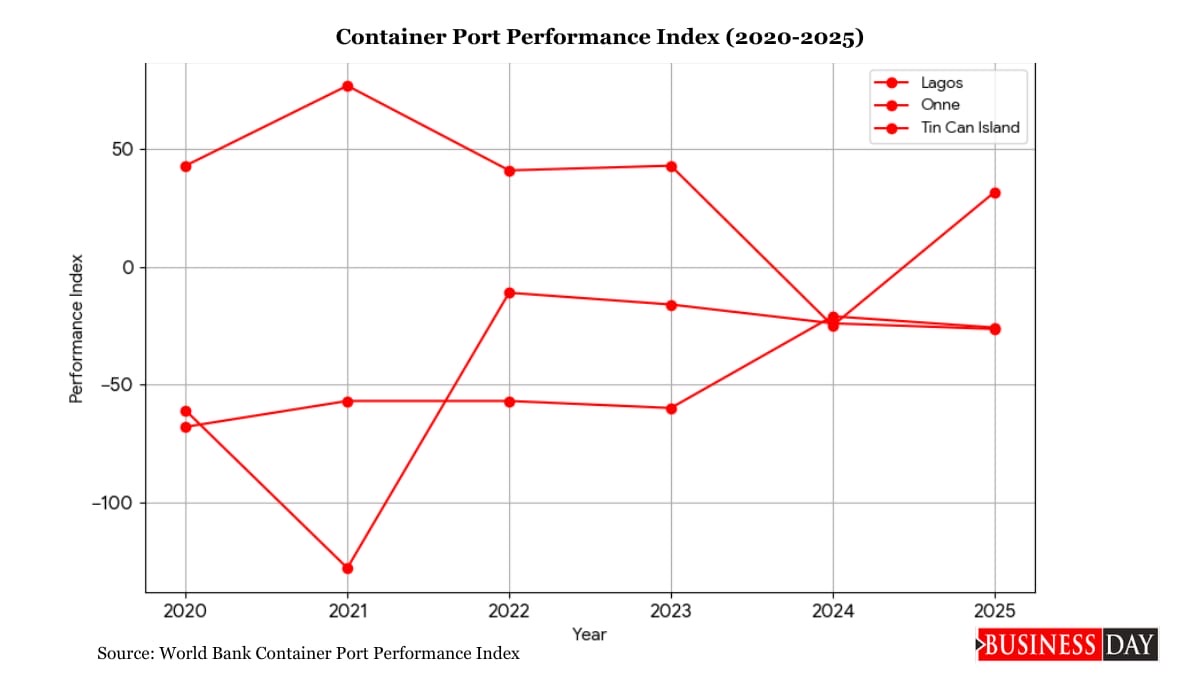
Nigeria’s Tin Can Island and Apapa ports have been globally ranked among the top 15 ports that improved total vessel time between 2020 and 2025 by the World Bank.
The Container Port Performance Index (CPPI), a benchmark developed by the World Bank based on data provided by S&P Global Market Intelligence, by which the ports were ranked, measured performance based on the total time from when a ship reaches the port limits until it departs from the berth.
Tin Can Island saw an improvement of 42 points in its CPPI score during this period from -68 in 2020 to -25.8 in 2025, while Apapa port improved by 35 points moving from -61 in 2020 to -26.4 2025. Globally, Apapa ranked 320 while TinCan sat slightly higher at 318.
Read also: Inside the purge of a sprawling extortion racket at Lagos’ ports
The report showed that Nigeria’s old ports, like others in Sub-Saharan Africa, generally record longer vessel times in port, attributed to import-dominated trade structures and capacity constraints.
“This year’s report focuses explicitly on the mutual relationship between vessel time in port and supply chain stress, both globally and at the individual port level. Prolonged time in port feeds back into broader supply chain stress by tying up vessel capacity and propagating delays,” wrote Bertrand De la Borde, group director, transport and logistics at the World Bank in the jointly-penned foreword with Guy Sear, vice president and head of maritim
It is not clear what boosted Nigeria’s CPPI, but the World Bank’s report said “high-performing ports” were more able to minimise time absorption, maintain operational discipline under volatility, operate in environments where roles and incentives among public authorities, terminal operators, and service providers are aligned, and can share reliable, timely information on vessel arrivals, berth status, yard conditions, and landside flows.
“They combine adequate nautical access, sufficient berth and crane capacity, and well-integrated yard operations with stable coordination routines. Importantly, they limit unproductive waiting time and maintain a high share of vessel time in productive berth operations,” the report noted.
Industry players have noticed the difference. “In those days, a vessel will come in and maybe for one week they are still looking for space to discharge the cargo or they have too many agencies to do their due diligence of checking what the cargo the vessel is brought in. All of that has been narrowed down to maybe one or two days,” Jonathan Nicol, president of the Shippers’ Association Lagos State told BusinessDay.
He traced the improvement to the success of regulatory oversight, particularly from the Shippers Council, which had previously “attached some of their staff to the shipping environment where they brought the vessel together with other agencies and issued clearance almost immediately.” Though he did not rule out reduced vessel calls as a factor.
Nigeria’s Onne port, with fewer calls than other busy berths, had maintained a positive record in the five years except 2024 when it dropped in ratings to -25. Still it is the most ranked Nigerian port sitting at 84 globally even above the Lekki deep seaport at 353.
Despite these gains, shippers said the report didn’t show the whole picture. Nicol said shipping companies must begin to take responsibility for the empty containers they leave behind that congest port terminals. “Some of them are overflowing with too many empty containers,” he said.
“The report is only centred on the number of days of call-up time for vessels. But leaving behind what normally they’re supposed to have carried along with them to ease up space at our ports,” he said.
Read also: Idle containers expose cracks in Nigeria’s non-oil trade
In 2025, the Sea Empowerment and Research Centre (SEREC), Nigerian advocacy group reported that an estimated 100,000 abandoned empty shipping containers sat idle in Nigeria’s terminals clogging ports and roads.

Join BusinessDay whatsapp Channel, to stay up to date
Open In Whatsapp


