Africa continues to dominate the list of the world’s fastest-growing economies despite a wave of downward revisions to global growth forecasts caused by the escalating conflict in the Middle East and rising geopolitical uncertainty.
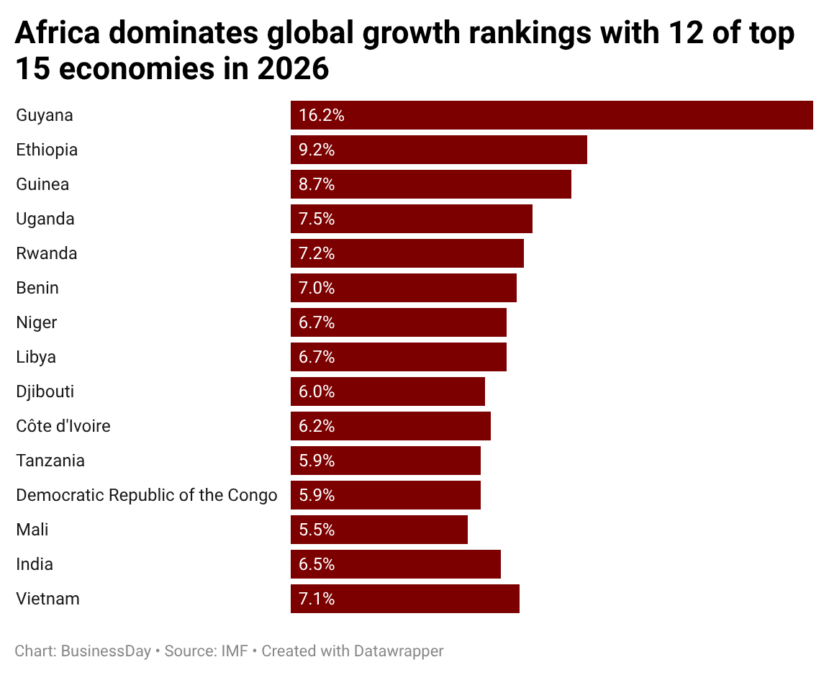
The International Monetary Fund (IMF), in its April 2026 World Economic Outlook report, projects that several African economies will remain among the world’s fastest-growing this year, led by Ethiopia, Guinea, Uganda, Rwanda, Benin and Côte d’Ivoire.
Ethiopia is expected to be the continent’s strongest performer and the world’s second-fastest-growing economy after Guyana, with real GDP growth forecast at 9.2 percent. Africa’s second-most populous nation has benefited from strong export performance, particularly in coffee and gold, as well as from ongoing economic reforms and infrastructure investment.
Guinea is projected to grow to 8.7 percent, supported by the expansion of its mining sector and production from the giant Simandou iron ore project. Uganda and Rwanda are forecast to expand to 7.5 percent and 7.2 percent respectively, maintaining East Africa’s position as one of the world’s most dynamic economic regions.
West African economies also feature prominently in the rankings. Benin is expected to record growth of 7.0 percent, while Côte d’Ivoire is forecast to expand to 6.2 percent, reflecting continued investment in infrastructure, agriculture and manufacturing.
Other African economies expected to post growth above six percent include Niger, libya, Tanzania and Djibouti, underscoring the breadth of the continent’s economic resilience despite a challenging global backdrop.
The latest IMF forecasts represent a notable shift from the Fund’s October 2025 outlook. South Sudan, which had previously been projected to grow to more than 22 percent and rank among the world’s fastest-growing economies, has seen its forecast slashed to 4.1 percent as disruptions to oil exports and spillover effects from the conflict in Sudan weigh on activity.
“After a strong 2025 with regional growth estimated at 4.5 percent, sub-Saharan Africa entered 2026 reaping the benefits of hard-won stabilisation gains. But the war in the Middle East has clouded the outlook,” the multilateral lender said in the report.
It added that the shock has led to a rapid rise in key commodity prices, particularly for fuel and fertilizer. Poverty, food insecurity, and other social indicators, already weakened by the pandemic, face renewed headwinds from declining foreign aid and rising food prices and that regional growth is expected to decline to 4.3 percent in 2026 with significant heterogeneity across countries.
“Downside risks are significant amid high global uncertainty and regional macroeconomic vulnerabilities. Policy must focus on addressing the shock in the near term and building resilience over the medium term.”
The conflict triggered by United States and Israeli strikes on Iran on February 28 has entered its fourth month, driving a sharp rise in energy prices following the closure of the Strait of Hormuz. The disruption has renewed inflationary pressures globally, strengthened expectations of tighter monetary policy across major economies, and pushed fertilizer prices higher, raising concerns about a potential food supply crisis.
But on Sunday, the US and Iran reached a breakthrough agreement to end active hostilities, with plans to formally sign the accord in Geneva. The deal provides for the permanent cessation of military operations, the reopening of the strategically important Strait of Hormuz, and the lifting of the American naval blockade on Iranian ports.
However, while tensions between Washington and Tehran are easing, conflict across the Levant remains unresolved. Israel has said its forces will remain in Lebanon, Syria and Gaza indefinitely to safeguard national security, while recent Israeli strikes have targeted Hezbollah command centres in Beirut.
The broader risk environment remains elevated. Geopolitical disruptions—including supply-chain bottlenecks, volatile energy markets, and persistent cyber and operational threats—continue to weigh on global businesses, financial institutions and investors.
Globally, the IMF expects economic growth to slow to 3.1 percent this year as higher energy costs, tighter financial conditions and lingering Middle East tensions create fresh headwinds for businesses and markets.
Despite these challenges, African economies continue to account for a disproportionate share of the world’s fastest-growing markets, reinforcing the continent’s position as a key frontier for long-term growth and investment.

Join BusinessDay whatsapp Channel, to stay up to date
Open In Whatsapp