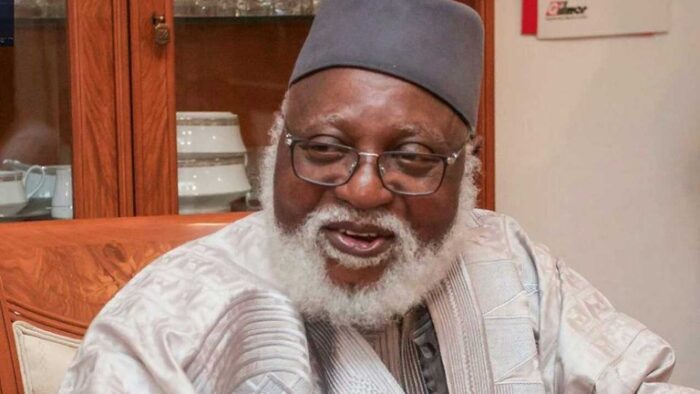
Former Head of State, Gen. Abdulsalami Abubakar (rtd), has revealed a startling account of the hours following the death of former military ruler, Gen. Sani Abacha, disclosing that he was locked inside a room at the Presidential Villa before being informed that the Head of State had died.
The dramatic revelation is contained in Abdulsalami’s autobiography, Call of Duty, unveiled in Abuja on Saturday to commemorate his 84th birthday.
According to the former military leader, he received an urgent call on the morning of June 8, 1998, informing him that Abacha wanted to see him. He said expecting another official assignment, he hurried to the Presidential Villa in casual attire.
However, upon arrival, he was directed to a waiting room where he remained for over an hour alongside Major-Gen. Ishaya Bamaiyi. Abdulsalami said his concern deepened when he discovered that the room had been locked from the outside.
Read also: Only God can end insecurity in Nigeria, says Minister of State for Defence, Matawalle
“On Monday, 8 June, I received a call very early in the morning that he (Abacha) wanted to see me. I quietly prayed that he would not send me to Togo where there was going to be an ECOWAS summit. I was tired of going everywhere.
“By this time, Lt-General Diya, his No 2, was in detention (over an alleged coup plot). I was effectively the No 2 man in government and I was always representing him at events. I told my wife I was not happy with the call because I didn’t want to travel to Togo. I told my orderly to pack my travelling bag and other personal effects.
“As I entered the bathroom, there was another call. I was told again that the Head of State wanted to see me. Out of frustration, I asked if I was travelling to Togo and the caller replied that it was on another issue. Because of the urgency, I didn’t wear my uniform. I wore a tracksuit and slippers and proceeded to the Presidential Villa.
“On getting to his residence, I was told he was in the office. I wondered why he would be that early in the office. As I was climbing the stairs, one of the guards informed me that Abacha said I should stay in the waiting room. What struck me was that anytime I went to see him, regardless of who was with him, I would still go in.
“After waiting for about half an hour, I reasoned that it was odd. Major-General Ishaya Bamaiyi joined me shortly after. We waited for about an hour. I decided to go and see Abacha by any means because I could not understand why I should be kept that long.
“To my greatest surprise, the door of the waiting room had been locked. I asked Bamaiyi if he was aware that we had been locked inside. Something kept telling me that something was wrong but I could not place a finger on it,” he said.
“After some time, the door was opened and the Inspector General of Police, Alhaji Ibrahim Coomassie, came in. He said, ‘Let’s go.’ We walked towards the residence and I informed him that I was told Abacha was at the office. It was at this stage that he informed me that Abacha was dead. I was shocked. I asked him what happened and he insisted we proceed first. He did not tell me anything else,” Abdulsalami wrote.
Abdulsalami said he personally viewed Abacha’s body and offered prayers before leaving the room in disbelief.
While he did not identify those responsible for locking him away, he suggested that some military officers may have been pursuing alternative plans as uncertainty gripped the nation’s leadership. Hours later, the Provisional Ruling Council selected Abdulsalami as Abacha’s successor.
Abdulsalami said he subsequently initiated a swift transition programme that culminated in the handover of power to a democratically elected government headed by Olusegun Obasanjo in May 1999.

Join BusinessDay whatsapp Channel, to stay up to date
Open In Whatsapp