People often imagine highly skilled hackers, cutting-edge malware, or advanced security tools when they think of cybersecurity. The human aspect of cyber defense gets far less attention.
Every security monitoring platform, firewall, and detection system has people behind it who analyze alerts, investigate suspicious activity, and determine whether an organization is under attack. Small security teams in many Nigerian organizations are required to keep an eye on expanding digital environments under rising pressure and with limited resources.
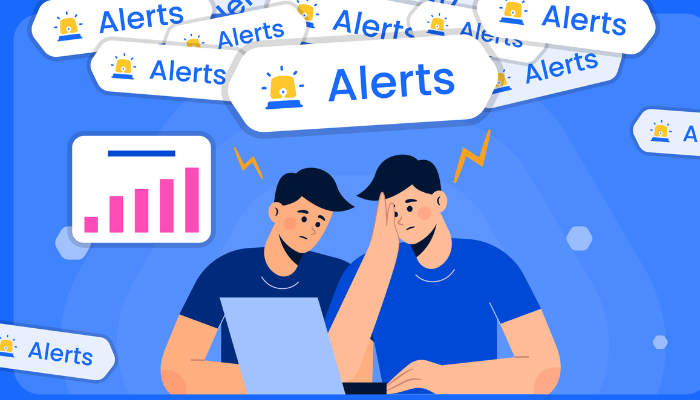
Alert fatigue is a condition that arises when security analysts become overwhelmed by the sheer frequency of notifications generated by security systems. Alerts are meant to assist defenders in identifying threats before they become incidents. In reality, thousands of alerts, many of which are false positives, low priority, or repetitive can come in every day. Analysts’ ability to spot truly malicious activity starts to deteriorate when they spend hours going over alerts that don’t lead anywhere.
Although the issue is not exclusive to Nigeria, local circumstances often make it more severe. Many businesses are growing their digital services while working with limited cybersecurity expenditures. Multiple system monitoring, security tool management, incident response, and compliance report preparation may fall within the responsibility of a single security analyst. In such a setting, the quantity of notifications frequently increases more quickly than the team in charge of looking into them.
The repercussions are substantial. Not all missed alerts result in missed notifications. More often than not, it indicates that a crucial alert was overlooked in favor of hundreds or thousands of additional occurrences. It gets harder to tell the difference between normal noise and real threats when every activity is marked as significant. As a result, while security staff concentrate on less important events, attackers could go unnoticed for lengthy periods of time.
A similar pattern has been identified in several of the world’s most destructive cyber incidents. Warnings produced by security technologies were disregarded, misinterpreted, or given less importance. The technology functioned as intended. The amount of information given to those in charge of taking action constituted a limitation. Cybersecurity failures are generally characterised as technological failures, although they are often operational capacity and prioritization failures.
This issue is especially pertinent given Nigeria’s expanding digital economy. Government organizations, banks, fintech firms, telecom providers, and healthcare facilities all rely on security monitoring capabilities. The number of events that need to be analyzed keeps growing as more services go online and businesses use cloud infrastructure. The disparity between visibility and responsiveness grows in the absence of commensurate investment in security operations.
The idea of a Security Operations Center, popularly known as SOC, is crucial in this situation. A security operations center (SOC) is primarily in charge of monitoring, detecting, analysing, and responding to cybersecurity incidents. But creating a SOC is just the first step. Staffing, procedures, training, and the capacity to discern significant risks from background activity are all critical to a security operations function’s efficacy. The issue cannot be resolved by technology alone.
The problem also draws attention to a more general cybersecurity governance concern. Because security tools are observable and quantifiable, many organizations make significant investments in them. Buying a new tool is simple. It is much more challenging to develop an efficient operating capability. Analysts need ongoing training. Detection rules need to be adjusted. Alert thresholds need to be reviewed frequently. Organisations run the danger of establishing settings where security teams are overloaded with information yet lack actionable insight if they don’t engage in these activities.
This reality is increasingly acknowledged by regulatory expectations. Global standards like ISO 27001 and frameworks like the Nigeria Data Protection Regulation (NDPR) place a strong emphasis on risk management, monitoring, and incident response capabilities. Although compliance is crucial, resilience cannot be ensured by compliance alone. Organisations need to be sure that their operational security departments can adequately address the hazards they encounter.
A change in perspective is necessary to address alert fatigue. The goal should be to produce better notifications rather than more alerts. Prioritisation, context, and quality must be the main concerns of security monitoring. Although repetitive work can be reduced with automation, human judgment is still crucial. Seeing everything is not the only objective. Finding what is important before it becomes a crisis is the goal.
Discussions about cybersecurity must shift from technology acquisition to operational performance as Nigeria pursues its digital transformation. Even with sophisticated security measures in place, an organization may still be at risk if the personnel in charge of keeping an eye on those systems are overwhelmed. The program that generates the most alarms is not the strongest. It is the one that makes it possible for defenders to promptly recognize real threats and take action before damage is done.
Visibility is important in cybersecurity, but it can give the false impression of control. The lack of knowledge is not the only problem that many organisations are currently confronting. It is the capacity to distinguish between signal and noise before the next breach goes undiscovered.
. Adesola, CISSP, is a cybersecurity professional and writer focused on risk management and threat-informed defense.

Join BusinessDay whatsapp Channel, to stay up to date
Open In Whatsapp