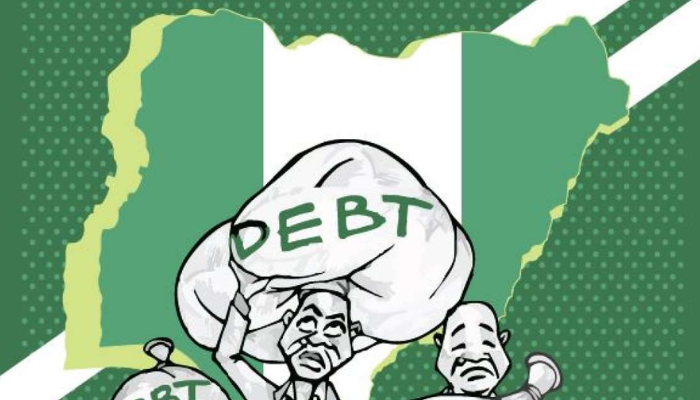
A nation should borrow to build its future, not mortgage it. Nigeria is increasingly in a position where debt servicing consumes resources that should be used to educate children, secure communities, build infrastructure, and drive economic growth. The country’s fiscal reality points to a deeper truth: Nigeria’s debt challenge is not only financial. It is fundamentally a governance and leadership failure.
Much of the public debate focuses on how much Nigeria owes or whether its debt-to-GDP ratio is sustainable. These are important questions, but they miss the more urgent issue: how much of government revenue is left after debt obligations are met. Increasingly, the answer is alarming.
A large share of federal revenue now goes directly into debt servicing. At the same time, revenues fall short of targets while debt costs exceed projections. The result is a fiscal squeeze that leaves little space for development spending. The government finds itself increasingly able to pay creditors but less able to fund the investments citizens actually need.
This is not an abstract problem. Every naira used for debt service is a naira not spent on roads, hospitals, schools, and security. The consequences are felt by farmers unable to move goods, businesses constrained by poor infrastructure, and young people searching for opportunities in a stagnant economy.
Nigeria is gradually moving toward what can be described as a debt-service state, a system where meeting creditor obligations becomes more predictable and protected than investing in citizens. This is not because creditors matter more than citizens, but because debt is legally binding, while development spending is often the first casualty when revenue falls short.
The danger is structural. When debt servicing consistently overrides capital investment, a country begins to finance its past at the expense of its future. Growth slows, revenue weakens, borrowing increases, and the cycle deepens.
At the centre of this crisis is a hard truth: Nigeria’s problem is not primarily debt stock. It is a revenue weakness.
Debt is repaid from revenue, not from GDP statistics or economic projections. A country can appear moderately indebted yet still struggle if its revenue base is narrow and underperforming. This is Nigeria’s reality. Despite its size, population, and resources, government revenue remains far too low to comfortably support its obligations.
For years, successive governments have relied on borrowing to fill fiscal gaps while postponing structural reforms needed to expand productivity. Oil revenue has remained volatile, while non-oil revenue growth has been inconsistent. Weak tax administration, leakages, inefficiency, and corruption further constrain fiscal capacity.
The result is a state that increasingly operates like a household surviving on loans without growing its income base. Such a model is unsustainable.
The crisis becomes clearer in budget execution. Debt servicing is now crowding out capital expenditure. While large sums are allocated to repayments, investment in future growth is repeatedly reduced. This is equivalent to a farmer eating the seeds meant for the next planting season, short-term obligations are met, but future output is destroyed.
The wider consequences are severe. Poor infrastructure discourages investment. Weak education reduces competitiveness. Underfunded healthcare lowers productivity. Insecurity constrains economic activity. When development spending falls, growth slows. When growth slows, revenue weakens. When revenue weakens, borrowing increases. The cycle reinforces itself.
However, borrowing itself is not the core problem. All developing economies borrow. The issue is whether borrowing produces returns that justify it. When borrowed funds are invested in infrastructure, energy, agriculture, industry, and human capital, they can drive growth. When they finance inefficiency or recurrent consumption, they deepen future crises.
This is why leadership is central to the problem. Fiscal sustainability cannot be achieved through borrowing alone or taxation alone. It requires disciplined leadership capable of making long-term decisions, strengthening institutions, and prioritising national development over short-term political survival.
Nigeria, therefore, needs a fiscal reset.
First, revenue must be expanded through economic growth, not excessive pressure on struggling citizens. This requires widening the tax base, formalising parts of the informal economy, improving tax collection, and strengthening productive sectors such as agriculture, manufacturing, mining, and technology.
Second, public spending must become more efficient. Waste, duplication, inflated contracts, and administrative excesses must be reduced. Every expenditure should be tied to measurable developmental outcomes.
Third, borrowing must be tied strictly to productive investment. Citizens should be able to see clearly what is borrowed, how it is used, and what value it generates. Debt without accountability becomes a burden passed to future generations.
Fourth, institutions responsible for budgeting, planning, and debt management must be strengthened. Long-term national planning should replace short-term political budgeting cycles.
Importantly, transparency must become non-negotiable. A government that borrows without accountability weakens trust and deepens fiscal vulnerability.
The warning signs are already visible. If current trends continue, Nigeria risks a future where debt servicing permanently dominates public finance, while development is continuously postponed. This would weaken growth, deepen poverty, and reduce the state’s ability to respond to crises.
Nigeria’s real fiscal danger is not simply rising debt. It is the growing normalisation of debt servicing as the government’s primary financial obligation, ahead of development itself. This reflects a deeper failure of governance, planning, and leadership.
The country does not lack resources or talent. It lacks a leadership culture capable of transforming potential into sustained prosperity. Until that changes, debt will remain more than a financial burden. It will remain evidence of a deeper national failure to build an economy capable of financing its own future.

Join BusinessDay whatsapp Channel, to stay up to date
Open In Whatsapp