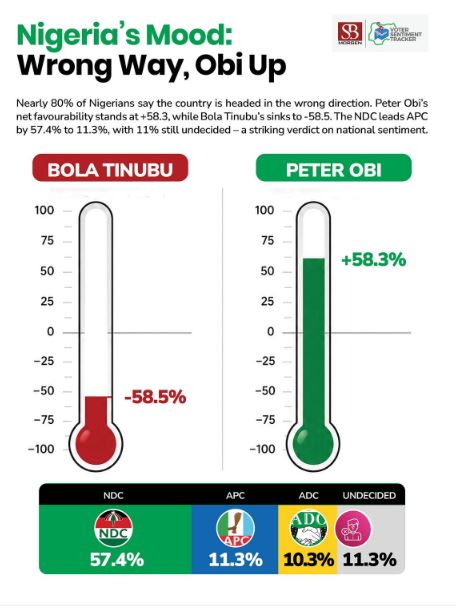
If Nigeria held its general elections today, the opposition National Democratic Coalition (NDC), led by Obi and Rabiu Kwankwaso, would enjoy a substantial advantage, according to a new Voter Sentiment Tracker released by SBM Intelligence.
The SBM report, as seen by BusinessDay, revealed that national voting intention stood at 57.4 percent for the NDC, compared with 11.3 percent for the ruling APC and 10.3 percent for the ADC, while 11.3 percent of respondents remained undecided.
The SBM survey of nearly 1,000 respondents across Nigeria’s six geopolitical zones found that President Bola Tinubu’s administration may be facing deep public discontent, while former Labour Party presidential candidate Peter Obi currently enjoys the strongest favourability ratings.
2027 elections to be determined largely by voter turnout
SBM analysts caution that public dissatisfaction alone may not determine the outcome of the 2027 election, noting that voter turnout could prove the decisive factor.
Read also: Soludo backs Tinubu’s re-election, urges Ndigbo to embrace politics of progress
Under a low-turnout scenario, SBM survey shows support for the NDC falling to 31.7 percent nationally, while under a high-turnout scenario, the coalition’s support could rise dramatically to 64.9 percent, suggesting that opposition fortunes depend heavily on voter mobilisation.
The Southeast, South-South and Northcentral zones currently show the strongest enthusiasm for voting, with more than seven in 10 respondents expressing high turnout intentions.
By contrast, the Southwest, the political base of President Tinubu, recorded the lowest turnout intention and the highest proportion of undecided voters.
The report describes the Southwest as the country’s most important electoral battleground heading into 2027. While the NDC leads in the zone with 45 percent support, the APC retains a significant base with 22 percent, and nearly a quarter of voters remain undecided.
Read also: Accord State Chairmen back Gbenga Hashim’s 2027 presidential bid
The Northeast presents a different challenge. Unlike other regions where one political bloc enjoys a clear advantage, voter preferences there remain fragmented among the NDC, APC and ADC, making it the only zone where the NDC does not currently lead.
“The Southwest and Northeast are the two zones where the outcome is most open, but for entirely different reasons. The Southwest has the lowest high-turnout intention of any zone (44%), the largest undecided share among major zones (23%), and the only significant APC vote base (22%), yet its sheer size and President Tinubu’s incumbency advantage make it structurally pivotal.
“The Northeast, by contrast, is not apathetic so much as fragmented: 43.3% fall in the high-turnout band, but the vote splits three ways: ADC at 23.1%, APC at 17.3%, NDC at 13.5%, with 16.4% still undecided. While the Southwest’s uncertainty stems from a Yoruba electorate that has yet to decide whether to defend its president or defect, the Northeast’s uncertainty stems from the genuine absence of a dominant opposition figure. Both zones could determine the margin of victory; neither will be won the same way.”
SBM Intelligence noted that the findings represent a snapshot of public opinion rather than an election forecast. The survey was conducted in May across eight states and the Federal Capital Territory and was not weighted against official voter registration or demographic data.
Beyond voting intentions, the survey also highlights concerns about the quality of information available to voters. Social media has become the dominant source of political information across most regions, while concerns about artificial intelligence-generated misinformation and deepfakes are growing, particularly among older voters.

Join BusinessDay whatsapp Channel, to stay up to date
Open In Whatsapp