

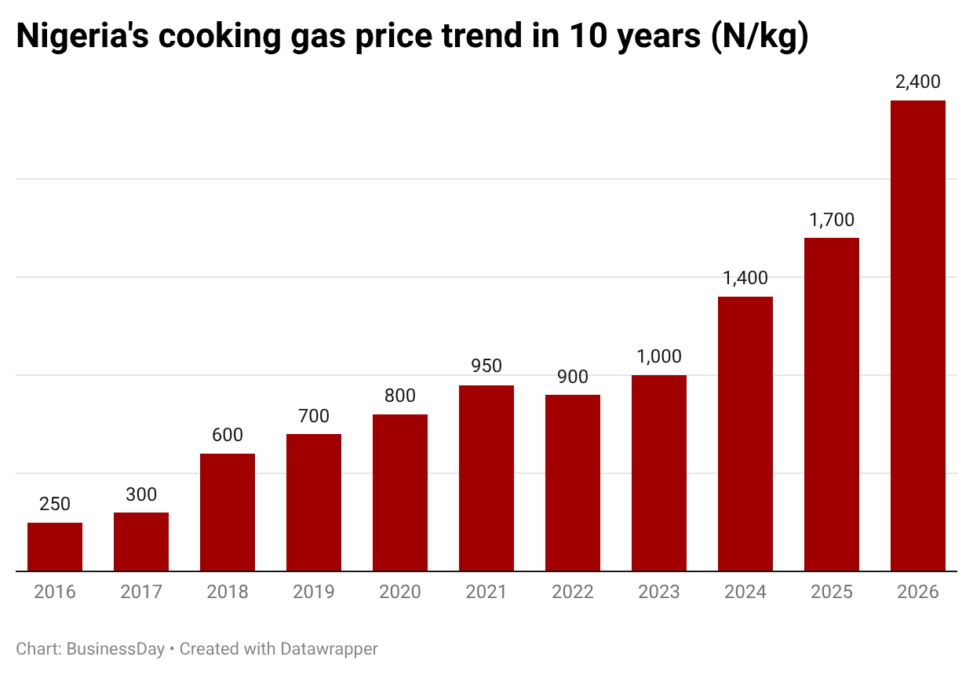
While studying chemical engineering at university in 2016, Michael Adesanya could buy a kilogramme of Liquefied Petroleum Gas (LPG), commonly known as cooking gas, for just N250. As a 200-level student living on a limited allowance, he had to budget every naira carefully, making the relatively affordable cost of cooking gas an expense he could easily accommodate.
He recalls a period in his life when, with a budget as low as N1,000, he could fill 2kg of his 6-kg gas cylinder for N500, sufficient to sustain him for about three weeks if he maintained his once-a-day eating habit, a habit peculiar to many students in Nigerian universities, and still afford a home-cooked meal with the balance.
However, 10 years down the line, not many students can afford such luxury, even with a rise in their monthly allowance. Between 2016 and 2026, cooking gas prices have jumped by more than 800 percent due to several supply bottlenecks reported by operators. But the price surge started gradually.
In 2018, prices increased marginally to N600/kg. By 2023, prices had gone beyond the three-digit mark to N1,000/kg. And by 2025, prices had moved to N1,400/kg. Today, gas prices range above N2,000, depending on location.
“Things have changed so much. It is difficult to reconcile how prices of cooking gas increased so much,” Adesanya lamented in an interview with BusinessDay.
Read also: Clean energy gains at risk as cooking gas nears N2,500/kg
Despite Nigeria’s position as home to the largest natural gas reserves in Africa, ranking among the top ten globally, more than 50 percent of domestically produced gas is exported.
Within the first three months of the year, Nigeria exported over 60 percent of its gas production, according to data obtained from the Nigerian Upstream Petroleum Regulatory Commission. This is compared to 38 percent left for local use in a population of over 200 million people. Gas retailers have confirmed that what they receive from depot operators is inadequate to meet local demand.
As of 2025, Nigeria recorded 2.71 trillion cubic feet of gas reserves, leading Algeria and Mozambique. Yet gas prices have elevated stubbornly over the last decade. While a need for foreign exchange is boosting exports, it comes at the cost of domestic demand.
In December, Nigeria’s largest producer of LPG, NLNG exported 2.1 billion cubic metres of gas. Analysts have said that while exports is a part of any growing economy, a defined portion of gas production should be reserved for households.
According to them, exports alone do not cook meals or reduce household expenses
“A clear domestic gas obligation regime should be enforced, ensuring that a defined portion of gas production is reserved for local LPG and power generation before export,” an analyst told BusinessDay.
This shortfall in local supply escalated when the US-Iran war began in February. From the moment the war started, the global oil market operated on the edge of uncertainty. Things took a more drastic turn when Brent crude hit a peak of $126.41/barrel, owing to an operational halt along the Strait of Hormuz.
Global gas supply was also affected. Operators polled by BusinessDay hint at a supply shortage at depots. They explained that rising international LPG benchmark prices and irregular inflows into key storage facilities have tightened the overall supply picture, leaving the local market exposed to shocks at multiple points along the chain.
Many households are currently struggling to sustainably fill their gas cylinders. The costs for a household relying on a 12.5kg cylinder have increased from N25,000 to N30,000, reflecting a 20 percent rise within two weeks.
Some Nigerians are now resorting to unhealthy alternatives like firewood and coal pots that not only pose severe health risks, but also dampen the country’s goal of achieving net-zero emissions by 2060 while eradicating energy poverty and driving economic growth.


Join BusinessDay whatsapp Channel, to stay up to date
Open In Whatsapp


