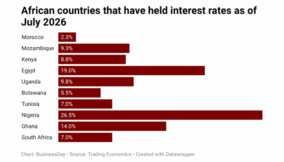
Kenya’s central bank left its benchmark lending rate unchanged at 8.75 percent on Tuesday for a second consecutive meeting, defying calls from commercial banks for tighter monetary policy as policymakers weighed rising inflation against slowing economic growth in East Africa’s biggest economy.
The decision was widely expected, with economists polled by Reuters and Bloomberg forecasting a hold after the Central Bank of Kenya (CBK) paused its easing cycle in April.
The move comes despite lobbying from the Kenya Bankers Association (KBA), which had urged the regulator to raise interest rates to curb mounting inflationary pressures triggered by rising global oil prices and the fallout from the Iran conflict.
Instead, the Monetary Policy Committee opted to maintain its current stance, arguing that existing policy settings remain sufficient to anchor inflation expectations and support exchange-rate stability.
“The MPC noted that there is need to continue monitoring the evolution of global oil prices and any second-round effects on inflation,” the central bank said in a statement.
The decision underscores the increasingly cautious approach adopted by African central banks as geopolitical tensions and higher energy costs complicate the inflation outlook.
Between March and June, central banks in Morocco, Mozambique, Namibia, Egypt, Ethiopia, Uganda, Tanzania, Nigeria and Ghana all left benchmark interest rates unchanged, signalling a broader shift from expectations of monetary easing toward a more cautious wait-and-see approach.
However, some policymakers have opted for tighter measures. Botswana, Rwanda, Mauritius and South Africa have raised interest rates in recent months as inflationary pressures intensified, while Angola and Zambia continued easing monetary policy amid improving inflation trends.
Inflation climbs but remains within target
Kenya’s inflation accelerated for a third consecutive month to 6.7 percent in May, its highest level since January 2024, driven largely by higher fuel costs linked to rising global energy prices.
Although inflation remains within the CBK’s target range of five percent plus or minus 2.5 percentage points, it is approaching the upper end of the band, increasing pressure on policymakers.
The regulator said inflation is expected to remain within target in the near term, assuming a de-escalation of tensions in the Middle East and continued government interventions to cushion fuel prices.
The outlook will also be supported by stable food prices resulting from favourable weather conditions, exchange-rate stability and existing monetary policy measures, it said.
Growth outlook weakens
While inflation risks are rising, concerns about economic growth also influenced the committee’s decision.
The CBK revised down its growth forecast for 2026 to 4.9 percent from an earlier projection of 5.3 percent, citing uncertainty stemming from the Middle East conflict and evolving global trade dynamics.
The downgrade highlights the difficult balancing act facing policymakers as they attempt to contain inflation without undermining economic activity.
Despite the weaker outlook, the central bank said high-frequency indicators continue to point to resilient economic activity in the first quarter of 2026.
The committee added that it remains prepared to act if inflationary pressures intensify.
“The MPC stands ready to take further action as necessary in line with its mandate,” the statement said.
The next monetary policy meeting is scheduled for August and will likely provide a clearer indication of whether Kenya joins the growing group of African countries tightening policy in response to rising energy-driven inflation.

Join BusinessDay whatsapp Channel, to stay up to date
Open In Whatsapp