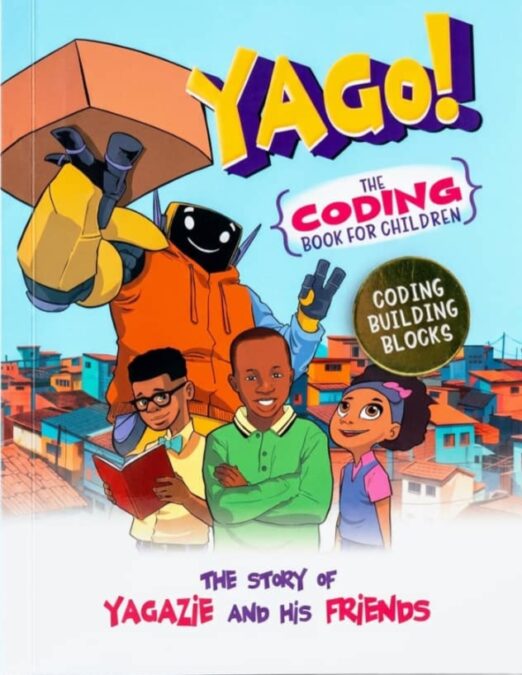
Title: Yago! The Coding Book for Children
Author: Akinyele Olubodun
Year of Publication: 2025
Number of Pages: 172
Category: Children’s Book
You can immediately tell that Akinyele Olubodun poured a great deal of passion, creativity, and genuine effort into Yago!. Even before opening the first page, the book already makes a strong impression. The cover is bright, beautiful, and highly creative, the kind of design that instantly captures a child’s attention. It reflects not only the imagination behind the story but also the author’s artistic talent beyond just teaching coding.
The subtitle is another clever and intentional touch. It immediately draws in any child with even the slightest curiosity about coding or technology. In a world where children are increasingly exposed to digital skills, Yago! feels both timely and relevant, offering an exciting entry point into programming.
From the very beginning of the book, you can feel the author’s excitement, and that energy naturally transfers to the reader. There is a genuine passion in the storytelling that creates curiosity and keeps the reader engaged, eager to continue turning the pages.
Interestingly, the book title is also the name of one of its main characters. The story quickly introduces Yago, who immediately becomes the centre of attention. We are also told about another important character, Yagazie, yet the author chooses not to reveal exactly who Yagazie is from the outset. Instead, the character is mentioned repeatedly without being fully introduced, leaving readers curious and searching for clues.
Whether this is a deliberate storytelling technique or not, it works well in creating intrigue. As the story unfolds, readers find themselves trying to piece together Yagazie’s identity while following Yago’s journey. This gradual unveiling of characters adds a sense of mystery to the book and keeps readers engaged, eager to discover how the different pieces of the story fit together.
What makes the book particularly strong is how approachable and inviting it feels. Rather than presenting coding as something difficult or intimidating, it transforms it into a fun, guided, and adventurous learning experience. Even readers who do not initially have an interest in coding may find themselves drawn in simply because of how easy the content is.
The visual presentation plays a major role in this appeal. The images, font style, layout, and overall design all contribute to a warm and engaging learning environment. There is something about the physical feel of the book that makes it enjoyable to hold which further enhances the reading experience.
One of the book’s strongest qualities is its clarity. The author avoids unnecessary complexity and ensures that instructions are simple and direct. Every concept is supported with clear visuals, making it easier for young readers to follow along without confusion. The pacing is slow and deliberate, giving kids enough time to absorb each idea properly before moving forward.
Another standout feature is how interactive the book is. Readers are encouraged to practise as they read, rather than waiting until the end of a chapter. This makes the experience more engaging and hands-on. At times, it begins to feel like being in a classroom setting where a teacher is guiding you step by step through each concept.
As the book progresses, the level of difficulty gradually increases. Early sections introduce simple ideas, while later sections become more challenging. This steady progression allows both Yago and the readers to develop together, building confidence and understanding over time.
Because of this structure, the book cannot be rushed. It requires patience, focus, and consistent attention. The best way to engage with it is to take it one chapter at a time, allowing each lesson to fully sink in. If rushed, the depth of learning may be lost.
This book is highly versatile in how it can be used. It works effectively in a classroom setting as a structured workbook where teachers guide students through exercises. It is equally useful at home, where parents can support their children and work through the activities together, making learning more interactive and meaningful.
One important consideration is that children who struggle with arithmetic may need additional guidance, as some sections assume a level of comfort with basic numeracy. With support, however, these challenges can be managed, and the learning experience remains rewarding.
Overall, Yago! is a thoughtfully designed educational book that successfully combines creativity, structure, and engagement. It is not only a tool for learning coding but also an experience that nurtures curiosity, patience, and problem-solving skills in young readers.
About the reviewer
Titilade Oyemade is a business executive in a leading organisation and holds a degree in Russian Language. She’s the convener of the Hangoutwithtee Ladies Event and the Publisher of Hangoutwithtee magazine. She spends her weekends attending women conferences, events and book readings. She loves to have fun and to help other women have the same in their lives. Email: [email protected] Social: @tiipreeofficial

Join BusinessDay whatsapp Channel, to stay up to date
Open In Whatsapp