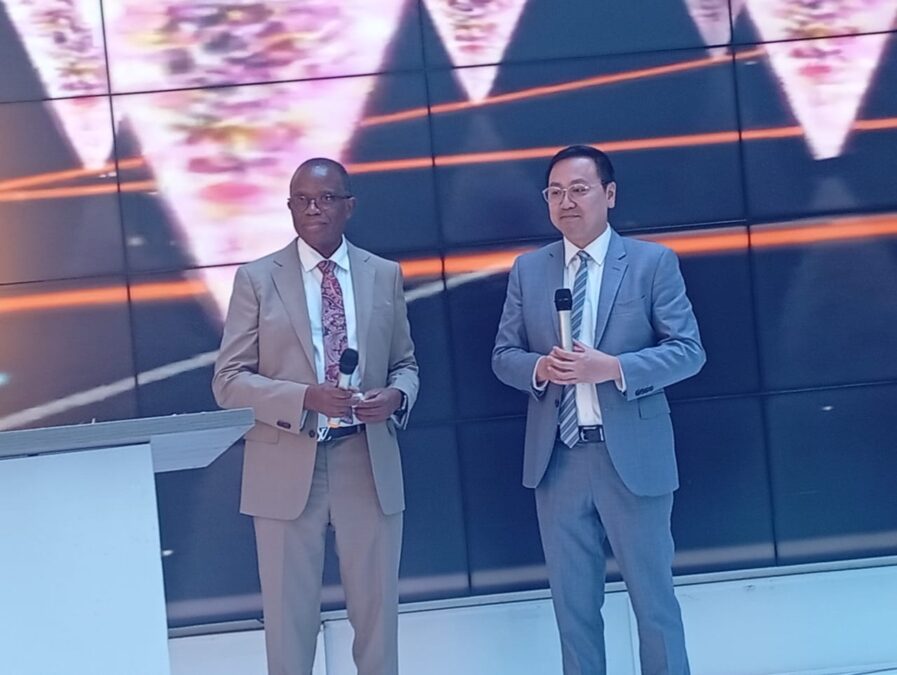
In a major move for the West African digital economy, Nigeria’s digital infrastructure pioneer, 21st Century Technologies, has forged a strategic partnership with China Mobile International Limited (CMI)—the global arm of the world’s largest telecommunications operator by subscriber count.
The collaboration aims to deploy a localized, highly advanced cloud and Artificial Intelligence (AI) infrastructure platform built directly on top of 21st Century’s massive data center footprint in Lagos.
Rather than a simple preliminary agreement, both companies have confirmed that project implementation is actively underway, with hardware deployment and localization protocols moving toward immediate commercial readiness.
The partnership comes at a critical time as Nigeria aggressively pursues data sovereignty and localizes its digital assets. By layering China Mobile’s global cloud resources, localized software tools, and agile AI incubation frameworks onto 21st Century Technologies’ underlying infrastructure, the joint project aims to give Nigerian enterprises, developers, and government agencies a massive performance edge—at a price point projected to be up to 40 percent cheaper than traditional global hyperscalers like Amazon Web Services (AWS), billed entirely in local currency.
For global tech giants, West Africa represents an uncultivated frontier for cloud architectures. Speaking on the strategic intent behind the rollout, Terry Leung, Chief Executive Officer for the Africa Region at China Mobile International Limited, emphasised that the collaboration is designed to move beyond traditional telecommunications into advanced sci-tech service delivery.
“We have an active, operational cooperation in the cloud space,” Leung explained. “We are co-building a comprehensive cloud platform in Nigeria, which is an exceptional start for both of us. Based on this platform, we will deliver an expanding suite of applications related to AI and cloud systems to the local market.”
When asked why China Mobile chose to anchor its Nigerian strategy with 21st Century Technologies, Leung pointed to the company’s deep market experience and localized execution model.
Leung clarified that the platform is not merely a long-term roadmap but an active deployment. “Today, we are past the phase of signing paperwork; we are already in the project construction phase and actively building out the resource platform. Very soon, it will be fully open for business.”
The economic implications for Nigeria are significant. Globally, the tech sector has entered a definitive “AI era,” where large-scale model training and intelligent applications rely heavily on high-performance cloud resource tiers. However, a stark regional digital divide remains across the continent.
Leung stressed that the project represents a crucial evolution beyond basic infrastructure: “A data center on its own is effectively real estate—it provides space, power, and cooling. That is only low-level infrastructure. Modern enterprises require complete, alternative solutions.
“This platform integrates cloud resources to help local businesses improve efficiency and give software developers an agile environment to incubate AI applications. If you lack these resources, catching up with global trends becomes incredibly difficult. The gap between Africa and developed countries will only widen, so we have to hurry.”
For Wale Ajisebutu, Chief Executive Officer of 21st Century Technologies, this partnership represents the culmination of an infrastructure journey nearly three decades in the making.
“I started 21st Century Technologies 29 years ago with a simple but profound vision,” Ajisebutu stated.
“To build compelling, world-class infrastructure in Nigeria that solves critical industry problems using best-in-class local talent. Crucially, we wanted to achieve this by partnering with global leaders while keeping operational sustainability at our core. For 29 years, we have built that physical foundation. Now, we are launching an operational partnership with China Mobile to revolutionize the local market.”
Responding to queries about the sheer scale of the deployment, Ajisebutu emphasised that 21st Century’s facilities go far beyond typical local server rooms, encompassing independent power plants, highly specialized data centers, and advanced training academies.
“Our digital infrastructure footprint is unmatched in Nigeria. To put it in perspective, the data center capacity we are building in this country is larger than all the other local data centers combined. It is that massive.”
Despite this immense capacity, critics often wonder whether the domestic market generates enough digital content to justify such heavy industrial investment. Ajisebutu strongly refutes the idea that the market is saturated, describing Nigeria’s digital space as “grossly uncultivated.”
This offshore data drain has long impacted local enterprises, exposing them to high dollar-denominated fees and severe foreign exchange volatility. When asked why local companies and government bodies continue to host critical data overseas despite having local options, Ajisebutu pointed to past market limitations while predicting an imminent shift.
“What we are executing right now is the beginning of a true digital renaissance in Nigeria,” Ajisebutu asserted.
“In the past, organizations faced subpar local options. But they will start coming back home very soon to leverage what we have built. There are no two ways about it: if you offer compelling solutions and world-class infrastructure, people will use it. Most of the players who have historically operated in this market are mediocre; they make loud announcements without building real capacity.”
For Ajisebutu, the ultimate competitive advantage comes down to economics and ease of access. “If I provide your business with a world-class cloud service that is 40 percent cheaper than AWS, and allow you to pay entirely in local currency without FX exposure, which one will you choose? The answer is obvious. You attract corporate clients by offering the absolute best technical and financial incentives.”
He also noted that the regulatory environment is aligning with this vision. “The federal government has already done its part by establishing clear data sovereignty policies. Now, it’s about continuous enforcement. Data generated in Nigeria must stay within Nigeria. Our cooperation with China Mobile is designed precisely to fulfill that mandate.
“They bring the advanced software applications and platform layers; we supply the industrial infrastructure. By combining these strengths, we are putting powerful tools directly into the hands of local businesses and developers.”

Join BusinessDay whatsapp Channel, to stay up to date
Open In Whatsapp