The global financial technology landscape is moving rapidly from basic digital transaction processing to highly advanced frontiers like artificial intelligence (AI), decentralized finance (DeFi), and complex automation systems.
Yet, as global commercial demand for sophisticated software engineering scales, sub-Saharan Africa’s fintech ecosystem continues to grapple with a persistent operational bottleneck: an acute technical skills shortage.
Bridging this structural gap requires a concerted, deliberate effort from both corporate entities and universities to make the industry visible, accessible, and aligned with practical enterprise application.
Standing at the center of this domestic talent transition is HabariPay, the financial technology subsidiary of Guaranty Trust Holding Company Plc (GTCO). The firm recently concluded the grand finale of its highly anticipated Squad Hackathon 3.0 at the GTCentre, marking the most ambitious, high-stakes iteration of the event since its inception.
What began as localized coding exercises in its 2024 and 2025 iterations has scaled into a rigorous national launchpad.
The annual event challenges student teams to create innovative solutions to problems within their immediate communities and the wider society.
By providing a platform for university and tertiary institution participants to showcase their technical capabilities, the hackathon serves as a vital stepping stone for young innovators to gain exposure, refine their skills, and potentially bring their solutions to market.
The Evolution of a Finclusion Revolution
The journey to Hackathon 3.0 was built on a foundation of rapid scaling. The first-ever edition, “Take on Squad Hackathon 1.0,” held at the state-of-the-art GTCO Training Complex (Tayo’s Plaza) in Abeokuta, Ogun State, focused on pushing young innovators to address operational bottlenecks using Squad APIs, cloud computing frameworks, and secure transaction protocols. Apart from cash rewards, the top three teams earned placement in the Squad Hackademy for internships and job opportunities.
By 2025, the second edition expanded into a three-day marathon themed “Finclusion Revolution: Unlocking Access, Empowering Communities.” That cohort produced platforms that digitized agricultural supply chains, enabled efficient group financial management, and streamlined property rental payments through integrated digital wallets—demonstrating deep proficiency in real-time transaction processing and algorithmic problem-solving.
The Hackathon 3.0 themed ‘Smart Systems: The Intelligent Economy,’ GTCO intensified its search for Africa’s next generation of tech architects with higher stakes, intense competition, and a wider set of problem statements.
Participants were given exclusive access to leverage Squad’s cutting-edge APIs to execute ideas that were technically sophisticated, economically relevant, and socially transformative.
A Tenfold Leap in the Tech Talent Pipeline
Reflecting the explosive momentum within Nigeria’s youth-led software ecosystem, this third edition recorded an unprecedented surge in engagement, drawing over 1,600 applications from university students across the federation.
Following a strict technical shortlisting process based on algorithmic competence, team composition, and verified GitHub portfolio submissions, 600 applicants were selected. Ultimately, more than 500 participants progressed to the grand finale to endure intensive coding sessions, product demos, panel discussions, and brainstorming marathons.
Eduofon Japhet, Managing Director of HabariPay, highlighted that student participation expanded more than tenfold compared to previous years, underscoring the platform’s role as a critical bridge.
“We realized there is still a wide gap between classroom theory and practical problem-solving,” Japhet noted during the finale.
“This platform is designed to help students build real-world solutions using emerging technologies like artificial intelligence and smart systems. We are not stopping at the competition; HabariPay is developing a long-term mentorship and talent pipeline program to support selected participants through structured training, tuition assistance, and potential employment opportunities over the next few years.”
AI-Driven Financial Inclusion: Team ‘Block X’ Takes the Crown
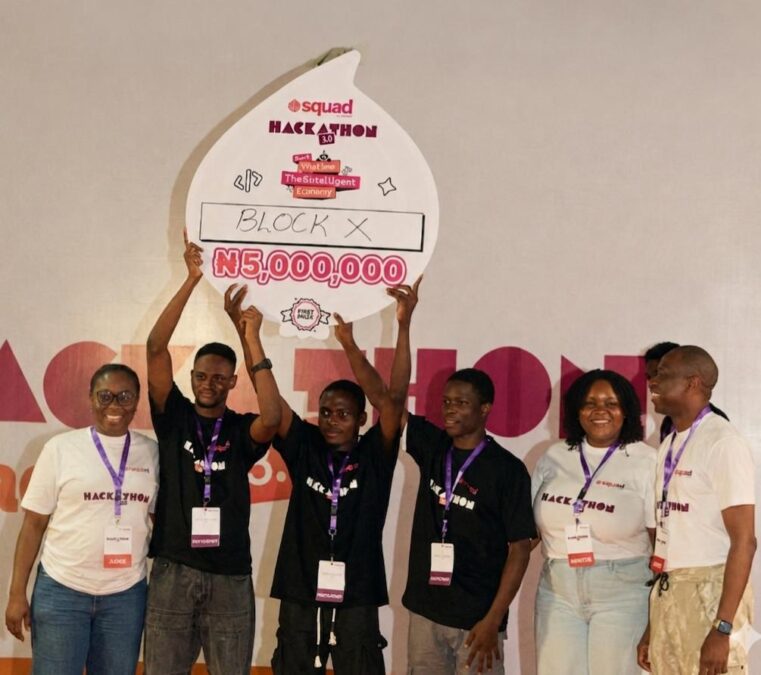
Following a highly competitive innovation showcase, the apex winner of Hackathon 3.0 was announced as Team ‘Block X’, an elite student engineering team from Obafemi Awolowo University (OAU).
The team—comprising Treasure Uvietobore (Platform & Systems Engineer), Naheem Olaide (Frontend & Machine Learning Developer), and Enoch Idowu (AI & Machine Learning Engineer)—secured the coveted first-place position and the grand prize of ₦5 million.
They impressed the panel of judges with Guild, an AI-powered platform specifically engineered to bridge Nigeria’s massive informal labor workforce with the formal financial architecture.
In a typical operational use case demonstrated during the live pitches, an informal artisan—such as a bricklayer—places a voice call to “Tola,” the platform’s localized Nigerian English voice agent.
The user is instantly matched to an open job opportunity, completes the assigned task, and receives secure, real-time digital payment routed directly through integrated Squad APIs.
Crucially, as these daily transactions pass through the system, the platform systematically generates a verifiable digital financial record for the worker. Within 90 days, this transactional footprint builds a reliable alternative credit profile, enabling previously unbanked informal laborers to access conventional banking services, commercial credit, and micro-loans.
Productivity Systems and Regulatory Balance
The action-packed environment also birthed standout solutions outside the financial inclusion space, emphasizing digital automation and workflow efficiency. Among the top-tier innovations was Tracker, an AI-powered workforce productivity monitoring platform designed by Sherif Sani, a Computer Science student at the University of Lagos (UNILAG).
The solution leverages machine learning models to analyze workflow patterns, task completion timelines, and browser activity for remote and onsite corporate teams. To balance operational visibility with compliance, the platform incorporates strict, privacy-focused monitoring controls, addressing a major operational concern for modern distributed businesses.
Reviewing the technical solutions, Segun Agbaje, Group Chief Executive Officer of Guaranty Trust Holding Company Plc (GTCO), emphasized that the ultimate value of the hackathon lies in developing resilient leadership capabilities through real-world execution.
“You are the best of the best. Everybody who made it into this room today is already a winner,” Agbaje stated, addressing the finalists. “The world is not ruled by extroverts; it is ruled by thinkers. Enterprise building requires resilience, deep collaboration, and ethical execution.”
By providing a structured ecosystem that pairs financial infrastructure with technical talent development, the HabariPay Squad Hackathon 3.0 reinforces GTCO’s broader institutional commitment to advancing innovation, mitigating the domestic IT skill deficit, and permanently positioning Nigeria as a leading hub in Africa’s expanding digital economy.

Join BusinessDay whatsapp Channel, to stay up to date
Open In Whatsapp