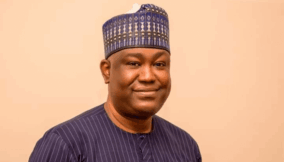
…Fault Oshiomhole’s claim on his influence on national politics.
Rotimi Amaechi, a former Rivers State Governor and former Minister of Transportation, has dismissed suggestions that his political differences with President Bola Tinubu are influenced by ethnic considerations, insisting that his identity is fundamentally Nigerian rather than tied to any regional or sectional affiliation
Amaechi, who is also a presidential aspirant for 2027 general election and prominent member of the African Democratic Congress (ADC), made the clarification during his recent interview on Trust TV News.
He was responding to interpretations that his political stance could be viewed as opposition from the South against a southern president. He rejected that framing, stressing that his political outlook is not shaped by ethnic loyalty.
According to him, “I don’t believe in ethnic politics. I am a Nigerian,” reinforcing his position on national unity over regional politics.
The former governor also reacted to comments attributed to former All Progressives Congress (APC) National Chairman, Adams Oshiomhole, which he said questioned his relevance in national politics.
Read also: APC primaries committee commends peaceful Assembly elections in Adamawa
Amaechi described the remarks as disrespectful and insisted he would not be drawn into a public altercation, particularly given their age difference and past political relationship.
He, however, maintained that he once occupied a superior position within the party structure, suggesting that Oshiomhole’s criticisms were inappropriate.
While hinting that he might address the matter at a later time, he declined to escalate the disagreement during the interview.
Amaechi also spoke on Nigeria’s ongoing debate over zoning and power rotation, describing it as a complex issue with both practical and political dimensions.
He acknowledged that zoning remains relevant in the country’s current political environment, where concerns about inclusion and balance continue to shape national discourse.
At the same time, he noted that there is no consensus among political leaders on the principle. Referencing former Vice President Atiku Abubakar’s rejection of zoning, he said differing positions make internal party processes, such as primaries, ultimately decisive in leadership selection.
He added that while zoning may serve a purpose for now, Nigeria’s political evolution continues to shape how such principles are understood and applied.

Join BusinessDay whatsapp Channel, to stay up to date
Open In Whatsapp