From banking expansion and sovereign credit upgrades to shifting startup dominance and resilient business activity, Africa’s largest economies are navigating a rapidly changing financial landscape shaped by currency volatility, geopolitical tensions and structural reforms.
This week’s key developments highlight how regional lenders, startups and governments are adapting to a tougher global environment while pursuing growth beyond traditional markets.
Access Bank UK overtakes Nigeria as biggest earnings contributor for first time
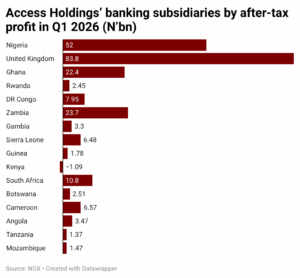
Access Holdings Plc’s United Kingdom subsidiary has overtaken its Nigerian operations as the group’s single largest earnings contributor for the first time, underscoring how the banking giant’s aggressive international expansion is steadily redrawing the geography of its profits.
BusinessDay analysis of the group’s first-quarter 2026 financial statements shows that Access Bank UK Limited, which was established in 2008, contributed more to group earnings than Nigeria, marking a symbolic turning point for a lender historically anchored by Africa’s most populous nation.
Why it matters: The development marks a major turning point for one of Africa’s largest banking groups, showing how Nigerian lenders are increasingly relying on international and pan-African operations to drive growth as earnings at home normalise. It also reflects the rising importance of trade finance and cross-border banking as global lenders retreat from parts of Africa.
Egypt dethrones Nigeria on FT fast-growing firms list
For the first time in four years, Egypt has dethroned Nigeria in the Financial Times ranking of Africa’s fastest-growing companies, signalling a shift in the continent’s startup hierarchy as the naira devaluations and broader macroeconomic pressures weighed on Nigerian firms.
The 2026 ranking, released Tuesday by the FT, a British media company in partnership with research firm Statista, placed Thndr at the top of the continent’s fastest-growing businesses, overtaking Nigeria’s Omniretail in the previous list.
Why it matters: The shift signals changing momentum in Africa’s startup ecosystem, with Egypt emerging as a stronger magnet for fintech growth and investor interest while Nigerian firms grapple with the impact of currency devaluation and macroeconomic instability. The ranking also highlights how exchange-rate volatility can reshape perceptions of business performance in emerging markets.
Fiscal reforms, economic recovery push Ghana’s rating to 5-year high
Fitch Ratings upgraded Ghana’s sovereign credit rating on Friday on the back of improving fiscal management and stronger foreign reserves, despite growing risks from the Middle East conflict that could threaten the country’s economic recovery.
BusinessDay analysis showed the latest upgrade marks the West African nation’s highest credit rating level since June 2021. The ratings agency raised its long-term foreign-currency issuer default rating to B from B-, with a Positive Outlook. The country is currently rated B- by S&P Global Ratings and Caa1 by Moody’s Ratings.
Why it matters: The upgrade strengthens confidence in Ghana’s economic recovery story after years of debt distress and restructuring. Improved ratings could lower borrowing costs, attract foreign investment and support the government’s efforts to restore fiscal stability, though external risks such as higher oil prices remain a concern.
Egypt’s inflation eases for first time in three months despite oil price shocks
Egypt’s inflation slowed in April for the first time in three months, defying expectations of sustained price pressures from the Middle East conflict that has driven up fuel costs and weakened the currency.
Data released on Wednesday by the Central Agency for Public Mobilization and Statistics (CAPMAS) showed that annual urban consumer inflation eased to 14.9 percent from 15.2 percent in March.
Why it matters: The slowdown offers policymakers temporary relief as Egypt battles one of the region’s toughest inflation crises. It also suggests that tighter monetary policy and stabilising supply conditions may be helping cushion the impact of higher global energy prices and currency weakness.
Business activity in Africa’s largest economy nears 4-year high despite Iran war shocks
Private sector activity in South Africa improved in April, with business conditions strengthening to near a four-year high despite mounting disruptions from the Middle East conflict.
The latest Purchasing Managers’ Index (PMI) released by S&P Global on Wednesday showed the headline index rose to 51.6 from 50.8 in March—the highest level since August 2022—marking a second consecutive month of expansion. A reading below 50.0 indicates contraction.
Why it matters: The improvement suggests Africa’s most industrialised economy is showing resilience despite geopolitical tensions and fragile global demand. Stronger business activity could support growth, jobs and investor sentiment at a time when South Africa is trying to rebuild confidence after years of power shortages and weak economic performance.
Chart of the Week

Join BusinessDay whatsapp Channel, to stay up to date
Open In Whatsapp