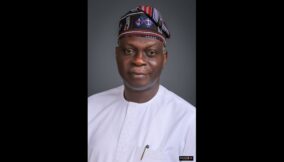
Samuel Obafemi George is a politician, technocrat and founder/CEO of Barachel Realty Limited, which manages real estate portfolio for high-net-worth individuals and corporate organisations valued in excess of over N750billion. He also sits on the board of several organisations and co-founded
of L.I.F.E. (Leadership, Inspiration, Family, and Entrepreneurial) Initiative, established in 2001. In this interview, he outlines some of the achievements of the President Bola Ahmed Tinubu administration and says the Nigerian president is a visionary for seeing what his predecessors ignored. BLESSING ADIMABUA brings the excerpts:
Tell us about your achievements in the corporate world?
I have overseen large-scale leadership and entrepreneurship programmes impacting over 34,000 students across secondary and tertiary institutions in South-West Nigeria. My conviction, growing up, is that L.I.F.E. are the four pillars that make up a society; good leadership, people inspired for patriotism and success, with respect for family values and an entrepreneurial culture.
So, what I’ve done over the years is to take back what I’ve learned in my journey of entrepreneurship and leadership to secondary schools and tertiary institutions to inspire Nigeria’s teeming youth population. I also sit on the board of Space and Shelter Limited. We have built quite a number of real estate properties across Lagos and southwest Nigeria. I joined the board of Lekki Concession Company, LCC, in December 2020 after the ENDSARS riot and served as a non-executive member for four years.
What have you done in politics, beyond your successful corporate strides?
I believe that patriotic citizens can’t sit on the fence and be complaining. So, I joined the Action Congress of Nigeria (CAN) in 2007, and 2008. I was a founding member of APC. I was the first Assistant Youth
Leader of APC in Eti-Osa local government. I contested for chairmanship of Eti-Osa LG in 2016. In 2018 and 2019, I was the director of Lagos State for the Buhari Campaign Organization. I ran the entire political architecture in Lagos State and was responsible for strategy implementation and door to door campaign and all of those.
Thankfully, God helped me and I did very well. I studied Political Science; holds bachelor’s degree from LASU, master’s degree from Unilag, and master’s degree in International Law and Diplomacy also from the University of Lagos. I’ve attended foreign courses in quite a number of places. The most recent being Kennedy School of Government in Harvard University in Boston, Massachusetts. I’m happily married with three wonderful kids.
As a real estate expert, what would you say is Nigeria’s problem in providing affordable mass housing for its citizens?
Coincidentally, I was on TV about a week ago and I was asked, what my expectations of the new Minister for Lands and Housing ae? I said for me, the game changer will be if he could come up with a social housing policy that could deliver. Historically, the only leader that has been able to crack that code was the late Alhaji Lateef Jakande as Governor of Lagos. Unfortunately, since then, we’ve been struggling with producing or delivering social housing across Nigeria.
Did you ever meet him in person?
Before the man died, I was privileged to meet with him in 2019. I’d structured a campaign trip to his house, with the current governor of Lagos State, his deputy and the former vice president. I asked Baba Jakande: How did you do it in the 80s? How did you deliver so many low-cost housing communities that still flourish all over Lagos today? The Jakande Estates are still the reference point when it comes to social housing in Lagos State, and here is what he shared with me. He said, number 1, it was not an economic decision, but a political decision. You see, one of the reasons why we haven’t been able to deliver social housing in Nigeria is because successive governments haven’t looked at it from the welfare perspective. Once you anchor it on economic indices, you take it out of the sphere of social housing, and make it a commercial transaction. All the assets that have been built so far across the country as housing are hinged on economic costs; costing the land, road, power, water, infrastructure, among others. Once you do that, it becomes a commercial venture and you take it out of the reach of the people at the bottom of the pyramid.
You are a pioneer party man and an expert realtor. So, what can be done in terms of housing in a state like Lagos in these modern times?
Narrowing it down to Lagos, it has to be public and private sector-driven because the government alone can’t bridge the gap. Lagos State’s population has more than quadrupled since the 80s to between 18 to 21 million. Based on statistics, the housing deficit in Lagos is about 3.4 million. No state government alone can deliver 3.4 million houses in four or even eight years. We need to begin to go vertical in our construction of social houses as they did in Singapore.
With poverty rising to 63 percent according to the World Bank, shouldn’t APC be taking steps to reduce poverty dramatically given the global index that rates Nigeria badly?
First from my perspective as a political scientist, when you see data from the Western world, you must learn that not every data is objective. It is in the interest of the West to paint Africa as a dark continent; a jungle that needs a messiah from Washington, New York or London. They try to control the global narrative. When COVID 19 came, Bill Gates and others like him said they were going to be picking up corpses on the streets of Africa. Same thing happened during the Ebola pandemic. But they were shocked. Our medical institutions, doctors, nurses, paramedics, government and wealthy individuals beat the pandemics hands down. The West knows that once Nigeria gets it right economically, Africa will get it right. And once Africa gets it right, take it or not, it’s going to affect Western economies negatively. So, it is not in their interests that we get it right economically. So, I will rather focus on the statistics that shows we are making progress
Now back to the question, the government of President Bola Ahmed Tinubu is investing massively in infrastructure, from roads to airports and seaports. There is investment in tertiary education supported by a transparent scholarship programme that is flawless. These are the long-term investments that take a nation out of poverty. Let me give you an example. China created a pathway to lift almost a billion people out of poverty. You need to create infrastructure for that, long-term. They also invested massively in education. They created special economic zones, comparable to what we call free trade zones. Those are the three things they did. In the first 10 years, nothing much happened. China’s economy only grew by 100 percent. But they did not stop. They kept doing those three things. By 1999, 20 years after, they crossed the $1 trillion-dollar threshold from just $99-billion-dollar economy 20 years before. By 2024, China’s economy was worth over $18 trillion. So, when you see a data that says poverty is increasing in Nigeria, that is just one side of the data. Can we quantify our investment in education, infrastructure and the free trade zones?
So beyond western criticism, how have we fared as a country?
Let’s begin to track the growth and look at this data together. APC came to power in 2015. By 2016, global price of crude oil dropped to 27 dollars per barrel from 100 dollars in 2014. Let’s personalise it. If your salary was N100,000 per month, and it suddenly dropped to N27,000 per month, yet your obligations and expenses keep increasing rather than drop, what choice do you have but to borrow? Since 1970, every government has promised a Second Niger Bridge in political campaigns, but nobody did it. As a matter of fact, a former president launched the bridge in 2014 with no drawing, no nothing. Who delivered on that bridge? An APC government started and finished that bridge even though when he contested, President Muhammadu Buhari did not win any of the South-East states. Secondly, since 1908 when the first railway station was built in Lagos, no government either colonial or Nigerian, ever started a rail project and finished it, except the APC-led government. Thirdly, we’re talking about infrastructure. The Lagos-Ibadan Expressway has been under construction since 2006 and was not built until President Muhammadu Buhari came and completed it. As at 2015, when President Goodluck Jonathan was leaving, his PDP-led government spent N3 billion to launch the flag off of the construction of the Shagamu interchange, but that interchange was just built and completed two weeks ago by President Bola Tinubu’s APC-led administration. And there is the Lagos-Calabar Coastal Highway, where construction is going on at net breaking speed. Funding for the Sokoto-Badagry expressway has just been approved.
Aren’t you over-hyping this administration?
But let’s look at the BRT buses, which Ghana came to understudy. Some of these buses are so comfortable and convenient that some are even air-conditioned. So quickly, Lagos has almost forgotten the derelict and dangerous Molue buses we used to commute in. This is visionary leadership, stirred up by our party leader and head of government. Tinubu created the free trade zone in 2003 that today now houses Africa’s largest investment – the Dangote Refinery – that Nigeria is proud of. A visionary leader doesn’t always do what is popular, but what is needful. Tinubu was heavily criticised for creating the free trade zone. His promise of a deep seaport was disbelieved. And they started voting against ACN in 2007, against AC, against APC in 2015. All of a sudden, Lagos has a deep seaport there now. Today, land that was selling N80,000 per plot has turned quite a few of the indigenous land owners into billionaires, marrying second, third and fourth wives. Now, they’ve made a complete U-turn to see what Tinubu saw 20 years ago, which they did not see. Look at the economic explosion along that Lekki corridor, which the United Nations has described as the fastest growing corridor in Africa.
Now, in terms of policies, all the candidates had similar manifestoes in 2023 that would remove fuel subsidy. But it is doubtful if any of them would have the guts to do it. It could have just been a mere campaign promise that would melt away once they saw the cabal behind fuel subsidy. Jonathan couldn’t do it. To govern a country as complicated as Nigeria, you need a man in office who is street smart, globally exposed, and can dare anyone based on his convictions. Nigeria will consume Peter
Obi completely. Looking at all the candidates for 2027, none of them has Tinubu’s competence, capacity or sagacity.
But Nigerians say while Tinubu’s government increase its borrowing, they swim in poverty?
Here is the thing. When you borrow to build legacy infrastructures, it is highly justifiable. The United States of America passed the Federal Aid-Highway Act of 1956 into law, a law that enabled the construction of speedy highway development and road infrastructure across the length and breadth of America. Today, America’s road network is phenomenal and has made it the largest economy in the world. The same aggressive road infrastructure development has made China the second largest economy in the world. That is why our government must remain aggressive about road, rail and waterway infrastructure development. The Lagos-Calabar Coastal Highway has been in the plans since the 70s to open up trade and travel within Nigeria as well as link up with the idea of an African Continental Highway envisioned by the Organization of African Unity, now African Union. Again, only the APC-led government of Tinubu has taken this step. It is a visionary 50-year project, which every leader before Tinubu had abandoned. It will cut through three economic zones – South-West, South-East and South-South. Besides, World Bank figures affirm that for every $1 billion spent on infrastructure, you create a minimum of 150,000 jobs directly, not to talk of the multiplier effect of indirect jobs that would also create. So, if anyone says that poverty has increased, it is only temporary. When these massive infrastructural investments begin to catch up and galvanize our economy, we would all look back, see and benefit from this genius strides. As a nation we either pay now and play later, or play now and pay much more later. All of this sounds surreal.
But life itself has become almost unbearable for Nigerians.
This reality is painful for every right-thinking Nigerian. You see, as of December last year, Nigeria’s economic figures were positive in all ramifications, even at the macroeconomic level. January this year, our economy was on cruise control. Then all of a sudden, we all woke up to the news that Israel had attacked Iran. The result of that, coupled with war escalations between Russia and Ukraine, has toppled the global economy and Nigeria doesn’t exist in isolation. That singular crisis crashed Nigeria’s economic projections, and that is beyond anybody’s control. Just two weeks ago, Germany – the strongest economy in Western Europe – cut its economic projections by half. No country or president has control over global economic shocks. Where we are as a nation is temporary and we are on the right path to a prosperous nation.
With the way you defend the government, some may call you an incurable optimist or party loyalist?
I am a party loyalist, no doubt about that, but I don’t follow people blindly. There are hard decisions that government must take, not just to rescue Nigeria, but to position it for true continental leadership. Tinubu’s predecessors refused to make those tough calls that Nigeria needs. Let me give you example. When President Tinubu came in, the first thing he did was to remove fuel subsidy. He didn’t allow it for any public debate. In his maiden speech, he declared subsidy was gone forever.
For the past 15 years, we have been sinking billions of dollars into foreign refineries all in the name of subsidy and watch our own refineries fail. It is hard on everyone now, but it is a price we must pay for a better tomorrow. I don’t have a second passport, neither do I plan to relocate, so we must make Nigeria work for us all.
The opposition, especially Peter Obi, appears to be resonating among the people. Aren’t you worried that Tinubu seems to be losing the support of Nigerians?
A former governor of Lagos State is not comparable to a former governor of Anambra. This year, the budget of Anambra is N766 billion, whereas that of Lagos is more than four times at N4.3 trillion. If you will situate that and without disrespect to Obi, he can only be at best a commissioner of works in Lagos State. When Tinubu was Lagos governor, almost all the states were of equal standing, with no money, no nothing. In eight years, he created about 14 agencies, which other governors criticised back then, but over 20 states have duplicated the same agencies for more meaningful governance. In terms of infrastructure, Lagos is the only state, now under Governor Babajide Sanwo-Olu, that has built a railroad train system, which countries in Africa can only still dream about. The Red Line and Blue Line have transported over two million people. Today Lagos State boasts of a deep seaport, a refinery located in Lekki Free Trade Zone just to mention a few. The foundation for all of these were laid by President Tinubu when he was Lagos State governor. Can you point to similar legacy projects in Anambra State that Peter obi did? The answer is no.

Join BusinessDay whatsapp Channel, to stay up to date
Open In Whatsapp