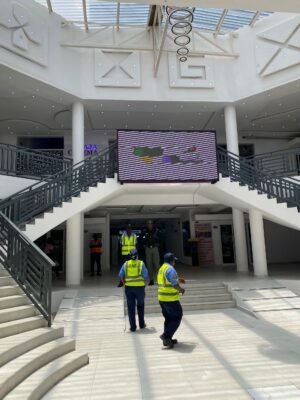
Shopping malls in Lagos are changing. They are no longer just places to buy things. In a city where public infrastructure is stretched, they are becoming self-contained systems, combining retail, power supply, security, and even community space in one location.
Ojaja Mall, on the Ogombo-Ajah axis, is one of the latest examples of that shift. Owned by Oba Adeyeye Enitan Ogunwusi, the Ooni of Ife, the development sits on about 18,000 square metres. It brings together shops, a hotel, leisure facilities, and a small technology hub within the same complex.
A PRIVATE SOLUTION TO PUBLIC GAPS
Running a business in Lagos is expensive. Power alone can take a large share of operating costs, with many shop owners relying on diesel generators for most of the day. An electronics retailer running a generator in Lagos can spend 30,000 to 50,000 naira daily on fuel alone, depending on the model and load.
At Ojaja Mall, electricity is managed centrally. The complex combines generator power with supply from Eko Electricity Distribution Company. The facility gets 18 hours of guaranteed power from EKEEDC daily, with synchronised generator backups covering the remainder. For tenants, that means fewer interruptions and more predictable costs.
“That allows businesses to stay open longer and plan better,” Adebimpe told BD Weekender during a media tour of the facility.
She led the project from construction to opening, after a career that began in banking and finance. The build took about two and a half years.
“With the grace of God Almighty, I started with my team of engineers. I have mechanical engineers, structural engineers, electrical engineers, and architects,” she said. “There were no deaths or injuries during construction, a significant achievement on a Lagos project of this scale.”
PRICING IN A TIGHT ECONOMY
Nigeria is dealing with high inflation and weaker consumer spending. Nigeria’s inflation rate hit 15.38 percent in March 2026, with consumer spending weakening significantly. In that context, Ojaja Mall is trying to position itself as a lower-cost retail option within its area.
According to management, some goods are priced below what is available in nearby outlets. “It’s not just about profit,” Adebimpe said. “It’s about helping people grow and creating opportunities.”
Furthermore, the mall’s philosophy, rooted in what the Ooni calls “Ojaja Moore”, a Yoruba phrase meaning “the more we are together, the happier we shall be”, extends to its structure.
The complex houses 295 retail shops in total, with an additional 30 standard rooms, three one-bedroom maisonettes, and two deluxe apartments within Ojaja Suites.
JOBS AND LOCAL SUPPLY
About 1,000 people work within the mall’s ecosystem, according to its operators. That includes retail staff, cleaners, security workers, and service providers. This represents one of the project’s most direct economic impacts on the Ajah neighborhood.
There is also a significant focus on local sourcing. Much of the furniture and interior work was produced in Nigeria, supporting carpenters and small-scale manufacturers.
As Adebimpe explained, “We are based on made-in-Nigeria products. Most of the products sold in the shopping center, artworks, picture frames, most of the chairs were made here.” This commitment to local procurement strengthens the economy beyond the mall’s immediate operations.
LIVING, WORKING, AND STAYING IN ONE PLACE
Attached to the mall is Ojaja Suites, a boutique hotel designed to operate as part of the same environment. Guests can access a swimming pool, cinema, lounge, and business centre without leaving the complex.
“The idea is convenience,” said Ikegwune Endurance, operations manager of Ojaja Suites. “You can stay, work, and relax in one place.” In Lagos, where traffic can take hours each day, that kind of setup can be a strong selling point.
The mall also includes an AI centre. Management says it is intended as a space for learning and digital skills.
OPERATIONAL DISCIPLINE
Operating a facility of this scale demands relentless attention to detail. Adebimpe acknowledged the challenge openly: “It’s a 24 hours work. My team and I work around the clock. It’s a Monday to Sunday thing.”
Fire safety protocols are built in, with some rooms designated as non-smoking and smoke detectors installed throughout. Other rooms accommodate smokers while maintaining safety standards.
EXPANSION AND VISION
The vision extends far beyond Lagos. There are already plans to expand the model to other locations, including Ibeju-Lekki near the Dangote Refinery and across the Southwest. “The plan is to have Ojaja Mall in all parts of the Southwest,” Adebimpe confirmed, with international expansion to Ghana, Cameroon, and Dubai following soon after.
The mall offers a snapshot of how retail is evolving in Lagos, as a mix of commerce, services, and community.
For a city wrestling with power shortages, high business costs, and a shortage of community gathering spaces, this model presents a practical solution built by private capital but designed around public benefit.

Join BusinessDay whatsapp Channel, to stay up to date
Open In Whatsapp