…joins Egypt, Nigeria, Kenya as price pressures re-emerge across Africa
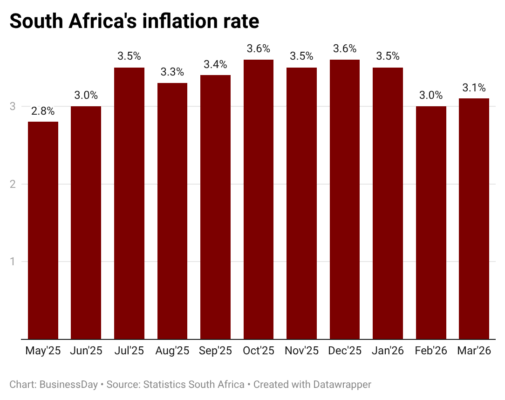
South Africa’s inflation edged higher for the first time in three months in March, even before the full impact of the Iran-linked oil shock filtered into domestic fuel prices—signalling renewed price pressures in Africa’s most industrialised economy.
The uptick comes amid rising global uncertainty triggered by escalating tensions involving the United States, Israel and Iran, which have already pushed oil prices higher and raised concerns about imported inflation across emerging markets.
Annual consumer inflation rose to 3.1 percent from 3.0 percent in February, according to the latest Consumer Price Index (CPI) data released by Statistics South Africa on Wednesday. The increase places South Africa alongside countries such as Egypt, Nigeria, Zimbabwe and Kenya, where inflation has also begun to trend upward again.
On a monthly basis, prices increased by 0.6 percent in March. Six of the 13 CPI basket categories recorded faster annual increases, including restaurants and accommodation services, education, transport, housing and utilities, information and communication, as well as recreation and culture.
Education and transport costs drive pressures
Education and transport emerged as key drivers of the March inflation print, reflecting both seasonal adjustments and shifting cost dynamics.
The education component—updated annually in March—rose by 5.4 percent in 2026, higher than the 4.5 percent increase recorded in 2025. Primary and secondary education costs climbed by 6.2 percent, while tertiary education rose by 4.2 percent. Private secondary schools recorded the sharpest increase, with fees up 7.5 percent.
Transport inflation, while still in deflationary territory, showed signs of firming. The annual rate improved to -1.6 percent from -2.1 percent, indicating that transport costs remain lower than a year ago but are rising gradually.
Fuel prices declined by 8.7 percent over the 12-month period, helping to keep transport inflation subdued, although vehicle prices edged up by 0.4 percent. On a monthly basis, passenger transport fares rose sharply, increasing by 1.6 percent, driven by a 20 percent surge in long-distance bus fares and a 14.3 percent rise in airfares.
Notably, last month’s CPI data does not capture the sharp fuel price increases implemented on April 1. The impact of these adjustments is expected to reflect in the next CPI release scheduled for May 20.
Food inflation eases further
In contrast, food inflation continued to moderate, offering some relief to households.
The annual rate for food and non-alcoholic beverages slowed to 3.6 percent, down from 3.7 percent and 4.4 percent in January—the lowest level in a year. Four of the 11 food categories recorded deflation, including fruits and nuts, vegetables, cereals, and dairy products.
The dairy and eggs category remained in deflation for a tenth consecutive month at -0.5 percent, with prices for fresh milk, powdered milk and eggs all lower than a year ago.
Cereal prices declined by 1.0 percent on average, with staples such as rice, maize meal, bread and noodles becoming cheaper compared to March 2025.
Meat prices also showed signs of easing on a monthly basis, with declines recorded across key beef products. However, annual meat inflation remained elevated at 11.6 percent, though down from 12.2 percent in February. Pork and processed meat products such as bacon bucked the trend, recording price increases.
Housing, wages and services show mixed trends
Other components of the CPI basket painted a mixed picture.
Rental inflation picked up, with actual rents rising by 4.0 percent in the first quarter of 2026, compared to 3.7 percent in the previous quarter. Townhouses recorded the fastest rental growth at 5.1 percent, followed by flats (4.2 percent) and houses (3.7 percent).
Domestic worker wages increased by 3.7 percent in the first quarter, slightly below the 3.8 percent rise recorded in late 2025.
Meanwhile, accommodation services saw a notable spike, rising by 5.4 percent month-on-month to an annual rate of 12.2 percent. University boarding fees and hotel prices were key contributors to the increase.
Mixed inflation trends across Africa
Across Africa, inflation trends are becoming increasingly divergent, reflecting differences in domestic policy, currency stability and exposure to global shocks.
While countries such as Ghana, Ethiopia, Angola and Mauritius continue to experience disinflation, the pace of improvement has slowed. Inflation remains in single digits in several economies, including Ghana (3.2 percent), Ethiopia (9.4 percent), Mauritius (2.7 percent) and Zambia (7.1 percent), according to Trading Economics data.
Tanzania has maintained relative stability, with inflation at a nine-month low of 3.2 percent, while Angola’s inflation eased to 12.42 percent—its 21st consecutive monthly decline and lowest level since July 2023.
However, price pressures are building again in several major economies. Egypt’s inflation rose to 13.6 percent, while Kenya and Zimbabwe both recorded 4.4 percent, reflecting the pass-through effects of higher fuel costs. Nigeria’s inflation also edged up to 15.38 percent from 15.06 percent.
The World Bank warned in a recent report that inflation risks across the continent remain skewed to the upside, citing global uncertainty, rising energy and food prices, and currency pressures linked to geopolitical tensions.
South Africa’s inflation uptick—coming even before the full impact of higher global oil prices—suggests that the disinflation trend seen across parts of Africa may be nearing its end.
With fuel price increases yet to fully feed into consumer prices, central banks across the continent could face renewed pressure to maintain tighter monetary policy for longer, potentially slowing growth and delaying rate cuts in 2026.

Join BusinessDay whatsapp Channel, to stay up to date
Open In Whatsapp