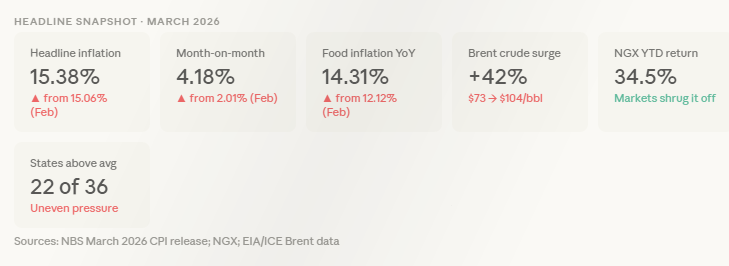
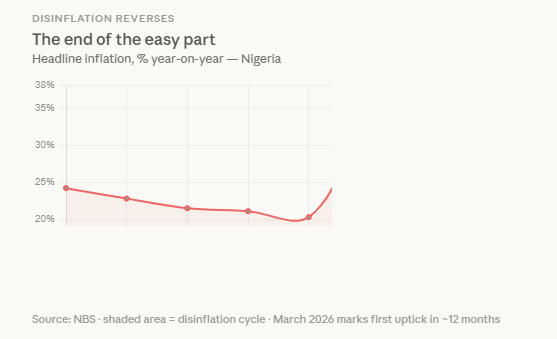
For nearly a year, Nigeria’s macroeconomic narrative had been cautiously optimistic. Inflation had been trending downward, monetary tightening appeared to be working, and exchange rate reforms were gradually stabilising the naira. But March 2026 may prove to be a turning point. Data shows that headline inflation rose slightly from 15.06% in February to 15.38% in March, marking the first upward movement in nearly a year and signalling the possible end of the disinflation cycle.
At first glance the increase appears modest, a 0.32 percentage point rise, but beneath that number lies a deeper story about structural pressures within Nigeria’s economy. Month-on-month inflation surged far more sharply from 2.01% to 4.18%, revealing that price pressures are rebuilding quickly across multiple sectors.
This shift is not simply a statistical fluctuation. It reflects a complex mix of external shocks and domestic bottlenecks — rising energy prices linked to geopolitical tensions in the Middle East, higher transportation costs, exchange rate pass-through effects, and persistent logistics constraints in Nigeria’s food supply chains. The message is clear: Nigeria’s inflation battle is entering a new and potentially more complicated phase.
Food Inflation Still Dominates the Story
Food prices remain the single most powerful driver of inflation in Nigeria. In March, food inflation climbed from 12.12% to 14.31% year-on-year, reflecting continued pressure from supply disruptions, insecurity in food-producing regions, and high transportation costs. The country’s food inflation dynamics highlight a structural problem rather than a cyclical one. Agricultural production continues to face disruptions from insecurity in key farming regions, while weak storage infrastructure and poor logistics networks push up distribution costs across the country. Interestingly, month-on-month food inflation slowed slightly from 4.69% to 4.17%, suggesting that seasonal supply improvements may have provided temporary relief. Yet this moderation does little to change the broader picture: Nigeria’s food system remains vulnerable to shocks. Until transportation networks improve, insecurity declines, and agricultural productivity rises, food inflation will continue to dominate the country’s price dynamics. In effect, Nigeria’s inflation problem is not merely a monetary phenomenon—it is fundamentally structural.
Regional Inequality in the Cost of Living
One of the most revealing insights from the inflation report is the stark divergence across Nigerian states. While the national headline inflation rate stands at 15.38%, twenty-two states recorded inflation above the national average, reflecting the uneven distribution of economic infrastructure and security conditions across the country. States such as Bayelsa and Sokoto recorded extremely high food inflation rates of 33.35% and 28.02% respectively, highlighting the severe cost-of-living pressures faced by residents in these regions. These elevated figures are largely driven by food supply disruptions and transportation challenges.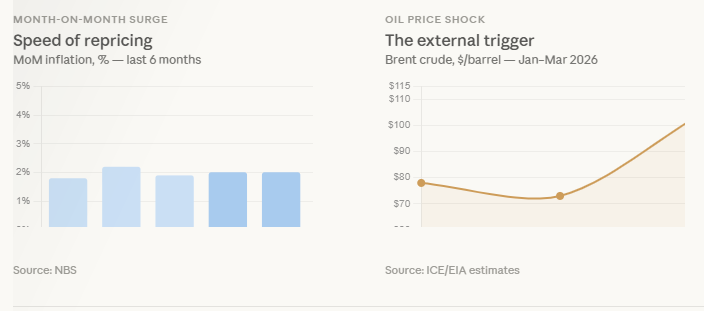
By contrast, states such as Lagos recorded significantly lower inflation levels around 9.63%, reflecting stronger logistics networks, better market integration, and proximity to major commercial hubs. This divergence reveals a deeper structural reality: inflation in Nigeria is not a uniform national experience. Instead, it is shaped by infrastructure gaps, regional insecurity, and uneven access to markets. Any serious policy response must therefore incorporate regional economic development alongside national monetary management.
External Shocks and the Energy Transmission Effect
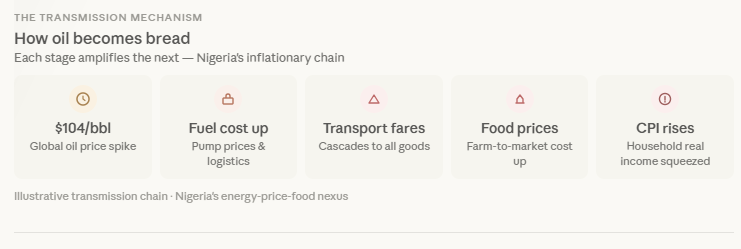
The global environment is also playing a critical role in Nigeria’s inflation trajectory. In March 2026, Brent crude prices surged dramatically from roughly $73 per barrel in February to about $104, representing a 42% increase driven by geopolitical tensions around the Middle East and the Strait of Hormuz. For Nigeria, higher oil prices are a double-edged sword. On one hand, they increase government revenues and strengthen foreign exchange inflows. On the other, they drive up domestic fuel costs, which then cascade through the economy via transportation and logistics expenses.
The inflation transmission mechanism is straightforward: higher fuel costs raise transport fares, increase production expenses, and push up the price of goods and services across the economy. The March inflation data therefore reflects not only domestic structural constraints but also the growing influence of global geopolitical developments on Nigeria’s economic stability.
Why Nigeria’s Stock Market Is Thriving Amid Inflation
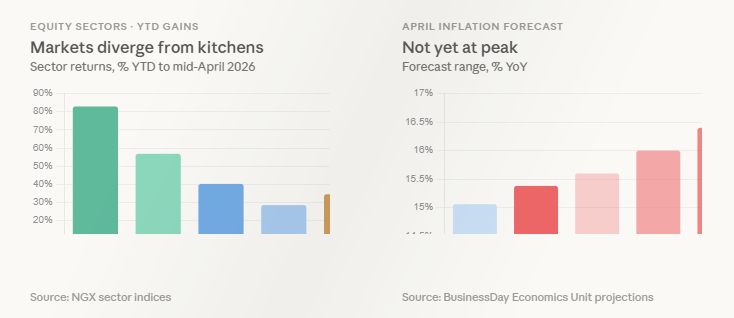
Perhaps the most intriguing aspect of Nigeria’s current macroeconomic environment is the divergence between inflation and financial markets. Despite rising price pressures and high interest rates, the Nigerian equity market has delivered remarkable returns. The NGX All-Share Index rose by 4.39% in March, crossing the historic 200,000-point threshold, while year-to-date returns reached 34.51% by mid-April 2026. This performance reflects several structural dynamics. Investors are increasingly viewing equities as a hedge against inflation, particularly in sectors with strong pricing power. The oil and gas sector recorded year-to-date gains of about 82.9%, while industrial goods rose by roughly 56.8% and banking stocks by over 40%. These sectors benefit directly from macroeconomic conditions. Oil companies gain from rising crude prices, banks benefit from higher interest margins in a tight monetary environment, and cement producers are able to pass rising input costs on to consumers due to strong demand from infrastructure and construction.
The Policy Dilemma for the Central Bank
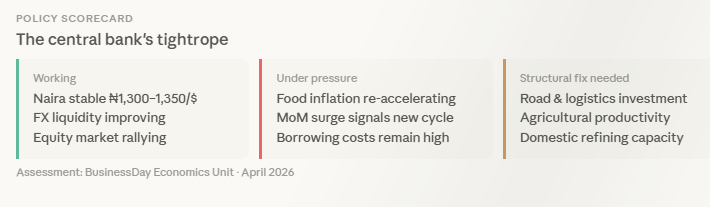
For policymakers, the resurgence of inflation creates a delicate balancing act. The Central Bank of Nigeria has maintained a tight monetary stance, with high interest rates helping to anchor inflation expectations and support currency stability. The naira has remained relatively stable within the ₦1,300–₦1,350 per dollar range, supported by improved FX liquidity and policy reforms encouraging the repatriation of export proceeds. However, continued tightening also raises borrowing costs for businesses and households, potentially slowing economic growth. The challenge therefore lies in balancing price stability with economic expansion. If inflation pressures persist, the central bank may be forced to maintain high interest rates for longer than anticipated, prolonging tight financial conditions across the economy.
Implications for Government and Economic Policy
For government policymakers, the resurgence of inflation highlights the urgent need to tackle Nigeria’s structural economic weaknesses. Monetary policy alone cannot solve inflation driven by logistics failures, insecurity, and agricultural inefficiencies.
Investments in transportation infrastructure, food storage systems, and agricultural productivity must become national priorities. Reducing post-harvest losses, improving rural road networks, and expanding irrigation systems would significantly lower food supply volatility. Equally important is the need to strengthen domestic energy infrastructure. Nigeria’s reliance on imported refined petroleum products exposes the economy to global oil price shocks, amplifying inflationary pressures whenever geopolitical tensions disrupt energy markets.
Strategic Implications for Investors and Businesses
For investors, Nigeria’s current environment presents both risk and opportunity. Inflation and high interest rates typically discourage investment, yet certain sectors are proving remarkably resilient. Companies with strong pricing power—particularly in cement, oil and gas, and banking—are emerging as effective inflation hedges. Meanwhile, sectors dependent on consumer purchasing power, such as consumer goods, face greater challenges as rising prices erode household spending capacity.
Businesses must therefore focus on cost efficiency, supply chain optimisation, and pricing strategies that protect margins without undermining demand. Firms that successfully adapt to inflationary conditions will likely emerge stronger once macroeconomic stability returns.
Looking Ahead: Inflation May Rise Further
Looking forward, inflation may not yet have reached its peak. Forecasts suggest that April inflation could rise to between 15.6% and 16.4% year-on-year, driven by energy costs, seasonal demand pressures during the Easter period, and continued geopolitical uncertainty. These pressures reinforce the reality that Nigeria’s inflation trajectory will remain closely tied to global energy markets and domestic supply chain efficiency. Yet there is also reason for cautious optimism. Higher oil prices may improve foreign exchange inflows, supporting the naira and helping to moderate imported inflation. If currency stability holds and structural reforms accelerate, the economy may eventually stabilise despite short-term price pressures.
The Bigger Economic Lesson
Nigeria’s inflation story in 2026 is not simply about rising prices. It reflects a deeper transformation of the economy—one shaped by global geopolitical shocks, domestic structural weaknesses, and evolving financial markets.
The lesson for policymakers, investors, and businesses alike is clear. Inflation is no longer just a monetary phenomenon. It is a structural challenge that demands coordinated reforms across agriculture, energy, logistics, and financial markets.
How Nigeria responds to this moment will determine whether the current reflationary phase becomes a temporary disruption or the beginning of a more prolonged inflation cycle.

Join BusinessDay whatsapp Channel, to stay up to date
Open In Whatsapp