…The hidden risk in shifting the cost of higher education
The federal government’s new lecturers’ allowance framework, reported by BusinessDay in “New lecturers’ allowance plan sparks inequality fears in Nigerian academia” on June 1, 2026, has been presented as a necessary step toward improving staff welfare and strengthening university autonomy.
Beneath the policy language, however, lies a more fundamental question: can Nigerian universities realistically finance greater autonomy when many are already struggling to fund their existing obligations?
The answer matters because the policy extends beyond lecturers’ allowances. It touches on the future financial architecture of public higher education itself.
For decades, Nigeria’s public universities have operated within a fragile funding model built around federal allocations, TETFund interventions and limited internally generated revenue. Rising enrolment, inflation, wage obligations and deteriorating infrastructure have steadily increased financial pressure across the system.
The result is that many institutions now operate with little margin for error. It is into this environment that universities are being asked to absorb a new recurring expenditure from their internally generated revenue.
The central issue is not whether autonomy is desirable. Most successful university systems around the world encourage institutions to generate independent income and reduce reliance on government funding. The question is whether Nigerian universities possess the financial depth required to sustain such autonomy.
When autonomy outruns capacity
Evidence from within the system suggests the challenge is already significant. At the University of Nigeria, Nsukka, one of the country’s oldest and most established federal universities, financial data cited in the BusinessDay report show revenues of approximately N43.56 billion against expenditures of N43.84 billion. The institution is effectively operating at a structural deficit.
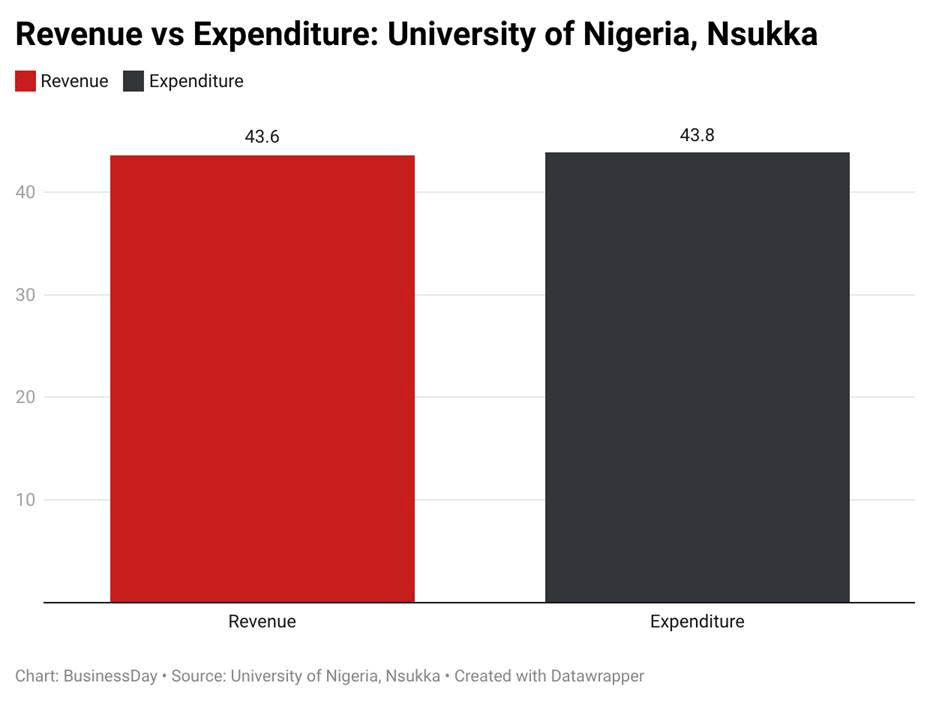
This is not a struggling peripheral institution. It is one of Nigeria’s flagship universities. If a university of that scale is already operating with almost no fiscal buffer, concerns about financing additional recurrent obligations become difficult to dismiss as isolated cases.
The picture at the University of Lagos is different but equally revealing. UNILAG benefits from advantages unavailable to most public universities: a prime commercial location, a large student population, strong alumni networks and proximity to corporate Nigeria. Even there, concerns have emerged about the long-term sustainability of absorbing a wage-related commitment that could run into billions of naira annually.
When one of the strongest revenue-generating institutions in the system expresses caution, the issue is no longer about institutional weakness. It becomes a question about the viability of the model itself.
A system built on unequal foundations
The challenge becomes even clearer once attention shifts beyond the country’s best-resourced universities. Institutions such as the Federal University Otuoke and many newer federal universities operate in environments with limited access to corporate partnerships, weaker alumni wealth concentration, fewer consultancy opportunities and less-developed commercial ecosystems.
Their revenue constraints are often structural rather than managerial. Expecting universities with vastly different economic realities to finance similar obligations assumes a level of institutional capacity that simply does not exist. The consequence is the gradual emergence of a two-tier public university system.
Universities with stronger revenue streams will be better positioned to retain talent, maintain infrastructure, support research and preserve academic quality. Institutions operating in less favourable environments will face increasingly difficult trade-offs between staff welfare, operational survival and educational quality. Over time, fiscal capability rather than academic mission may become the defining feature of institutional performance.
When funding pressure reaches students
Students are likely to feel the consequences early. Nigeria’s recent experience suggests that when universities face mounting financial pressure, the burden rarely remains within administrative accounts. It eventually reaches households.
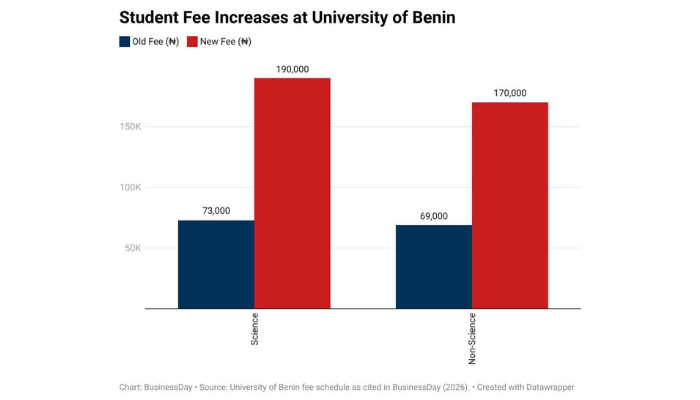
The University of Benin provides a useful illustration. Recent adjustments reportedly increased fees for science programmes from about N73,000 to N190,000, while non-science programmes rose from approximately N69,000 to N170,000.
While broader economic conditions contributed to these increases, they reveal a consistent pattern. Financial stress within universities often migrates to students and their families. What begins as an institutional funding challenge can quickly become an access-to-education challenge.
The sequencing problem
Supporters of the policy argue that greater financial independence is necessary if Nigerian universities are to compete globally. They are not wrong.
Leading universities across the world rely on diversified income streams, including endowments, research grants, intellectual property, consultancy services and industry partnerships. The problem lies not in the objective but in the sequencing.
Countries whose universities generate substantial independent income first spent decades building research ecosystems, innovation networks, strong industry linkages and cultures of philanthropy. Financial autonomy was the outcome of institutional development.
It was not the starting point. Nigeria’s universities remain constrained by weak research funding, limited commercialisation frameworks, inadequate infrastructure and inconsistent engagement with industry.
Attempting to build a self-financing university system before these foundations are firmly established risks creating a mismatch between policy ambition and institutional reality.
Recent implementation challenges surrounding agreements with academic unions reinforce this concern. Across the sector, delays, inconsistencies and uneven execution continue to expose weaknesses in institutional and fiscal capacity. Policy ambition is advancing faster than the systems designed to support it.
The bigger question
The deeper issue is not whether universities should become more financially independent. Most successful higher education systems encourage exactly that. The issue is whether Nigeria is transferring financial responsibility faster than institutions can develop the capacity to manage it.
The risk is not simply that some universities will struggle. It is that public higher education becomes increasingly defined by geography, commercial potential and revenue generation rather than academic mission. In that scenario, autonomy becomes less a tool for strengthening universities and more a mechanism for distributing fiscal pressure across an already unequal system.
Nigeria is not merely adjusting lecturers’ allowances. It is redesigning the economics of public higher education. The consequences will be felt long after the current debate has passed.
Oluwafemi Mayowa Olusola is the opinion page editor at BusinessDay. He writes provocative, data-driven essays on youth development, governance, and strategic partnerships in Nigeria, with a growing focus on climate resilience and ESG (Environmental, Social, and Governance) frameworks as critical lenses for national development. His work explores the intersections of education, economic policy, sustainability, and institutional reform, offering pragmatic insights into how Nigeria can drive inclusive growth and long-term transformation in a rapidly changing global landscape.

Join BusinessDay whatsapp Channel, to stay up to date
Open In Whatsapp