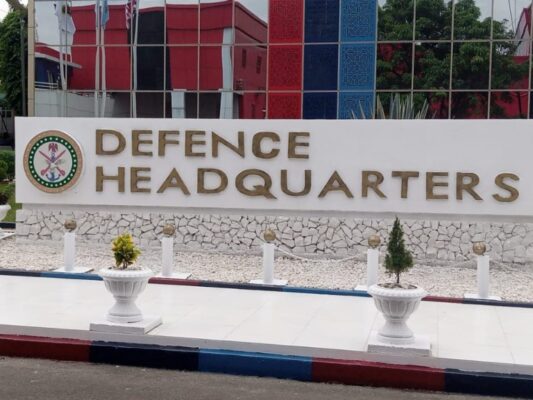
The Defence Headquarters (DHQ) has firmly dismissed allegations that repentant terrorists are being secretly recruited into the Nigerian military, describing such claims as false and misleading.
Addressing journalists in Abuja on Tuesday, Yusuf Alli, Coordinator of Operation Safe Corridor, said the Armed Forces of Nigeria would never enlist individuals with criminal records into its ranks.
“We are not recruiting any killers into the army, and we can never do that,” Alli stated, reacting to growing public concerns that former insurgents were being absorbed into the military through unofficial channels.
He also dismissed fears that rehabilitated ex-fighters are returning to aid terrorist groups such as Boko Haram and Islamic State – West Africa Province (ISWAP), describing such insinuations as unfounded.
According to him, many of the individuals processed under the programme are classified as “low-risk” and were largely conscripted or forced into insurgency.
He explained that such individuals are unlikely to rejoin terrorist groups, as they would be viewed with suspicion and possibly executed.
Read also: DHQ denies reports of planned US drone base relocation to Nigeria
“There is no way these individuals can go back. The high-risk terrorists see them as government collaborators who will expose them,” he said.
Alli emphasised that the Nigerian military maintains stringent recruitment standards that automatically disqualify anyone with a criminal background.
“Once you have any criminal record, you cannot join the military or any security agency,” he stressed.
He clarified that Operation Safe Corridor is not a recruitment scheme or a physical camp, but rather a structured initiative designed to manage surrendered insurgents through rehabilitation and reintegration.
The programme, launched between 2015 and 2016 at the peak of insurgency in Nigeria’s North-East, was created to address the increasing number of fighters surrendering during military offensives.
Many of these individuals, he noted, were victims of circumstance, forced into terrorist ranks following attacks on their communities, including Gwoza, Bama and Madagali.
Alli explained that a comprehensive screening process involving the Ministry of Justice and other local and international stakeholders categorises surrendered individuals into different risk levels.
“Only the low-risk group, those determined by the justice system to have no case to answer, are admitted into the programme,” he said.
“Participants in the initiative undergo deradicalisation, trauma counselling and vocational training aimed at preparing them for civilian life.
“Many of them arrive with deep psychological trauma and drug dependency issues,” Alli noted, adding that skills such as tailoring, carpentry and farming are provided to support their reintegration into society.
He further clarified that the programme does not replace the criminal justice system.
“Hardcore terrorists captured during operations are prosecuted and, if convicted, imprisoned,” he said.
Describing the initiative as a dual-track system, he explained that while offenders face prosecution, victims of forced recruitment are rehabilitated and reintegrated.
Reaffirming the military’s position, Alli said the core objective of Operation Safe Corridor is to prevent a relapse into extremism.
“The message is clear: this programme is about rehabilitation, not recruitment. Its purpose is to ensure these individuals do not return to violence,” he added.

Join BusinessDay whatsapp Channel, to stay up to date
Open In Whatsapp