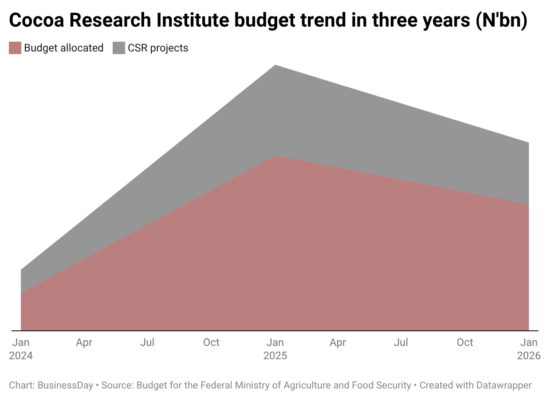
Over 50 percent of the Cocoa Research Institute of Nigeria (CRIN) budgetary allocation is being diverted to constituency projects such as roads, health centres, solar streetlights and boreholes among others.
BusinessDay’s analysis of CRIN’s budget from 2024 to 2026 shows a consistent pattern: more than 50 percent of allocations to the institute over the three-year period were directed toward non-research activities, including construction of roads, health centres, solar streetlights and boreholes across states such as Lagos, Rivers, Kano, Jigawa and Zamfara.
Rasheed Adedeji, executive director of CRIN, said in an interview with BusinessDay that constituency projects are included in the institute’s budget by the federal government without consultation from the institute.
Describing these non-core research projects as “insertions”, he said: “The Nigerian government finances constituency projects. These things are determined by the National Assembly.”
CRIN’s original core mandate includes developing improved cocoa seedlings, advancing disease-resistant varieties and supporting farmers to boost yields and strengthen the cocoa value chain. But misappropriation of funds holds the institute back.
Muhammed Magaji, president of the All Farmers Association of Nigeria (AFAN), said misallocation of funds remains one of the biggest setbacks in the agricultural sector.
“Whatever is meant for research should be used for that purpose,” Magaji told BusinessDay. “This is a misplacement of priorities.”
Of the N32.2 billion allocated to the institute in 2026, N15.67 billion is budgeted for projects unrelated to cocoa research. These include installation of solar streetlights in Kabo/Gwarzo Federal Constituency in Kano and the supply of hand pumps in Hadejia/Kafin Hausa/Auyo Federal Constituency in Jigawa, among others.
A similar pattern was observed in 2025, when roughly N23.03 billion of the N44.62 billion allocation went to non-core projects. In 2024, more than half of the institute’s budget (N9.68 billion) was also directed toward constituency-related interventions (N5.84 billion).
From the provision of vehicles “to ease the movement of traditional institutions” in Owo/Ose Federal Constituency in Ondo State, to distribution of palliatives, construction of boreholes in Oyo and Bauchi States, and youth entrepreneurship support in Kogi, the institute’s spending has been consistently tilted toward non-research activities.
“This is one of the things that always takes us backwards,” Magaji said.
BusinessDay earlier reported that about 24 percent of the N1.4 trillion proposed 2026 budget for the Federal Ministry of Agriculture and Food Security is not tied to core agricultural activities, raising broader questions about sectoral priorities.
Cocoa remains one of Nigeria’s flagship export crops, generating an estimated N1 trillion annually, according to the National Bureau of Statistics (NBS). Despite this, the value chain continues to struggle with ageing trees and weak yields.
“Nothing is happening in most agric research institutes in the country,” said Ayopo Somefun, a farmer in Ogun State, in a previous interview with BusinessDay. “If the research institute mandated for the crop does not have the improved seedlings, where do you then get them?”
Nigeria ranks as the world’s fourth-largest cocoa producer, with an average annual output of about 350,000 metric tons. However, productivity remains low when compared with peers. Ghana produces about 530,000 tons and Côte d’Ivoire produces around 1.89 million tons, according to FAOStat.
With a cocoa land area of about 1.4 million hectares, Nigeria lags in yield at 0.27 tons per hectare — significantly below Ghana’s 0.57 tons and Côte d’Ivoire’s 0.50 tons.
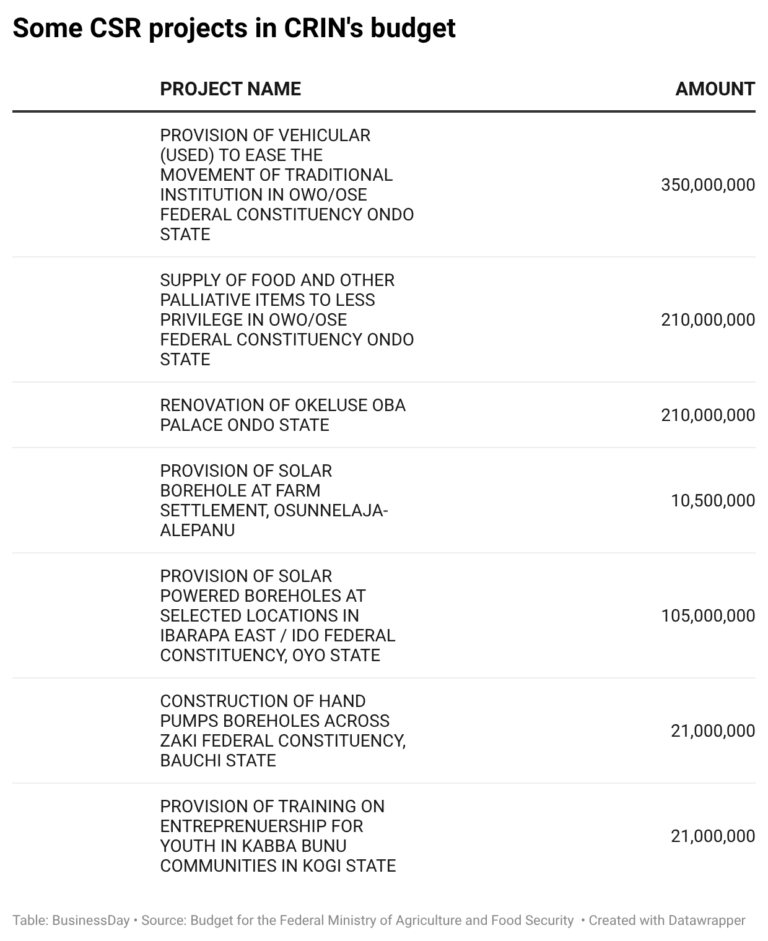
Some constitutional projects in CRIN’s 2026 budget
Experts call for address to structural budget flaws
Agricultural experts warn that sustained growth in the sector will remain difficult if ministries and research institutes divert funds to projects unrelated to their primary mandates.
Muda Yusuf, chief executive officer of the Centre for the Promotion of Private Enterprise (CPPE), said Nigeria’s budgeting process remains structurally flawed, with constituency projects often embedded within institutional allocations.
“The budget should focus on the key objectives of institutions. But that is not happening in many cases. Core mandates are sometimes relegated,” he told BusinessDay.
“If the federal government wants to allocate funds for constituency projects, let them stand alone,” Yusuf said. “Don’t mix them with institutional budgets. Once funds are released, these non-core allocations sometimes take precedence over research.”
Adedeji of CRIN disclosed that research receives only a fraction of the institute’s capital budget, with constituency projects accounting for the bulk of spending. “The budget is divided into personnel, overhead and capital budget. Constituency projects are under capital budget, and it is a chunk of the budget.”
Yield per hectare remains low
While some farmers said they sometimes receive seedlings from CRIN, research shows that quality seedlings are limited and accessing them is even more difficult.
“I have received seedlings from CRIN before. The federal government sponsors it and makes it easy for cocoa farmers to get seedlings from the institute,” said Hassan Taiwo, an Ogun-based cocoa farmer.
But for many other smallholder farmers, the story is different. A recent study published by the International Journal of Research and Innovation in Social Science found that more than 50 percent of cocoa farmers in Ondo State experience low yields due to barriers like poor access to certified seedlings.
“The lack of accessible, affordable and certified seedlings creates a severe supply-side bottleneck, forcing farmers to rely on non-validated, often low-quality planting materials,” the study noted.

Join BusinessDay whatsapp Channel, to stay up to date
Open In Whatsapp