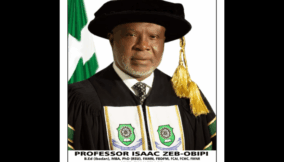
…says agency recovered N33.1bn cash, $1.98m asset
…ICPC, EFCC Warn Funding Gaps Could Cripple Nigeria’s Anti-Graft War
Nigeria’s leading anti-corruption agencies have warned that severe funding shortfalls are crippling their operations and threatening the country’s fight against graft, despite billions of naira recovered from corrupt practices.
The Independent Corrupt Practices and Other Related Offences Commission (ICPC) and the Economic and Financial Crimes Commission (EFCC) raised concerns on Tuesday during their 2026 budget defence before the Senate Committee on Anti-Corruption and Financial Crimes.
Musa Aliyu, the Chairman of the ICPC, a Senior Advocate of Nigeria, disclosed that the commission received just N5.35 billion out of a total N22.4 billion appropriated for personnel, overheads and capital expenditure in 2025, forcing prosecutors to personally fund official duties and delaying critical investigations.
Read also: Senate pushes electricity subsidy removal to shore up 2026 budget
“Our major challenge remains funding. Prosecutors sometimes use their personal money to go to court, and several investigations could not proceed as scheduled because we could not pay service providers,” Aliyu told lawmakers.
He explained that while personnel costs were almost fully funded, other critical budget components suffered sharp cuts. According to him, the ICPC received N10.13 billion out of N10.62 billion allocated for personnel costs, but overhead and capital releases were far lower.
“Only N2.2 billion out of the N7.82 billion overhead allocation was released, representing 28 per cent. For capital expenditure, only N449 million out of N7.3 billion approved was released, and that came late, on November 28, 2025,” he said.
Despite the constraints, the ICPC recorded notable recoveries, including N33.1 billion in cash and $1.98 million, alongside assets such as land, vehicles, and businesses.
The commission also filed 72 cases, secured 36 convictions, handled 453 ongoing cases, and processed over 1,100 petitions.
Aliyu, however, said limited resources and manpower shortages continued to slow investigations and prosecutions.
“Some cases take two to five years to conclude. Funding constraints affect travel, document retrieval, forensic tools, and manpower. We have to prioritise cases based on available resources,” he said.
He added that increased funding would significantly improve outcomes, noting that some lawyers still pay out of pocket to prosecute cases.
“With adequate funding, infrastructure, and manpower, the number of completed investigations will increase. We prioritise prevention because investigations require significant funds and time. Human capital gaps in state offices also delay investigations,” he said.
The ICPC chairman also raised concerns about staff welfare and security, revealing that one of the commission’s staff members had recently been kidnapped.
“My staff morale is very low. Their welfare is poor, yet they investigate highly sensitive and risky cases. Two days ago, our staff was kidnapped and is still in captivity,” he told the committee.
He urged lawmakers to boost funding, improve infrastructure, and enhance staff welfare, noting that some state offices still operate from rented premises.
“Without adequate funding, there is no way this agency can effectively fight corruption. It will also affect Nigeria’s image globally,” Aliyu said, while assuring lawmakers of strict fiscal discipline.
The EFCC echoed similar concerns, warning that limited releases and unpaid obligations could disrupt its operations in 2026.
Olu Olukoyede, the Executive Chairman of the EFCC, said only 74 per cent of the commission’s total budget was released in 2025, while capital funding stood at just 50 per cent, leaving contractors and licence providers unpaid.
Read also: 2026 budget defence with MDAs hits an unusual lull in House of Reps
“Most of our contractors have not been serviced, including licence providers.
“This will pose a major problem for us going forward because we need those licences to continue our work,” Olukoyede said.
He disclosed that the EFCC proposed a total budget of about N88 billion for 2026, including N22.8 billion for capital projects, but warned that outstanding obligations from 2025 could stall new projects.
He also revealed unpaid severance liabilities of about ₦3 billion owed to 32 retired officers.
Members of the Senate committee acknowledged the funding gap and pledged to push for improved allocations.
Emmanuel Udende, the Chairman of the committee, said, “It is sad that funding for anti-corruption agencies is very poor compared to other countries.
“We will see what we can do to improve it.”

Join BusinessDay whatsapp Channel, to stay up to date
Open In Whatsapp