As Nigeria heads toward the 2027 general elections, advocates for women’s leadership are warning that democracy itself is at risk unless women are fully included in governance and political participation.
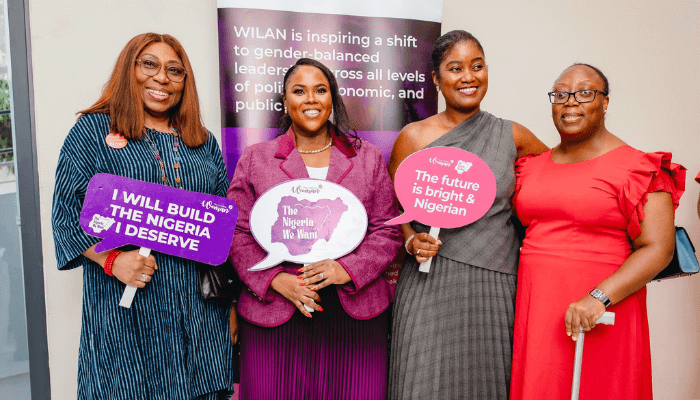
That message took centre stage in Lagos at the premiere of The Leading Woman Show – Season 4, themed “The Nigeria We Want.”
Hosted by the Women in Leadership Advancement Network (WILAN), the premiere brought together Nigerian culture shapers spanning law, governance, disability rights, civil society, energy policy and business strategy.
The programme, now in its fourth season, is designed to move conversations about women’s leadership from private spaces into the national spotlight.
Women’s Political Representation and Democratic Participation
Speaking at the close of the premiere, Abosede George-Ogan, Founder, Women in Leadership Advancement Network (WILAN), urged Nigerians to actively support women’s leadership and participate meaningfully in the democratic process.
“Nigeria is almost evenly split, with women about 49 per cent, yet representation in leadership, especially politics, remains in single digits,” she told BD Weekender. “The highest we have reached is 7.6 per cent. That is a problem we must confront.”
She warned that low voter turnout poses a serious threat to democracy, noting that at peak participation, only about 20 per cent of registered voters cast ballots.
“Your vote is your right, and turnout makes elections harder to rig,” she said, cautioning against vote-buying and short-term incentives that often result in long-term hardship.
Gender-Balanced Leadership: From Tokenism to Structure
The executive premiere featured conversations with Tawakalit Kareem, writer and editor and Chairperson of the European Union Youth Sounding Board (Nigeria), who challenged what she described as the token inclusion of women in governance.
She argued that appointing a small number of women to leadership positions is often celebrated as progress, even when structural inequality remains intact.
Legal practitioner and entrepreneur Ngozi Nwabueze, founder of PocketLawyers, added an economic lens, pointing to Nigeria’s vast informal economy. With an estimated 30 to 40 million unregistered businesses compared to roughly three million formal enterprises, she said “leadership and policy exclusion limits access to credit and long-term growth.”
Inclusive Governance Beyond Gender
Disability inclusion also emerged as a central theme during the discussions. Abigail Rotimi-Turkson, a disability rights advocate with the Joint National Association of Persons with Disabilities (JONAPWD) Lagos, highlighted how exclusion can have fatal consequences.
One case described during the programme involved a hearing-impaired woman and her baby who died because a hospital lacked a sign-language interpreter.
On her part, Diversity and inclusion expert Dolapo Agbede, founder of Will Way Paradigm, argued for “universal design”, embedding inclusion into policies and infrastructure from the outset rather than retrofitting later at higher cost.
Security, Identity and the Economy
According to Muhammad Abdulkareem, Energy systems engineer and policy expert, leadership and economic policies cannot succeed without security.
“Businesses and communities cannot thrive if people are not safe to move, trade and participate,” he said, linking insecurity to weakened civic trust and economic stagnation.
Political scientist and governance strategist Obafemi George described Nigeria as a country with “pockets of excellence” constrained by structural and constitutional challenges, arguing that citizen ownership and accountability are essential to national cohesion.
A Call to Action Before 2027
Civil society leader Yemisi Ransome-Kuti, founder of the Nigerian Network of NGOs, who also featured in the premiere, reflected on Nigeria’s post-independence years, contrasting early collective accountability with today’s fractured civic culture.
The Leading Woman Show, which will air weekly for 13 weeks on NTA, Channels Television and YouTube, aims to ensure citizens’ voices are heard ahead of the elections.
“The office of the citizen is the highest office in the land,” George-Ogan said. “This show ensures candidates cannot claim ignorance of what Nigerians want.”

Join BusinessDay whatsapp Channel, to stay up to date
Open In Whatsapp