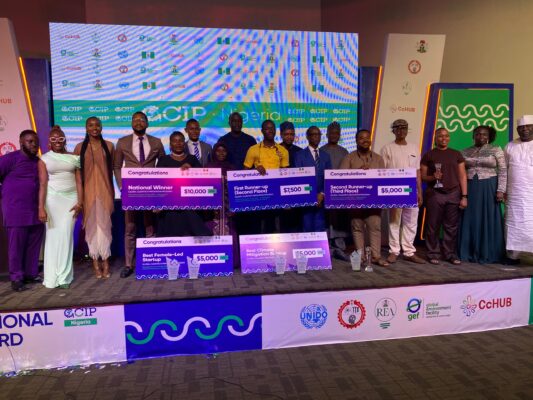
Nigeria’s push to build a resilient, low-carbon economy gained fresh momentum last week as three pioneering startups clinched top honours and a share of $32,500 at the third Global Cleantech Innovation Programme (GCIP) National Awards.
The event, held in Lagos recently, celebrated local innovators dedicated to tackling the nation’s urgent climate and environmental challenges, showing that the fight against global warming can be won on African soil.
The competition, championed by the United Nations Industrial Development Organisation (UNIDO) and funded by the Global Environment Facility (GEF), marks a crucial step in transforming promising ideas into market-ready solutions.
From Farm Waste to Funding: The Top Winners
The award ceremony saw three companies, focused on sustainable farming, clean energy access, and cooling, split the $32,500 prize money.
Allgreen Ivy Limited was crowned the national winner, securing a $10,000 prize. The company also won a special award as the Best Female-led Startup.
Founder Lydia Ekpong Thompson highlighted the immediate impact the funding will have on scaling their sustainable agriculture model.
“Currently, we are only able to deliver 150 to 200 packs daily,” Thompson said, referring to their biodegradable sanitary pads made from farm waste like banana stems. “With the automated equipment that we want to buy, we’ll be able to increase our production to at least 3,500 packs daily.”
Thompson added that the prize provides a “push” for more efficiency, profitability, and crucial impact on women and the environment.
The first runner-up, One Grid Energies, received $7,500 and was recognized as the Best Climate Mitigation Startup. Rekool Access Technology secured the second runner-up position, earning $5,000.
Bridging the ‘valley of death’ for green ideas
The GCIP is designed to help local cleantech businesses bridge the difficult gap between a great idea and market success, often called the “valley of death.”
Akinwande Akinsulire, Head of Startup Support at CcHub Africa (the Project Management Unit), explained the program’s vital role. “Over the last three years, we have been supporting 25 entrepreneurs each year… They got both technical and non-technical support during this period,” Akinsulire noted.
This support includes mentorship, business model refinement, and calculating the crucial CO2 emission offset their work achieves. This effort is central to Nigeria’s climate goals.
Lukman Amin, the Project Lead for GCIP at the Rural Electrification Agency (REA), emphasized the global context. “The whole world is going green. We are going toward net-zero emissions… CleanTech is the future,” Amin stated.
The REA’s specific role is providing the financial mechanism to help these enterprises access the capital needed to upscale their technologies.
A National Strategy for Resilience
The program is a core part of the government’s commitment to sustainable development. Esuabana Nko Asanye, Permanent Secretary, Federal Ministry of Innovation, Science and Technology (FMIST), stressed that the GCIP “directly addresses this mandate by nurturing Small and Medium Enterprises… that tackle the most pressing environmental and climate challenges.”
She further highlighted the resilience of the local entrepreneurs in her keynote address.
“These innovators have been contributing in their own way to really ensuring that we are able to offset a lot of CO2” she said, acknowledging the difficulty of building cleantech businesses in Nigeria due to import costs and exchange rate challenges.
Similarly, Reuben Bamidele from UNIDO reinforced the organisation’s commitment to a low-carbon future for Nigeria, noting that even as the initial project concludes. “Clean technology is not just good for the planet, it’s good for business,” he told BD Weekender. “We hope to have the second phase of that project.”
He also confirmed that UNIDO’s ongoing Programme for Country Partnership (PCP) in Nigeria extends support for industrial development through 2028, ensuring sustained commitment to clean technologies.
“This continued collaboration is essential for building a robust policy environment that promotes the widespread uptake of cleantech solutions across the country,” he said.

Join BusinessDay whatsapp Channel, to stay up to date
Open In Whatsapp