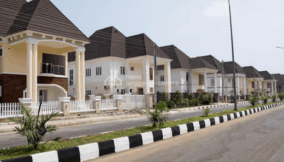
There is every likelihood that more Nigerians may slip into homelessness as the rent crisis in the country worsens across cities, dislocating and pushing tenants to the fringes.
Nigeria is currently grappling with low homeownership level, estimated at 25 percent of the population, and a housing deficit, estimated at 28 million units. The country has one of the highest tenancy levels in Africa, especially in its major cities.
House rent in the country is always on the rise, driven by a combination of high demand, low supply, inflationary pressures, and high interest rates, which caused the real estate sector to close the first half of 2025 with a deepening housing deficit.
The rise in housing deficit has continued to displace homeownership ambitions in favour of rentals, which dominate transactions in many cities, including Lagos, Abuja, Port Harcourt, Enugu, Onitsha, Kaduna, Kano, among others.
BusinessDay findings show that rent increases are no longer peculiar to the big cities of Lagos, Abuja and Port Harcourt where expanding population and fast-paced urbanisation have combined with inflation and interest rate to increase rents by well over 100 percent in some cases.
In Lagos, for instance, many residents living in places like Surulere, Gbagada, Ilupeju, Yaba, and others classified as middle-class settlements are now relocating to suburbs such as Idimu, Ejigbo, Abulegba, Egbeda, Ojodu Berger, etc, on account of rising rent.
Read also: High house rent forces low-income earners out of city centres
In the federal capital territory, Abuja, the story is no different, as areas such as Kubwa, Lugbe, Gwarimpa, Lokogoma, and many more, where most middle-class people reside, have seen significant rent increases.
“I was living in Lokogoma before, where rent for a two-bedroom flat was between N1 million and N1.2 million per annum. But, like a flash, my landlord increased the rent to N2 million per annum, forcing me to move to Zuba where I paid N700,000 for a two-bedroom flat,” Alloy Asogwa, a civil servant, told our reporter.
Asogwa noted, however, that relocating to the suburb comes at a price as, according to him, there are longer periods and higher costs of commuting to work daily, explaining that whether one is driving one’s car or going by public transport, the costs are high, up to N10,000 and N4,000 respectively.
In Kubwa, the rent for a one-bedroom apartment has increased from ₦500,000 to ₦700,000; a self-contained flat costs between 600,000 and 800,000 to rent; one-bedroom flat goes for between N1 million and N1.2 million, while a two-bedroom flat rents for between N1.5 million to N2 million per annum.
The rent situation in Gwarinpa area of the FCT is such that our reporter quotes another civil servant, who did not want his name mentioned, as saying that people are being evicted because they can’t afford the kind of rents landlords demand from tenants.
According to the civil servant, what is happening in Abuja is beyond house rent problem. “It is a humanitarian crisis waiting to happen in the FCT,” the civil servant said.
In Kaduna, house rent is said to have gone up by 150 percent, and for a civil service state like that, it is an overkill as majority of the residents cannot afford what the landlords are asking for. The residents are therefore appealing to the state government for help.
- Scenario analysis: The missing link between sustainability disclosure and financial decision-making
- Africa’s wealth creation paradox: Why prosperity falters and how the digital age offers historic reset
- Business events have spent decades optimising for broadcast. The next one will optimise for participation
Residents of the city are blaming landlords for their plight, alleging that the landlords are arbitrarily increasing rents on a yearly basis, leaving many families distressed and unable to cope.
A recent survey by a reputable media organisation quotes a tenant, Mubarak Aliyu, as saying, “I was paying N350,000 annually for my apartment in Unguwan Rimi; just recently, I received a call from my landlord, telling me I now have to pay N900,000.”
The residents want the state government to come up with a formal tenancy law that stipulates notice periods, caps on rent increases, mandatory agreements, and a mediation framework to resolve disputes, contending that, without such legal backing, tenants will continue to be vulnerable.
In the Southeastern part of the country, the story is not better. Virtually all the state capitals are experiencing high rent increases. Our reporter in that part of the country says rent in Enugu, Awka, Abakaliki, Aba, Owerri, Onitsha, Umuahia, and other places has been on a steady rise.
According to him, city dwellers, especially civil and public workers and small business owners, are groaning as many of them can no longer cope, more so with excruciating economic hardship faced by Nigerians.
In Awka, the capital city of Anambra State, rent increases are pushing people, particularly the low-income earners, to the outskirts. House rent has become so high that many civil servants are being forced to relocate their families out of Awka, some to their villages.
In that city, a 3-bedroom flat that used to rent for N250,000 per annum now attracts over N700,000. Residents attribute this to a number of factors, including government’s lack of interest in housing development to meet growing demand; rising construction costs, inflation, and unwholesome activities of estate agents.
Read also: House rent: New level economic nightmare for Nigerian families
Besides agents, the influx of internet fraudsters known as Yahoo Boys into the cities also causes rent increase as can be seen in Umuahia, Abia State capital, where a 2-bedroom flat goes for between N400,000 and N600,000 per annum, depending on the location, while rent for 3-bedroom flat ranges from N700,000 to N1 million.
An estate agent told our reporter that a 2-bedroom flat in a new building in a good location costs up to N700,000, while a 3-bedroom flat in a new building at a good site goes for between N800,000 and N1 million. Some 3-bedroom flats with modern facilities at a good location costs up to N1.2 million per annum in that state.
Though some landlords blame the rent increases on rising cost of building materials and maintenance, a landlord who did not want to be named, attributed the increase to “old generation landlords, agents and some lawyers who see rent increase as only way for survival.”
“As a new generation landlord, I consider a lot of things before I fix rent. I don’t behave like old generation landlords and their children who inherited houses to punish the people in the name of collecting house rent.
“Go and do your investigations, you will discover that the people involved in the incessant increase in rent are not the young people building houses; the people doing that are old generation landlords or their children who inherited their late parents’ property.
These people are not even carrying out any renovation in such houses, but every year, they increase house rent and give quit notices to tenants who disagree with such increases,” the landlord said.

Join BusinessDay whatsapp Channel, to stay up to date
Open In Whatsapp