

For the third time this week, the United States struck Iran, prompting retaliatory attacks on at least five Arab nations as Washington and Tehran issued conflicting declarations over whether the Strait of Hormuz remains open to shipping.
Iran responded in the early hours of Sunday with drone and missile assaults on American allies across the Middle East, including Kuwait, Jordan and Qatar. So far, only minor damage was reported and no casualties.
Going further, the Islamic Republic issued a warning that the embattled strait would be closed till further notice. US Central Command denied that, saying that the waterway was still open to all vessels and the US military was prepared to ensure freedom of navigation. The Joint Maritime Information Centre, a global monitoring body, reported Sunday it was still possible to transit the strait’s southern route.
Trump equally insisted that the strait remained open, as reported by Bloomberg. “We bombed the hell out of them last night,” he said. “They’re very, very evil and sick people.”
Nonetheless, the United States president has ordered fresh strikes, targeting Tehran’s ability to attack commercial vessels after Iranian forces hit a Cyprus-flagged container ship. Huge blasts were heard south of the country’s coast impacting petrochemical hubs of Bushehr and Asalouyeh, the port cities of Bandar Abbas and Bandar-e Dayyer, and the Sirik area near the Hormuz Strait, a global energy chokepoint. A communication tower was part of the casualties, injuring two people along with it.
The increasingly heated tit-for-tat attacks are throwing into doubt the fate of US-Iran negotiations that are supposed to lead to the settling of key issues such as the Islamic Republic’s nuclear program and eventually bring an end to the war Washington and Israel began in late February. In addition, these renewed attacks are heavily impacting the global oil price as well.
At the time of writing, international benchmark Brent crude was trading at $76 per barrel on oilprice.com, while US benchmark West Texas Intermediate (WTI) stood at $71.41 per barrel.
Analysts said the market continues to attach a geopolitical premium to oil prices because of lingering uncertainty over the security of shipping routes through the Strait of Hormuz, through which roughly one-fifth of global oil supplies move.
“Prices have backed off the mid-week highs, but there is still a substantial risk premium as Hormuz transits are back to a near-standstill with no clear signs on when normal reopening might resume,” said Vandana Hari, founder of Vanda Insights.
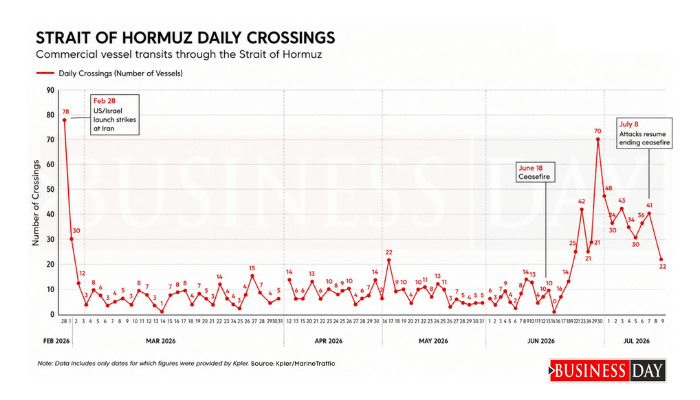
According to Warren Patterson, commodity strategist at ING, shipping activity through the Strait of Hormuz remains significantly below levels recorded before the conflict.
“Vessels transiting the Strait of Hormuz remain well below pre-war levels,” Patterson said.
“And recent developments show that safe passage of vessels is still an issue facing the market,” he added.
He noted that despite the use of alternative export routes and a partial easing of Iran’s restrictions on maritime traffic, crude oil exports from the Middle East have averaged around 14 million barrels per day, down sharply from approximately 20 million barrels per day before the conflict began.
The continued disruption to shipping activity has kept a geopolitical risk premium embedded in oil prices. However, expectations of a diplomatic breakthrough between Washington and Tehran continue to limit further gains.

Join BusinessDay whatsapp Channel, to stay up to date
Open In Whatsapp


